
The short summary
What is Philippians about?
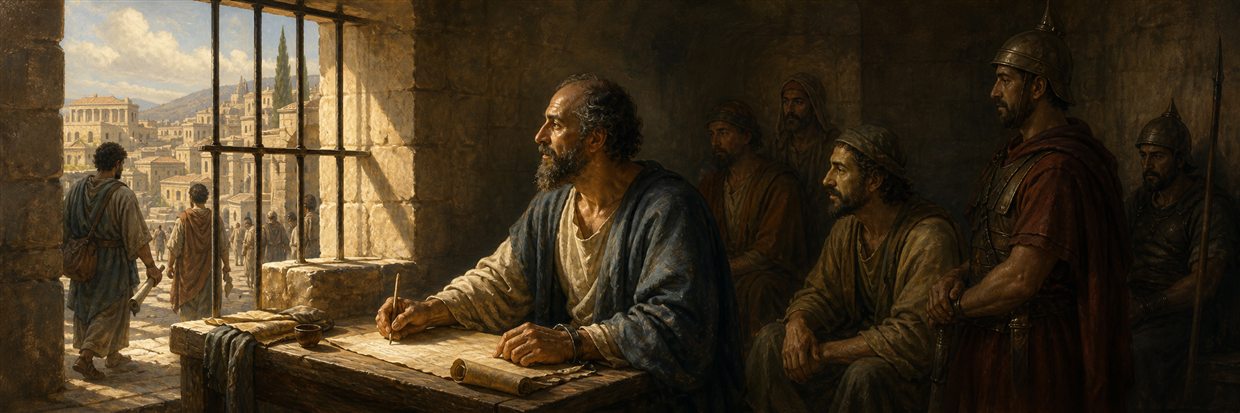
Philippians is Paul’s letter of gratitude and encouragement to a community that supports his ministry. Writing in chains, he speaks of the gospel’s progress and calls the church to unity and humility patterned on Christ. He urges perseverance, prayer, and joy, warns against misplaced confidence, and thanks the Philippians for sharing in his hardship.
Philippians 1:3–26; Philippians 2:1–11; Philippians 3:1–14; Philippians 4:2–20.01 / Understand the whole
The book in context
Paul and Timothy greet the believers in Philippi, and Paul thanks God for their partnership in the gospel. He reports that his imprisonment has encouraged further proclamation, even amid mixed motives. His uncertain future becomes an occasion to speak about honoring Christ in life or death. The community is urged to stand together and live in a manner worthy of the gospel. Philippians 1:1–30.
An appeal against rivalry and conceit leads into the account of Christ’s self-humbling, obedience to death, and exaltation. The Philippians are called to live out their faith without grumbling as God works among them. Paul then discusses Timothy and Epaphroditus, whose concern and costly service illustrate the practical relationships sustaining the mission. Philippians 2:1–30.
Paul warns against confidence in religious credentials and describes knowing Christ as surpassing his former gains. He presses toward the goal and calls the community to stand firm, seek agreement, pray, and practice what is good. His final thanks recount their material support and explains that he has learned contentment in both abundance and deprivation through Christ’s strength. Philippians 3:1–21; Philippians 4:1–23.
02 / Follow the structure
A reading outline
A chapter-level reading guide; some literary movements cross these boundaries. Each link opens the section’s first chapter.
- 1Partnership from prisonThanksgiving and news lead to encouragement for united witness.
- 2The mind of ChristHumility, faithful conduct, and coworkers’ service shape the chapter.
- 3Knowing Christ and pressing onwardPaul reassesses his credentials and describes the direction of his hope.
- 4Peace, contentment, and shared supportPractical exhortations lead into thanks for the Philippians’ gift.
03 / Notice the connections
Major themes
Humility in shared life
The account of Christ’s humility answers the appeal to consider others’ interests. It belongs within instruction about how the community treats one another. Philippians 2:1–11.
Joy amid real hardship
Paul rejoices in the gospel’s progress while still facing imprisonment and uncertainty. The letter’s joy coexists with difficulty and dependence on others. Philippians 1:12–26; Philippians 4:10–14.
Partnership expressed through care
Prayer, personal service, and financial help sustain the relationship. Timothy, Epaphroditus, and the Philippians’ gifts make partnership concrete. Philippians 1:3–11; Philippians 2:19–30; Philippians 4:14–18.
04 / Background
Background at a glance
- Literary form
- Apostolic letter of encouragement and thanks
- Setting in the text
- Paul writes from imprisonment to Philippi
More about the background
The USCCB introduction places the letter within Paul’s imprisonment but emphasizes uncertainty about its location and date. Rome, Caesarea, and Ephesus are among the proposals discussed. It also notes scholarly debate over whether shifts in tone reflect a single letter or the combination of several communications. [1]
The greeting names Paul and Timothy. Paul refers to his chains, the Philippians’ gift through Epaphroditus, and plans involving Timothy. These details establish a continuing partnership, but they do not supply a city of composition. The account of Christ in chapter 2 is introduced as a model for the community’s disposition. Philippians 1:1; Philippians 1:13; Philippians 2:1–11; Philippians 2:19–30; Philippians 4:18.
05 / Return to the text
Passages to explore
Passage links open the Berean Standard Bible. These selections offer starting points for exploring the book.
Humility and Christ’s example
Read the account of Christ with the opening appeal about rivalry and others’ interests.
Philippians 2:1–11 MemorizeKnowing Christ and pressing on
Notice both Paul’s changed assessment of gain and his admission that he has not yet arrived.
Philippians 3:7–14 MemorizeContentment and generosity
Read the statement about strength within the discussion of need, abundance, and support.
Philippians 4:10–20 MemorizeWhat is the context of Philippians 4:13?
Paul is thanking the Philippians for their support and explaining that he has learned contentment in both plenty and hunger. His statement about Christ’s strength concerns enduring these changing circumstances. The surrounding verses also affirm the value of the community’s practical help. Philippians 4:10–20.
Read Philippians
Sources and reading notes
The summaries describe the biblical text; passage references let you check them in context. Historical and authorship notes are attributed separately. The outlines and passage selections are editorial reading aids.
- United States Conference of Catholic Bishops. The Letter to the Philippians. New American Bible introduction; discussion beginning “The location of Paul’s imprisonment” and the following paragraphs on composition. Catholic reference perspective. Accessed September 11, 2026. ↩
Prepared for BibleVerse · September 11, 2026. An initial editorial edition; independent specialist review is pending. Biblical references use the Berean Standard Bible. The illustration is interpretive artwork.