The short summary
What is 1 Maccabees about?
1 Maccabees recounts resistance to the suppression of Jewish religious life under Seleucid rule. Beginning with Mattathias and his sons, it follows Judas Maccabaeus, Jonathan, and Simon through warfare, temple restoration, and diplomacy. The narrative celebrates their defense of the law and sanctuary while tracing the rise of their family’s religious and political authority.
1 Maccabees 1; 1 Maccabees 2; 1 Maccabees 4:36–59; 1 Maccabees 9:23–31; 1 Maccabees 10:18–21; 1 Maccabees 14:25–49.01 / Understand the whole
The book in context
After an account of Alexander’s conquests and his successors, the narrative turns to Antiochus Epiphanes, conflict within Judea, and measures against Jewish worship and observance. Mattathias resists a demand to offer sacrifice and withdraws with his sons. His final counsel appeals to ancestral examples, and Judas becomes the leading military figure in the struggle. 1 Maccabees 1; 1 Maccabees 2; 1 Maccabees 3:1–9.
Judas’ campaigns lead to the cleansing and rededication of the Jerusalem sanctuary. The book describes an eight-day celebration and an instruction to repeat it annually. Further battles and diplomacy follow, including correspondence concerning Rome. Judas dies in battle, and Jonathan takes over amid renewed pressure, combining military action with negotiations that lead to his appointment as high priest. 1 Maccabees 4:36–61; 1 Maccabees 5; 1 Maccabees 6; 1 Maccabees 7; 1 Maccabees 8; 1 Maccabees 9:1–31; 1 Maccabees 10:18–21.
After Jonathan’s capture, Simon assumes leadership and later secures significant relief from Seleucid control. The narrative praises prosperity in his time and records recognition of his authority as leader and high priest. The ending is unsettled: Simon and two sons are murdered, while another son, John, escapes the plot. A final reference points readers to further records of John’s rule. 1 Maccabees 12:39–53; 1 Maccabees 13; 1 Maccabees 14; 1 Maccabees 15; 1 Maccabees 16.
02 / Follow the structure
A reading outline
A chapter-level reading guide; some literary movements cross these boundaries. Each link opens the section’s first chapter.
- 1–2Crisis and resistanceSuppression of observance, Mattathias’ revolt, and his final counsel.
- 3–4Judas and the restored sanctuaryMilitary victories and the temple’s rededication.
- 5–8Campaigns and diplomacyFurther conflict, shifting rulers, and the approach to Rome.
- 9–12Jonathan’s leadershipJudas’ death, Jonathan’s succession, high priesthood, and capture.
- 13–16Simon and the family’s authorityPolitical consolidation, public recognition, renewed conflict, and assassination.
03 / Notice the connections
Major themes
Fidelity under coercion
The narrative frames resistance around the law, covenant, and sanctuary. Its conflict includes divisions among Jews as well as confrontation with foreign rulers. 1 Maccabees 1:11–15; 1 Maccabees 1:41–64; 1 Maccabees 2:15–28.
Restoring worship
The sanctuary’s cleansing and rededication become a focal point of the struggle. The annual eight-day celebration preserves the memory of that restoration. 1 Maccabees 4:36–59.
Leadership and political power
The family’s authority develops through warfare, diplomacy, and public recognition. The favorable portrait of Simon is followed by an ending that exposes the continuing danger of political violence. 1 Maccabees 10:18–21; 1 Maccabees 14:25–49; 1 Maccabees 16:11–24.
04 / Background
Background at a glance
- Literary form
- Historical narrative with speeches, poetry, and diplomatic documents
- Setting in the text
- Judea under Seleucid rule and the rise of the Hasmonean family
More about the background
The USCCB introduction describes an anonymous Jewish author and a work originally composed in Hebrew, surviving through Greek translation. It notes the author’s favorable presentation of Mattathias’ family and explains that 1 and 2 Maccabees are independent accounts with overlapping events. The overview follows this narrative’s perspective without treating it as a neutral record of every participant. [1]
The book presents speeches, letters, battle accounts, and praise of its central leaders. Its own conclusion refers to additional records of John’s high priesthood. The temple dedication passage specifies eight days of celebration but does not tell the later story of oil miraculously lasting eight days. The summary keeps to the account contained here. 1 Maccabees 4:52–59; 1 Maccabees 8:17–32; 1 Maccabees 14:4–15; 1 Maccabees 16:23–24.
05 / Return to the text
Passages to explore
Passage links open the World English Bible, Catholic Edition. These selections offer starting points for exploring the book.
Ancestral examples in a crisis
Read Mattathias’ counsel as the narrative’s explanation of what the family is defending.
1 Maccabees 2:49–64 MemorizeThe sanctuary rededicated
Follow the cleansing, rebuilding, celebration, and command for annual remembrance.
1 Maccabees 4:36–59 MemorizeAuthority publicly recognized
Notice how the document explains Simon’s leadership and its basis.
1 Maccabees 14:25–49 MemorizeDoes 2 Maccabees simply continue the story of 1 Maccabees?
No. The two books are independent accounts with overlapping events, as the cited introduction explains. 1 Maccabees follows the family’s leadership beyond Judas through Jonathan and Simon, ending with John’s succession. Its own ending points to further records of John’s acts rather than identifying 2 Maccabees as a sequel. 1 Maccabees 9:23–31; 1 Maccabees 14:47–49; 1 Maccabees 16:23–24.
Read 1 Maccabees
Sources and reading notes
The summaries describe the biblical text; passage references let you check them in context. Historical and authorship notes are attributed separately. The outlines and passage selections are editorial reading aids.
- United States Conference of Catholic Bishops. The First Book of Maccabees. New American Bible introduction; opening discussion of the two accounts and the paragraph on language, author, and purpose. Catholic reference perspective. Accessed September 11, 2026. ↩
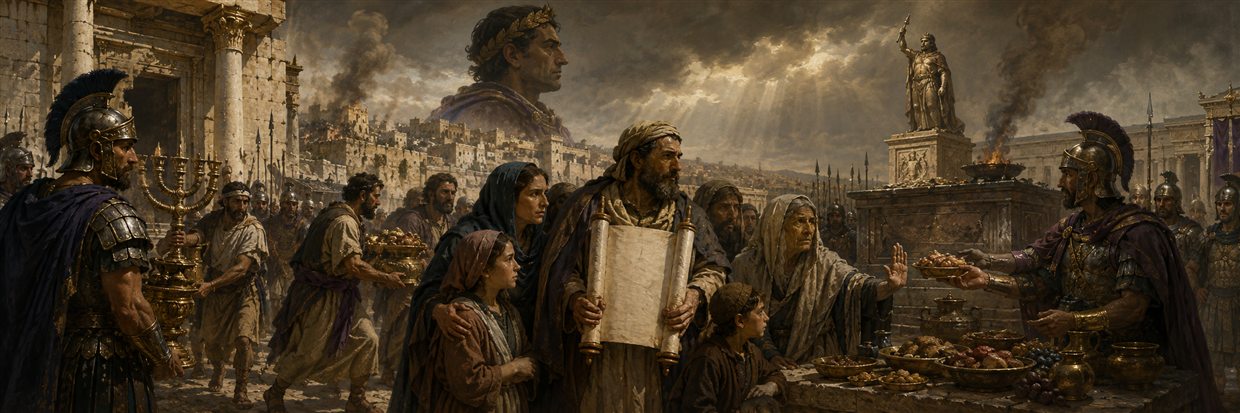
Prepared for BibleVerse · September 11, 2026. An initial editorial edition; independent specialist review is pending. Biblical references use the World English Bible, Catholic Edition. The illustration is interpretive artwork.