
The short summary
What is Baruch about?
Baruch brings together confession of sin, a prayer for mercy, praise of wisdom, and hope for the return of exiles. Jerusalem speaks as a grieving mother who looks toward restoration. This overview follows the six-chapter Catholic form, which closes with the Letter of Jeremiah against idolatry; the Orthodox edition on this site presents that letter separately.
Baruch 1; Baruch 2; Baruch 3; Baruch 4; Baruch 5; Baruch 6.01 / Understand the whole
The book in context
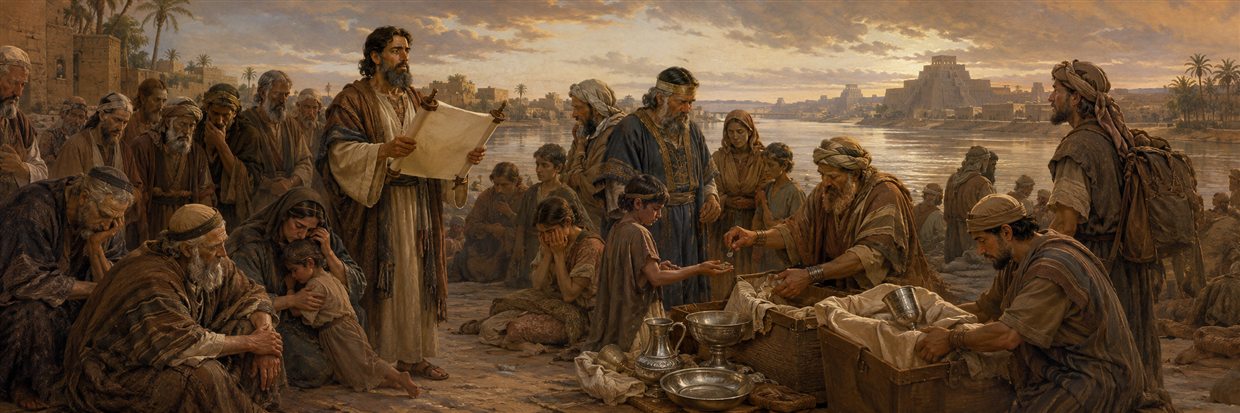
The opening places Baruch among the exiles in Babylon, reading a scroll that prompts weeping, fasting, prayer, and gifts for Jerusalem. A communal confession acknowledges disobedience and interprets disaster in relation to neglected commandments. The prayer appeals to God’s mercy and asks for deliverance and a renewed covenant relationship. Baruch 1; Baruch 2; Baruch 3:1–8.
The book then calls Israel to seek wisdom. Human power and wealth cannot secure it; God makes it known to Israel, and the poem connects it with the enduring law. A new movement turns to consolation. Personified Jerusalem mourns her scattered children and encourages them to turn toward God, while the closing vision of this section anticipates their joyful return. Baruch 3:9–37; Baruch 4; Baruch 5.
In the six-chapter edition used for the overview’s citations, the final chapter is the Letter of Jeremiah. It addresses people facing captivity in Babylon and repeatedly warns them not to fear handmade gods. Its descriptions contrast elaborate decoration and public display with the images’ inability to speak, move, protect themselves, or save their worshipers. Baruch 6:1–16; Baruch 6:45–58; Baruch 6:70–73.
02 / Follow the structure
A reading outline
A chapter-level reading guide; some literary movements cross these boundaries. Each link opens the section’s first chapter.
- 1–2Confession and prayerThe Babylonian setting, gifts to Jerusalem, acknowledgment of sin, and an appeal for mercy.
- 3From prayer to the search for wisdomThe prayer concludes and the wisdom poem begins.
- 4–5Wisdom and consolationThe law, Jerusalem’s lament, and the promise of return.
- 6The Letter of JeremiahThe warning against idolatry, printed separately in the site’s Orthodox edition.
03 / Notice the connections
Major themes
Confession and mercy
The community acknowledges wrongdoing and appeals to God’s character. The prayer seeks restored relationship rather than merely an end to discomfort. Baruch 1:15–22; Baruch 2:11–19; Baruch 2:30–35; Baruch 3:1–8.
Wisdom and the law
The search for wisdom ends with God’s gift to Israel. The poem’s invitation is to take hold of the law and walk in its light. Baruch 3:29–37; Baruch 4:1–4.
Grief giving way to hope
Jerusalem’s mourning is answered by the promise of her children’s return. The imagery of clothing, light, and a level road gives restoration a visible shape. Baruch 4:19–29; Baruch 5:1–9.
04 / Background
Background at a glance
- Literary form
- Exilic prayer, wisdom poetry, consolation, and a letter against idolatry
- Setting in the text
- Exiles in Babylon and Jerusalem personified as a grieving mother
More about the background
The USCCB introduction distinguishes the book’s attribution to Jeremiah’s assistant from its literary formation as a collection of different compositions. It treats the Babylonian scene as a literary setting and leaves the date uncertain. It also notes that the Letter of Jeremiah circulated separately in major Greek manuscripts. [1]
The opening names Baruch and places the public reading in Babylon. The linked Catholic edition has six chapters, with the Letter of Jeremiah in chapter 6. Brenton’s Septuagint in the Orthodox library has five chapters of Baruch and a separate Epistle of Jeremiah. These are different arrangements; the five-chapter listing does not indicate missing local content. Baruch 1:1–14; Baruch 6:1–7.
05 / Return to the text
Passages to explore
Passage links open the World English Bible, Catholic Edition. These selections offer starting points for exploring the book.
A prayer for mercy
Notice the relationship between confession, remembrance, and hope.
Baruch 3:1–8 MemorizeJerusalem’s change of clothing
Follow the images that transform mourning into an expectation of return.
Baruch 5:1–9 MemorizeImages that cannot save
Read the warning within the letter’s address to people going into exile.
Baruch 6:4–16 MemorizeWhy does Baruch have five chapters in some editions and six in others?
The six-chapter Catholic form includes the Letter of Jeremiah as chapter 6. The Orthodox edition used in this library prints Baruch in five chapters and provides that text separately as the Epistle of Jeremiah. The overview’s Scripture links use the six-chapter World English Bible Catholic Edition, while the chapter collection follows the selected tradition. Baruch 6:1–7.
Read Baruch
Sources and reading notes
The summaries describe the biblical text; passage references let you check them in context. Historical and authorship notes are attributed separately. The outlines and passage selections are editorial reading aids.
- United States Conference of Catholic Bishops. The Book of Baruch. New American Bible introduction; opening paragraph on attribution, composition, setting, and the separate Letter of Jeremiah. Catholic reference perspective. Accessed September 11, 2026. ↩
Prepared for BibleVerse · September 11, 2026. An initial editorial edition; independent specialist review is pending. Biblical references use the World English Bible, Catholic Edition. The illustration is interpretive artwork.