
The short summary
What is 1 Samuel about?
1 Samuel follows Israel’s transition to kingship through the lives of Samuel, Saul, and David. Samuel becomes a prophet and anoints Saul as king, but Saul’s disobedience leads to his rejection. David is anointed and rises to prominence, then becomes a fugitive pursued by Saul. The book ends with Saul’s death in battle, before David begins his reign.
1 Samuel 3:19–21; 1 Samuel 10:1; 1 Samuel 15:22–28; 1 Samuel 16:1–13; 1 Samuel 19:9–12; 1 Samuel 31:1–6.01 / Understand the whole
The book in context
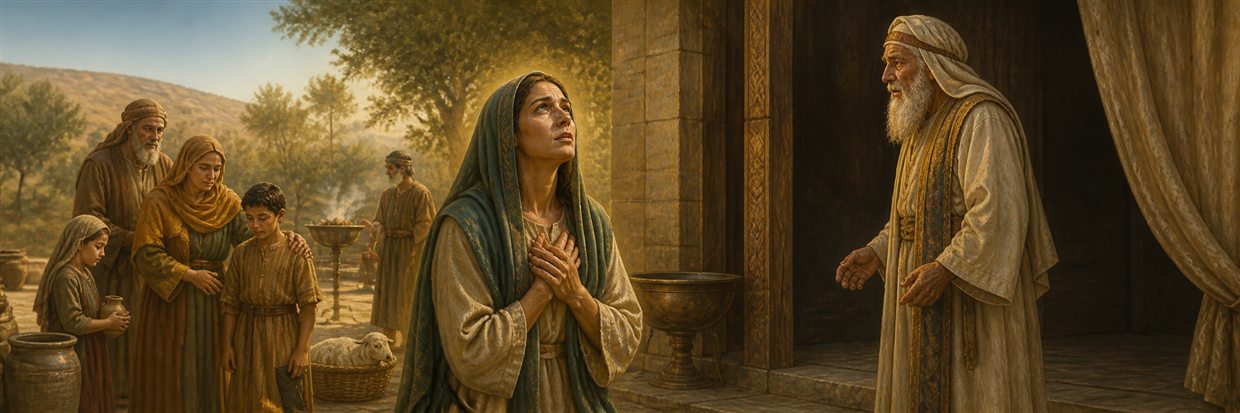
The story begins with Hannah praying for a child and later dedicating her son Samuel to the LORD at Shiloh. Samuel grows into a recognized prophet. Israel’s defeat and the capture of the ark expose the crisis surrounding Eli’s household; the ark eventually returns, and Samuel leads the people in turning back to God. When the elders request a king, Samuel warns about the demands a ruler will place on their families and resources. 1 Samuel 1:9–28; 1 Samuel 3:19–21; 1 Samuel 4:10–22; 1 Samuel 7:1–17; 1 Samuel 8:4–22.
Samuel anoints Saul, who wins a victory over the Ammonites and is confirmed as king at Gilgal. Yet the new monarchy remains accountable to God. Samuel confronts Saul over his failure to keep God’s command, and later announces his rejection following the campaign against Amalek. Samuel then anoints David, Jesse’s youngest son. David defeats Goliath and gains public acclaim, while Saul increasingly fears him and tries to kill him. 1 Samuel 10:1; 1 Samuel 11:1–15; 1 Samuel 12:13–25; 1 Samuel 13:8–14; 1 Samuel 15:1–28; 1 Samuel 16:1–13; 1 Samuel 17:41–54; 1 Samuel 18:6–16.
David’s friendship with Jonathan offers protection amid Saul’s hostility. As David moves from place to place, the conflict extends beyond the two rivals: Saul orders the killing of the priests at Nob. David twice spares Saul when he has an opportunity to kill him. Near the end, David recovers the families taken from Ziklag, while Saul and three of his sons die during Israel’s defeat by the Philistines on Mount Gilboa. The succession remains unresolved within this book. 1 Samuel 20:12–17; 1 Samuel 22:17–19; 1 Samuel 24:4–12; 1 Samuel 26:7–12; 1 Samuel 30:1–3; 1 Samuel 30:17–24; 1 Samuel 31:1–6.
02 / Follow the structure
A reading outline
A chapter-level reading guide; some literary movements cross these boundaries. Each link opens the section’s first chapter.
- 1–3Hannah, Eli, and Samuel’s callingA prayer for a child leads into Samuel’s service and recognition as a prophet.
- 4–7The ark and Israel’s return to GodDefeat, the ark’s capture and return, and Samuel’s leadership frame a national crisis.
- 8–12Israel receives a kingThe people request a king; Saul is anointed, wins a victory, and is confirmed publicly.
- 13–15Saul’s kingship under judgmentMilitary conflict and disobedience lead to Samuel’s announcement that Saul is rejected.
- 16–26David’s rise and life as a fugitiveDavid is anointed, defeats Goliath, and escapes Saul while twice sparing his life.
- 27–31Ziklag and Mount GilboaDavid lives among the Philistines and rescues captives; Saul’s reign ends in defeat and death.
03 / Notice the connections
Major themes
Kingship and accountability
Israel asks for a king like other nations, but Samuel warns about royal demands and insists that both king and people remain accountable to God. 1 Samuel 8:4–22; 1 Samuel 12:13–25.
Obedience and appearances
Samuel’s rebuke of Saul gives obedience priority over sacrifice. At David’s selection, outward appearance is contrasted with God’s knowledge of the heart. 1 Samuel 15:22–23; 1 Samuel 16:6–13.
Loyalty and restraint
Jonathan commits himself to David’s safety, while David refuses opportunities to kill Saul. These episodes explore fidelity and restraint within a struggle for power. 1 Samuel 20:12–17; 1 Samuel 24:4–12; 1 Samuel 26:7–12.
04 / Background
Background at a glance
- Literary form
- Narrative with prayers and speeches
- Setting in the text
- Israel’s transition from judges to monarchy
More about the background
The USCCB introduction treats 1 and 2 Samuel together and describes their formation from distinct narrative blocks shaped by an editor. It emphasizes that the books preserve both favorable and critical perspectives on monarchy. This is an attributed account of the books’ literary development, rather than a claim that Samuel wrote the complete work. [1]
The narrative names Samuel as a prophet and judge, but reports his death before the book ends. Its title should therefore not be treated as proof that he authored every chapter. This overview does not assign a precise composition date. 1 Samuel 3:20; 1 Samuel 7:15–17; 1 Samuel 25:1.
05 / Return to the text
Passages to explore
Passage links open the Berean Standard Bible. These selections offer starting points for exploring the book.
Samuel learns to listen
Follow Samuel’s calling, Eli’s guidance, and the difficult message Samuel must deliver.
1 Samuel 3:1–21 MemorizeThe costs of kingship
Read the people’s request together with Samuel’s warning about the demands of a king.
1 Samuel 8:4–22 MemorizeDavid spares Saul
Notice the contrast between the advice of David’s men and his refusal to kill the king.
1 Samuel 24:4–12 MemorizeDoes David become the reigning king in 1 Samuel?
Samuel anoints David in chapter 16, but Saul continues to rule and later pursues him. Saul’s death comes at the end of chapter 31. David’s anointing and his eventual accession are separate events; the account of his reign continues in 2 Samuel. 1 Samuel 16:1–13; 1 Samuel 19:9–12; 1 Samuel 31:1–6.
Read 1 Samuel
Sources and reading notes
The summaries describe the biblical text; passage references let you check them in context. Historical and authorship notes are attributed separately. The outlines and passage selections are editorial reading aids.
- United States Conference of Catholic Bishops. The Books of Samuel. New American Bible introduction; Paragraphs on perspectives toward monarchy and the editing of independent narrative blocks. Catholic reference perspective. Accessed September 11, 2026. ↩
Prepared for BibleVerse · September 11, 2026. An initial editorial edition; independent specialist review is pending. Biblical references use the Berean Standard Bible. The illustration is interpretive artwork.