
The short summary
What is Jonah about?
Jonah tells of a prophet who flees a command to speak against Nineveh. A storm, a great fish, and a prayer lead into a renewed commission. Nineveh responds to his warning by turning from evil, and God spares the city. Jonah becomes angry at this mercy, and the book closes with God questioning his concern for a plant beside his lack of concern for Nineveh.
Jonah 1:1–17; Jonah 2:1–10; Jonah 3:1–10; Jonah 4:1–11.01 / Understand the whole
The book in context
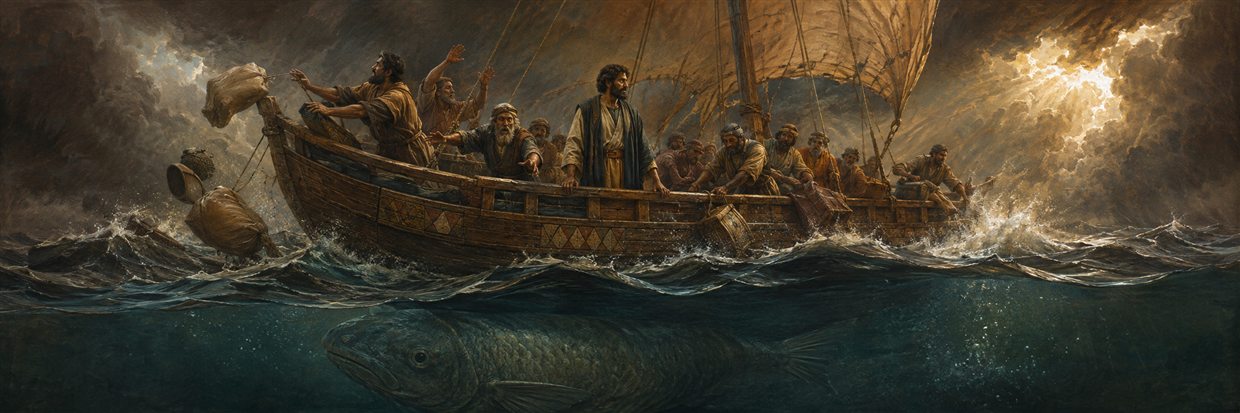
God commands Jonah son of Amittai to go to Nineveh, but he boards a ship bound for Tarshish. A violent storm threatens the sailors, who question Jonah and eventually throw him into the sea at his direction. The sea becomes calm, and the sailors respond with fear of the LORD, sacrifice, and vows. A great fish appointed by God swallows Jonah. Jonah 1:1–17.
From inside the fish, Jonah prays, recalling his distress and deliverance. The fish then deposits him on dry land. When the commission comes again, Jonah goes to Nineveh and announces its coming overthrow. The people believe the warning; the king calls for fasting and a turning away from evil and violence. God sees their changed conduct and does not bring the threatened disaster. Jonah 2:1–10; Jonah 3:1–10.
The spared city provokes Jonah’s anger. He explains that he fled because he knew God to be compassionate and willing to relent. Outside the city, a plant provides shade, then a worm and an east wind bring further distress. God contrasts Jonah’s concern for the short-lived plant with divine concern for Nineveh’s people and animals. The story ends with this question, without recording Jonah’s answer. Jonah 4:1–11.
02 / Follow the structure
A reading outline
A chapter-level reading guide; some literary movements cross these boundaries. Each link opens the section’s first chapter.
- 1Flight and the stormJonah’s refusal brings him among sailors confronting danger at sea.
- 2Prayer from the fishJonah recalls distress and deliverance before returning to dry land.
- 3The second commission and Nineveh’s responseThe city hears the warning, turns from evil, and is spared.
- 4Anger and the final questionThe plant episode exposes the tension between Jonah’s concerns and God’s compassion.
03 / Notice the connections
Major themes
Responses to God’s word
The sailors and Ninevites respond with seriousness, while the commissioned prophet repeatedly resists. Jonah 1:5–16; Jonah 3:5–10; Jonah 4:1–4.
Repentance includes changed conduct
Nineveh’s response involves abandoning evil and violence, not only outward signs of mourning. Jonah 3:7–10.
Compassion beyond the prophet’s preference
The closing question names people and animals as objects of divine concern. Jonah 4:9–11.
04 / Background
Background at a glance
- Literary form
- Prophetic narrative with a prayer poem
- Setting in the text
- The sea, Nineveh, and its outskirts
More about the background
The USCCB introduction distinguishes Jonah’s narrative about a prophet from a collection of prophetic oracles. It emphasizes irony and notes that scholars classify its literary form in different ways, including parable and satire. This overview follows the story’s presentation without claiming a settled genre label or precise date of composition. [1]
The opening names Jonah son of Amittai, but the book tells his story largely in the third person and gives no author’s identification. Its concluding question is part of the account’s design; a final change of heart for Jonah should not be supplied as though it were narrated. Jonah 1:1–3; Jonah 4:9–11.
05 / Return to the text
Passages to explore
Passage links open the Berean Standard Bible. These selections offer starting points for exploring the book.
The prophet and the sailors
Compare Jonah’s actions with the sailors’ attempts to respond to danger.
Jonah 1:1–17 MemorizeNineveh turns from evil
Read the proclamation, the king’s appeal, and God’s response together.
Jonah 3:1–10 MemorizeThe unanswered question
Follow Jonah’s explanation of his flight into the lesson involving the plant and the city.
Jonah 4:1–11 MemorizeIs the fish the conclusion of Jonah’s story?
No. The fish episode leads into a second commission, Nineveh’s response, and Jonah’s anger when the city is spared. The final chapter focuses on compassion and ends with God’s question rather than Jonah’s reply. Jonah 2:10; Jonah 3:1–10; Jonah 4:1–11.
Read Jonah
Sources and reading notes
The summaries describe the biblical text; passage references let you check them in context. Historical and authorship notes are attributed separately. The outlines and passage selections are editorial reading aids.
- United States Conference of Catholic Bishops. The Book of Jonah. New American Bible introduction; Discussion of irony and the paragraph distinguishing narrative from prophetic oracles. Catholic reference perspective. Accessed September 11, 2026. ↩
Prepared for BibleVerse · September 11, 2026. An initial editorial edition; independent specialist review is pending. Biblical references use the Berean Standard Bible. The illustration is interpretive artwork.