
The short summary
What is 3 Maccabees about?
3 Maccabees tells of a threat to the Jews of Egypt under Ptolemy Philopator. After his attempt to enter Jerusalem’s sanctuary is stopped, the king turns against Jewish communities in his kingdom. They are gathered for execution by elephants, but prayer and divine intervention bring deliverance. Celebration, royal protection, and the return home close the account.
3 Maccabees 2:21–33; 3 Maccabees 5:1–5; 3 Maccabees 6:16–32; 3 Maccabees 7:17–23.01 / Understand the whole
The book in context
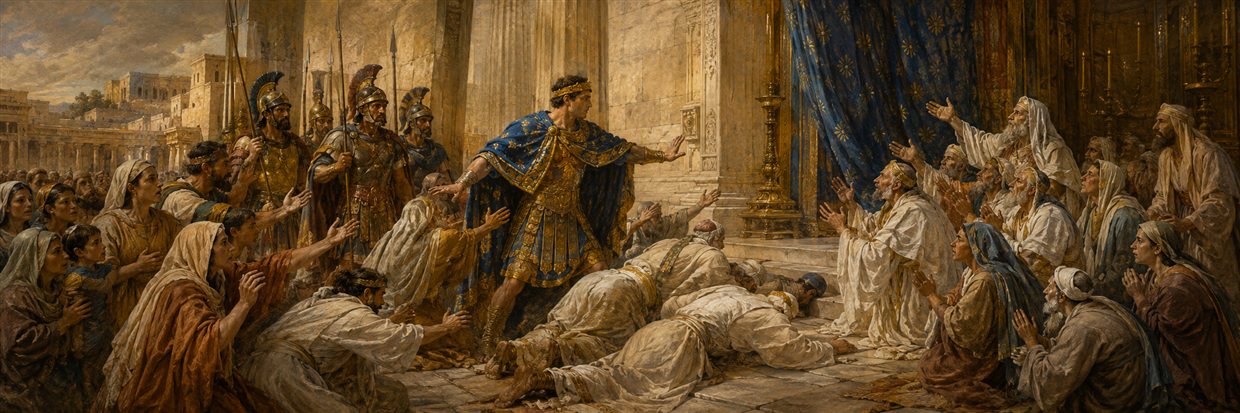
After victory at Raphia, Ptolemy visits Jerusalem and insists on entering the sanctuary despite opposition. The high priest Simon prays, and the king is struck down. Returning to Egypt without repenting, Ptolemy imposes registration and demands associated with the worship of Dionysus; most Jews resist abandoning their observances. 3 Maccabees 1:8–29; 3 Maccabees 2:1–24; 3 Maccabees 2:25–33.
Royal orders bring Jews from across Egypt into confinement in Alexandria. The planned execution uses elephants prepared to trample them. Repeated delays are attributed to God’s intervention, while the prisoners appeal for mercy. Eleazar’s prayer recalls earlier rescues and asks God to preserve the threatened people. 3 Maccabees 3:1–3; 3 Maccabees 4:11–21; 3 Maccabees 5:1–12; 3 Maccabees 6:1–15.
Two angels appear, and the elephants turn against the armed forces. The king orders the prisoners released and provides a feast where death had been expected. He grants protection for their return. The ending also recounts the community’s killing of Jews who had abandoned their law, before concluding with thanksgiving and homecoming. 3 Maccabees 6:16–40; 3 Maccabees 7:1–16; 3 Maccabees 7:17–23.
02 / Follow the structure
A reading outline
A chapter-level reading guide; some literary movements cross these boundaries. Each link opens the section’s first chapter.
- 1–2The sanctuary and the royal responseA confrontation in Jerusalem leads to restrictions on Jews in Egypt.
- 3–5A community marked for destructionArrest, confinement, and repeated execution plans place the people in danger.
- 6Prayer and deliveranceEleazar prays, the attack is reversed, and a feast replaces the expected massacre.
- 7Protection and returnA royal letter, reprisals within the community, and homecoming end the narrative.
03 / Notice the connections
Major themes
Faithfulness under pressure
Most of the community rejects the advantages offered for joining the king’s religious rites. 3 Maccabees 2:27–33.
Prayer and remembered rescues
The prayers appeal to God’s sovereignty and earlier acts of deliverance as grounds for present hope. 3 Maccabees 2:1–20; 3 Maccabees 6:1–15.
Deliverance remembered together
Feasting and recurring days of celebration turn survival into a shared act of remembrance. 3 Maccabees 6:30–40; 3 Maccabees 7:17–23.
04 / Background
Background at a glance
- Literary form
- Narrative of persecution and deliverance
- Setting in the text
- Jerusalem and Egypt under Ptolemy IV Philopator
More about the background
The United Bible Societies introduction explains that this book concerns a setting earlier than the Maccabean family’s story, despite its title. It identifies the author as unknown and the date as disputed. The narrative should therefore be read as its own account of persecution and deliverance, rather than as a sequel to 2 Maccabees. [1]
This overview follows the seven-chapter Brenton text available through the Orthodox library. The summaries distinguish what the narrator claims from independently established history. The violent reprisals in the final chapter are included as part of the account, without treating them as a rule for religious communities.
05 / Return to the text
Passages to explore
Passage links open the Brenton Septuagint Translation. These selections offer starting points for exploring the book.
Simon’s prayer
How does the prayer connect God’s greatness with the protection of the sanctuary?
3 Maccabees 2:1–20 MemorizePrayer at the place of execution
Which remembered rescues shape Eleazar’s appeal, and how does the narrative answer it?
3 Maccabees 6:1–21 MemorizeRemembering the return
How is the rescue carried into the community’s future life?
3 Maccabees 7:17–23 MemorizeDoes 3 Maccabees continue the history of the Maccabean family?
No. Its story centers on Ptolemy Philopator and the Jews of Egypt, rather than Judas Maccabaeus and his family. Its themes of religious pressure and divine deliverance connect it with the Maccabean literature, but it tells a distinct story. 3 Maccabees 1:1–8; 3 Maccabees 7:1–9.
Read 3 Maccabees
Sources and reading notes
The summaries describe the biblical text; passage references let you check them in context. Historical and authorship notes are attributed separately. The outlines and passage selections are editorial reading aids.
- United Bible Societies, hosted by TIPs. Translation introduction to 3 Maccabees. Translation handbook introduction; “Name and status of 3 Maccabees” and “Author, date, and place of origin”. Bible translation reference perspective. Accessed September 11, 2026. ↩
Prepared for BibleVerse · September 11, 2026. An initial editorial edition; independent specialist review is pending. Biblical references use the Brenton Septuagint Translation. The illustration is interpretive artwork.