
The short summary
What is Joel about?
Joel begins with a devastating loss of crops and calls the community to lament and gather before God. The approaching day of the LORD intensifies the appeal to return wholeheartedly. Promises of restored harvests and an outpouring of the Spirit follow, together with judgment on the nations and a vision of security for Judah and Jerusalem.
Joel 1:2–14; Joel 2:1–17; Joel 2:18–32; Joel 3:1–3; Joel 3:16–21.01 / Understand the whole
The book in context
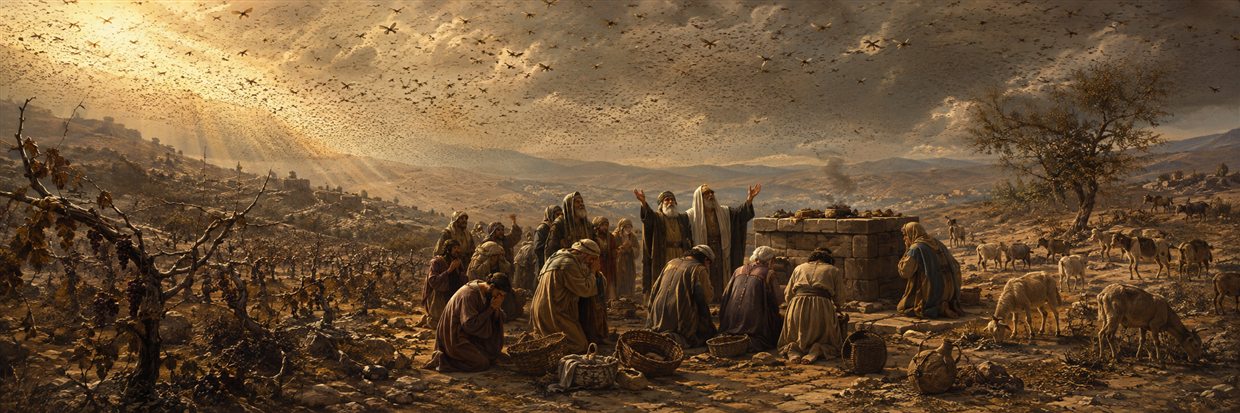
Locust devastation disrupts farming, food, wine, and offerings at the temple. Joel calls elders, farmers, priests, and the wider population to recognize the crisis, mourn, and tell later generations about it. Drought and fire deepen the picture of loss. The opening turns agricultural suffering into a summons to communal prayer and an announcement that the day of the LORD is near. Joel 1:2–20.
The second chapter announces an overwhelming approach using the imagery of darkness, fire, and a disciplined army. An urgent call to return follows: outward mourning must accompany changed hearts. The entire community is summoned, and priests are directed to plead for the people. God’s response promises renewed provision, the removal of reproach, and restoration of what the locusts consumed. Joel 2:1–17; Joel 2:18–27.
The promised outpouring of the Spirit includes sons and daughters, old and young, and male and female servants. Cosmic signs accompany the day of the LORD and the promise of deliverance. The final chapter gathers nations for judgment over their treatment of God’s people. Its closing images contrast their judgment with water, abundance, and divine presence in Zion. Joel 2:28–32; Joel 3:1–8; Joel 3:9–21.
02 / Follow the structure
A reading outline
A chapter-level reading guide; some literary movements cross these boundaries. Each link opens the section’s first chapter.
- 1Devastation and lamentCrop loss, disrupted worship, and drought lead to a call for a sacred assembly.
- 2:1–17The day of the LORD and a call to returnTerrifying imagery leads into an appeal for wholehearted repentance.
- 2:18–32Restoration and the SpiritRenewed harvests are followed by promises of the Spirit and deliverance; the link opens chapter 2.
- 3Judgment and securityThe nations face judgment, while Judah and Jerusalem are promised renewed life.
03 / Notice the connections
Major themes
A community called to respond
The summons includes elders, children, newlyweds, and priests, presenting the crisis as a shared concern. Joel 1:14; Joel 2:15–17.
Inward return
The appeal to changed hearts grounds repentance in God’s compassion while leaving room for humble uncertainty. Joel 2:12–14.
Renewal and divine presence
Restored harvests and the Spirit’s outpouring lead toward the closing assurance of God’s dwelling in Zion. Joel 2:25–29; Joel 3:16–21.
04 / Background
Background at a glance
- Literary form
- Prophetic poetry and communal summons
- Setting in the text
- Judah and Jerusalem amid agricultural devastation
More about the background
The USCCB introduction notes that Joel’s opening provides no specific historical date and offers a postexilic dating based on internal evidence. This is an attributed scholarly assessment. Its edition divides Joel into four chapters; this overview follows the BSB’s three-chapter arrangement, so some corresponding references differ. [1]
The opening names Joel as the son of Pethuel but does not name a reigning king. Priests, offerings, Zion, and Jerusalem feature prominently in the text. These observations support a clear description of its concerns without requiring a certain year for its composition. Joel 1:1; Joel 1:9–14; Joel 2:15–17; Joel 3:17.
05 / Return to the text
Passages to explore
Passage links open the Berean Standard Bible. These selections offer starting points for exploring the book.
Lament amid agricultural loss
Read the call to priests and people alongside the suffering of the land and animals.
Joel 1:13–20 MemorizeReturn with the whole heart
Notice both the inward appeal and the practical gathering of the community.
Joel 2:12–17 MemorizeThe Spirit and deliverance
Read the range of people named together with the signs and promise that follow.
Joel 2:28–32 MemorizeWhy does Joel have three chapters in some Bibles and four in others?
The chapter divisions differ, rather than indicating an extra story. In the four-chapter arrangement used by the cited USCCB edition, BSB Joel 2:28–32 forms chapter 3, and BSB chapter 3 corresponds to chapter 4. The reading links here use BSB numbering. Joel 2:28–32; Joel 3:1.
Read Joel
Sources and reading notes
The summaries describe the biblical text; passage references let you check them in context. Historical and authorship notes are attributed separately. The outlines and passage selections are editorial reading aids.
- United States Conference of Catholic Bishops. The Book of Joel. New American Bible introduction; Opening discussion of historical dating and the concluding chapter divisions. Catholic reference perspective. Accessed September 11, 2026. ↩
Prepared for BibleVerse · September 11, 2026. An initial editorial edition; independent specialist review is pending. Biblical references use the Berean Standard Bible. The illustration is interpretive artwork.