
The short summary
What is Esther about?
In the Hebrew form of Esther summarized here, a Jewish queen and her guardian Mordecai confront Haman’s plan to destroy the Jews throughout the Persian Empire. Esther risks approaching the king and exposes the threat to her people. Haman falls, a new decree permits Jewish defense, and deliverance is commemorated in the festival of Purim.
Esther 2:5–7; Esther 2:17; Esther 3:5–13; Esther 4:13–17; Esther 7:1–10; Esther 8:8–13; Esther 9:20–28.01 / Understand the whole
The book in context
After Queen Vashti is removed, Esther is taken into the royal household and becomes queen. Mordecai, her cousin who raised her as his daughter, instructs her not to disclose her Jewish identity. He uncovers a plot against the king, and the incident is recorded. Later, Haman’s anger at Mordecai’s refusal to bow grows into a plan against all the Jews, backed by a royal decree. Esther 1:10–22; Esther 2:5–10; Esther 2:16–23; Esther 3:1–15.
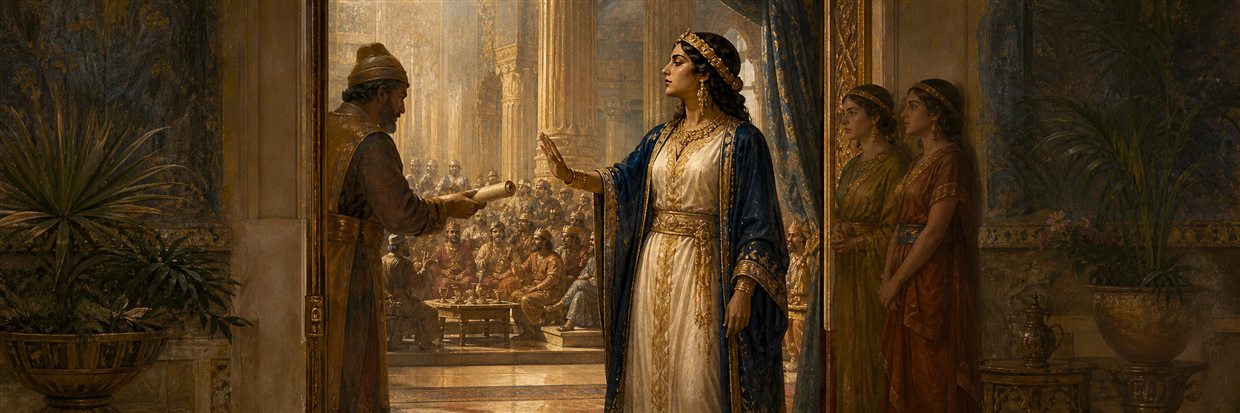
Mordecai urges Esther to intervene despite the danger of entering the king’s presence uninvited. She asks the Jews in Susa to fast and then approaches the king. Through a sequence of banquets, Esther brings Haman into a setting where she can expose his plan. Meanwhile, the king learns that Mordecai’s earlier service was never rewarded, and Haman is forced to honor him. Esther identifies herself with the threatened people, and Haman is executed. Esther 4:1–17; Esther 5:1–8; Esther 6:1–14; Esther 7:1–10.
Haman’s death does not by itself remove the original decree. Esther appeals again, and a new edict authorizes the Jews to assemble and defend themselves. The narrative describes a violent reversal in which they kill their enemies; it also repeatedly states that they do not take plunder. Letters establish Purim as an annual commemoration with feasting, gifts, and help for the poor. A final notice describes Mordecai’s elevated position and his work for his people. Esther 8:3–14; Esther 9:1–16; Esther 9:20–32; Esther 10:1–3.
02 / Follow the structure
A reading outline
A chapter-level reading guide; some literary movements cross these boundaries. Each link opens the section’s first chapter.
- 1–2Esther becomes queenVashti’s removal, Esther’s selection, and Mordecai’s discovery of a plot set the scene.
- 3–4A decree and a dangerous decisionHaman plans destruction, and Mordecai urges Esther to intervene.
- 5–7Banquets and reversalsEsther approaches the king, Mordecai is honored, and Haman’s plan is exposed.
- 8–9Defense and commemorationA new decree, violent conflict, and deliverance lead to the establishment of Purim.
- 10Mordecai’s positionThe conclusion records Mordecai’s standing and concern for his people.
03 / Notice the connections
Major themes
Identity and responsibility
Esther moves from concealing her identity to identifying herself with those under threat. Her position at court becomes a responsibility involving personal risk. Esther 2:10; Esther 4:13–17; Esther 7:3–6.
The reversal of power
Haman must honor the man he hoped to destroy, and the appointed day turns against those who expected to overpower the Jews. Esther 6:6–11; Esther 9:1–5.
Remembering deliverance
Purim joins remembrance with celebration, gifts to one another, and generosity to the poor. Esther 9:20–28.
04 / Background
Background at a glance
- Literary form
- Court narrative and festival origin story
- Setting in the text
- The Persian court at Susa and the empire’s provinces
More about the background
The USCCB introduction distinguishes the Hebrew form from Greek versions containing additions, including explicit references to God. This overview and its BSB citations follow the Hebrew form’s ten chapters. The Greek additions are not summarized here; Catholic and Orthodox chapter collections retain their own text and numbering. [1]
The story locates its court at Susa and links its events with the observance of Purim. Its references to royal records are features of the narrative, not independent confirmation of every episode. This overview does not name an author or assign a precise composition date. Esther 1:1–2; Esther 6:1–3; Esther 9:20–28.
05 / Return to the text
Passages to explore
Passage links open the Berean Standard Bible. These selections offer starting points for exploring the book.
Esther’s decision
Read the danger of approaching the king together with Mordecai’s appeal and Esther’s response.
Esther 4:10–17 MemorizeThe threat is exposed
Notice how Esther identifies her people and the threat before naming Haman.
Esther 7:1–10 MemorizeThe meaning of Purim
Follow the connection between remembrance, celebration, and gifts to the poor.
Esther 9:20–28 MemorizeDoes Haman’s death cancel the decree against the Jews?
No. Esther must appeal again, and the king authorizes another decree permitting the Jews to assemble and defend themselves. The account presents this new authorization as the response to an earlier royal decree that cannot be revoked. Esther 8:3–13.
Read Esther
Sources and reading notes
The summaries describe the biblical text; passage references let you check them in context. Historical and authorship notes are attributed separately. The outlines and passage selections are editorial reading aids.
- United States Conference of Catholic Bishops. The Book of Esther. New American Bible introduction; Paragraphs distinguishing Hebrew and Greek versions and explaining the Greek additions. Catholic reference perspective. Accessed September 11, 2026. ↩
Prepared for BibleVerse · September 11, 2026. An initial editorial edition; independent specialist review is pending. Biblical references use the Berean Standard Bible. The illustration is interpretive artwork.