The short summary
What is 1 Kings about?
1 Kings begins with Solomon succeeding David and building the temple in Jerusalem. His wisdom and wealth are followed by an account of his turn toward other gods. After his death, the kingdom divides under Rehoboam and Jeroboam. The book follows rulers in Judah and Israel, with Elijah’s ministry and his confrontations with Ahab occupying much of its later chapters.
1 Kings 1:32–40; 1 Kings 6:1–14; 1 Kings 10:23–24; 1 Kings 11:1–13; 1 Kings 12:1–20; 1 Kings 17:1; 1 Kings 21:17–24.01 / Understand the whole
The book in context
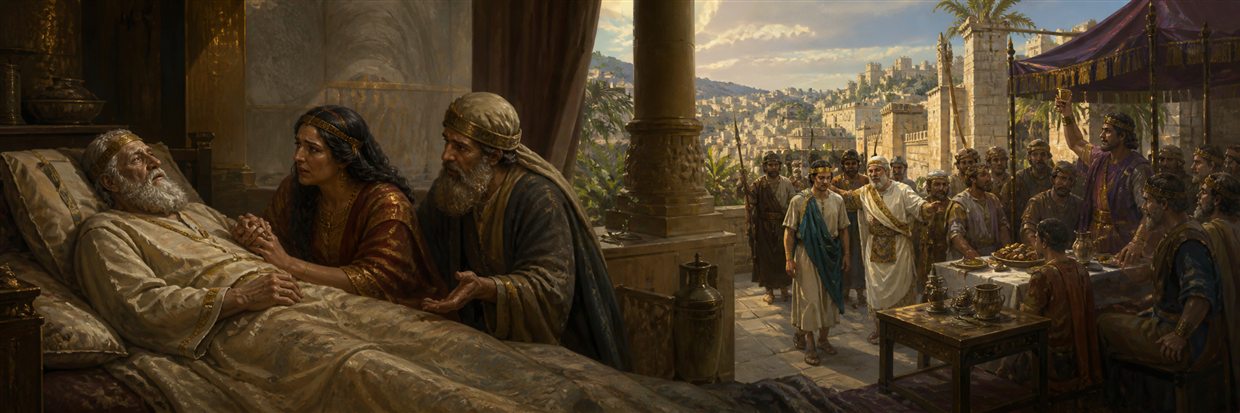
A contested succession ends with Solomon being anointed while David is still alive. After David’s death, Solomon consolidates his rule and asks God for discernment to govern. His reign includes the construction and dedication of the Jerusalem temple, extensive building projects, and international recognition. Solomon’s dedication prayer stresses that even the heavens cannot contain God and asks that prayers directed toward the temple be heard. 1 Kings 1:32–53; 1 Kings 2:10–12; 1 Kings 2:46; 1 Kings 3:5–14; 1 Kings 6:1–14; 1 Kings 7:1–12; 1 Kings 8:27–30; 1 Kings 10:1–13.
Solomon’s later worship of other gods brings an announcement that the kingdom will be torn from his son. After Solomon dies, Rehoboam refuses a request to lighten the people’s burdens. The northern tribes make Jeroboam king, while Rehoboam retains rule in Judah. Jeroboam establishes calf images and sanctuaries at Bethel and Dan, a policy the narrative condemns. The book then alternates between the rulers of the two kingdoms. 1 Kings 11:1–13; 1 Kings 11:41–43; 1 Kings 12:1–20; 1 Kings 12:26–33; 1 Kings 15:1–9; 1 Kings 15:25–34.
In Ahab’s time, Elijah announces a drought, receives provision, and confronts the prophets of Baal at Mount Carmel. After fleeing Jezebel, he travels to Horeb and receives further instructions. The later chapters include war with Aram and Naboth’s death after Jezebel arranges false accusations against him. Elijah condemns Ahab’s seizure of Naboth’s vineyard. Ahab finally dies in battle after disregarding Micaiah’s warning, and the closing notices introduce the next reign in Israel. 1 Kings 17:1–16; 1 Kings 18:20–40; 1 Kings 19:1–18; 1 Kings 20:1–34; 1 Kings 21:1–24; 1 Kings 22:13–40; 1 Kings 22:51–53.
02 / Follow the structure
A reading outline
A chapter-level reading guide; some literary movements cross these boundaries. Each link opens the section’s first chapter.
- 1–2Solomon succeeds DavidThe succession is contested, David dies, and Solomon establishes his rule.
- 3–4Wisdom and administrationSolomon asks for discernment and organizes the kingdom.
- 5–8Building and dedicating the templePreparations, construction, furnishings, and prayer center on Jerusalem’s sanctuary.
- 9–11Splendor and divided loyaltyRoyal achievements are followed by Solomon’s turn to other gods and a warning of division.
- 12–16Two kingdoms and their rulersRehoboam and Jeroboam’s conflict gives way to alternating accounts of Judah and Israel.
- 17–22Elijah, Ahab, and prophetic confrontationDrought, Mount Carmel, Naboth’s vineyard, and war bring kings and prophets into conflict.
03 / Notice the connections
Major themes
Wisdom for just rule
Solomon asks for discernment in judging the people. The subsequent dispute between two women illustrates the exercise of that wisdom. 1 Kings 3:5–28.
Worship and divided loyalty
The temple’s dedication calls for wholehearted fidelity, while Solomon’s later conduct and Jeroboam’s sanctuaries reveal departures from that ideal. 1 Kings 8:54–61; 1 Kings 11:1–13; 1 Kings 12:26–33.
Prophetic challenge to royal power
Elijah confronts Ahab over Naboth’s death and land. Micaiah refuses to tailor his message to the favorable predictions the king has already heard. 1 Kings 21:17–24; 1 Kings 22:13–28.
04 / Background
Background at a glance
- Literary form
- Royal narrative and prophetic accounts
- Setting in the text
- Solomon’s reign and the kingdoms of Israel and Judah
More about the background
The USCCB introduction places Kings within what many scholars call the Deuteronomistic History, linking it with Joshua, Judges, and Samuel. It describes the books as a religious interpretation of Israel’s monarchy and notes that scholars dispute the stages of their editorial development. [1]
The narrator refers readers to records of Solomon and to chronicles of the kings of Israel and Judah. Those references show that the narrative presents itself as drawing on other records; they do not name its final author. This overview does not assign a single author or precise composition date. 1 Kings 11:41; 1 Kings 14:19; 1 Kings 14:29.
05 / Return to the text
Passages to explore
Passage links open the Berean Standard Bible. These selections offer starting points for exploring the book.
Solomon asks for wisdom
Read what Solomon requests and why the request is commended.
1 Kings 3:5–14 MemorizePrayer at the temple
Consider how Solomon distinguishes the temple from the God who cannot be contained by it.
1 Kings 8:27–30 MemorizeNaboth’s vineyard
Follow the refusal, false accusations, seizure, and prophetic judgment as one connected account.
1 Kings 21:1–24 MemorizeWho rules the two kingdoms after the division?
Rehoboam, Solomon’s son, rules in Judah, while Jeroboam becomes king over the northern kingdom of Israel. Their similar names can be confusing. Chapter 12 describes both the dispute over burdens and the establishment of Jeroboam’s rule. 1 Kings 12:1–20.
Read 1 Kings
Sources and reading notes
The summaries describe the biblical text; passage references let you check them in context. Historical and authorship notes are attributed separately. The outlines and passage selections are editorial reading aids.
- United States Conference of Catholic Bishops. The Books of Kings. New American Bible introduction; Opening paragraph; discussion of theological interpretation; closing paragraphs on sources and editorial revision. Catholic reference perspective. Accessed September 11, 2026. ↩
Prepared for BibleVerse · September 11, 2026. An initial editorial edition; independent specialist review is pending. Biblical references use the Berean Standard Bible. The illustration is interpretive artwork.