
The short summary
What is Esther (Greek) about?
Greek Esther tells the story of Esther and Mordecai’s response to a decree threatening the Jewish people. Its expanded form includes Mordecai’s dream, prayers for deliverance, fuller royal documents, and an account of God changing the king’s disposition. The conclusion interprets the deliverance as God’s work and connects it with Purim.
Esther (Greek) 1:1; Esther (Greek) 3:13; Esther (Greek) 4:18–47; Esther (Greek) 5:1–2; Esther (Greek) 10:4–14.01 / Understand the whole
The book in context
The Greek form opens with Mordecai’s dream and a report of a plot against the king before the royal banquet narrative. Esther becomes queen, while Haman’s hostility to Mordecai develops into a threat against the Jewish people. A fuller version of the destructive decree exposes the accusations used to justify violence against them. Esther (Greek) 1; Esther (Greek) 2; Esther (Greek) 3.
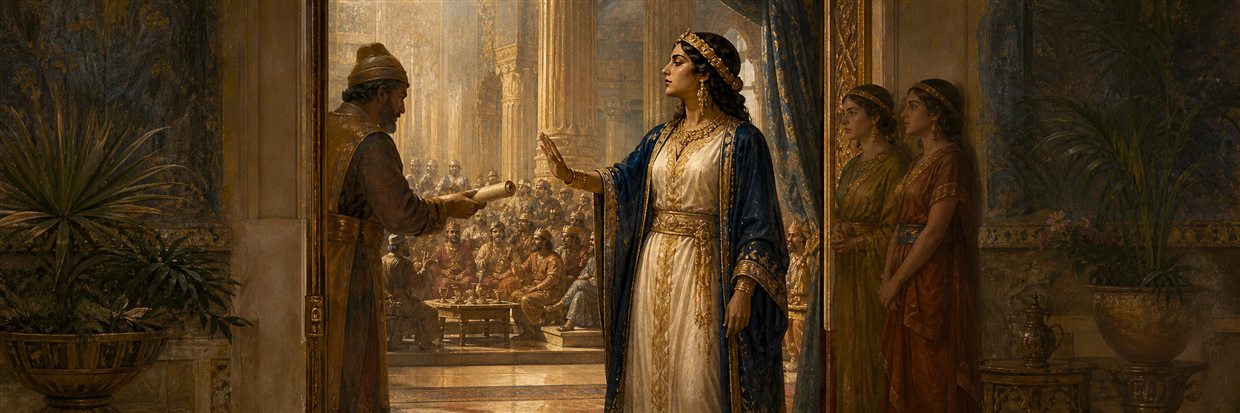
Mordecai urges Esther to intervene, and she prepares to risk approaching the king. In this form of the story, both Mordecai and Esther pray explicitly to God. Esther’s prayer voices her vulnerability and asks for help in speaking. The expanded audience scene then attributes the king’s turn toward gentleness to God before the banquet plot unfolds. Esther (Greek) 4; Esther (Greek) 5; Esther (Greek) 6; Esther (Greek) 7.
Haman’s downfall does not by itself settle the danger to the people. Further royal action permits resistance to their enemies, and the closing chapters narrate deliverance and remembrance. Mordecai interprets the opening dream in terms of Esther, the conflict with Haman, and God’s rescue of Israel. A final note gives information about the transmission of the Purim letter. Esther (Greek) 8; Esther (Greek) 9; Esther (Greek) 10.
02 / Follow the structure
A reading outline
A chapter-level reading guide; some literary movements cross these boundaries. Each link opens the section’s first chapter.
- 1–2Dream, court, and queenshipMordecai’s opening dream and Esther’s rise at court.
- 3The decree of destructionHaman’s hostility and the expanded royal document.
- 4–5Appeal, prayer, and royal audienceThe community’s danger, the prayers, and Esther before the king.
- 6–7Reversal at courtMordecai is honored and Haman is exposed.
- 8–9Deliverance and remembranceFurther royal action, conflict, and the observance of Purim.
- 10The dream interpretedMordecai attributes the rescue to God and the text closes with a transmission note.
03 / Notice the connections
Major themes
Prayer within the story
The expanded narrative gives words to Mordecai’s and Esther’s dependence on God. Their prayers join confession, remembrance, and urgent appeal. Esther (Greek) 4:18–47.
Power and public responsibility
Esther’s position creates an opportunity to act on behalf of her people, but approaching the king involves danger. Her prayer and audience place vulnerability alongside influence. Esther (Greek) 4:10–17; Esther (Greek) 5:1–2.
Deliverance interpreted
The conclusion reads the opening dream through the events of the story. God’s rescue and the community’s observance are made explicit. Esther (Greek) 10:4–14.
04 / Background
Background at a glance
- Literary form
- Court narrative with dreams, prayers, and royal decrees
- Setting in the text
- The Persian court at Susa and Jewish communities under threat
More about the background
The USCCB introduction distinguishes the Hebrew form from an expanded Greek form with explicit prayers, divine references, and fuller decrees. Its edition labels six additions A through F. It treats Esther as a literary narrative rather than a historical document and explains that the additions reshape the experience of reading the story. [1]
This page covers the longer Greek form, not a translation of the shorter form alone. The local World English Bible Catholic Edition places the additions within ten numbered chapters; some lengthy sections are included within a single numbered verse. References here follow that local numbering, which differs from editions using A–F or placing additions after chapter 10. Esther (Greek) 1:1; Esther (Greek) 3:13; Esther (Greek) 4:18–47; Esther (Greek) 5:1–2; Esther (Greek) 10:4–14.
05 / Return to the text
Passages to explore
Passage links open the World English Bible, Catholic Edition. These selections offer starting points for exploring the book.
Mordecai’s prayer
Read his explanation of loyalty alongside the plea for the people’s preservation.
Esther (Greek) 4:18–27 MemorizeEsther’s prayer
Notice how her royal position is described from within her fear and dependence.
Esther (Greek) 4:29–47 MemorizeThe dream and its interpretation
Return to the opening dream and compare it with the conclusion.
Esther (Greek) 10:4–14 MemorizeWhy does Greek Esther still have ten chapters in this library?
Chapter totals alone do not measure the extent of the text. This edition incorporates the Greek additions inside its ten chapters, including prayers in chapter 4 and Mordecai’s interpretation in chapter 10. Other editions label the additions A–F or use a different arrangement. The passage links here follow the local edition’s numbering. Esther (Greek) 4:18–47; Esther (Greek) 10:4–14.
Read Esther (Greek)
Sources and reading notes
The summaries describe the biblical text; passage references let you check them in context. Historical and authorship notes are attributed separately. The outlines and passage selections are editorial reading aids.
- United States Conference of Catholic Bishops. The Book of Esther. New American Bible introduction; discussion of literary character and the Hebrew and Greek forms, followed by the explanation of additions A–F. Catholic reference perspective. Accessed September 11, 2026. ↩
Prepared for BibleVerse · September 11, 2026. An initial editorial edition; independent specialist review is pending. Biblical references use the World English Bible, Catholic Edition. The illustration is interpretive artwork.