
The short summary
What is 2 Corinthians about?
In 2 Corinthians, Paul addresses a strained relationship with the church, explains his ministry, and expresses relief at signs of reconciliation. He describes God’s comfort amid suffering and power at work through human weakness. The letter urges generous support for other believers and defends Paul’s apostolic work against criticism, ending with a call to examine themselves and pursue restoration.
2 Corinthians 1:3–11; 2 Corinthians 2:1–11; 2 Corinthians 4:7–18; 2 Corinthians 7:5–16; 2 Corinthians 8:1–15; 2 Corinthians 10:1–18; 2 Corinthians 13:5–11.01 / Understand the whole
The book in context
Paul and Timothy greet the church, and Paul blesses God for comfort that enables believers to comfort others. He explains changes in his travel plans and recalls a painful letter written out of love. He urges forgiveness and reaffirmed care for a person who has been disciplined. Titus’s later report brings relief as Paul describes the community’s sorrow and response. 2 Corinthians 1:1–24; 2 Corinthians 2:1–13; 2 Corinthians 7:5–16.
Paul’s account of ministry presents God’s power working through fragile human messengers. Suffering and hope are held together as he speaks of renewal and resurrection. Christ’s love motivates the ministry of reconciliation, and Paul appeals to the Corinthians to open their hearts. He then urges completion of a collection, emphasizing willing giving according to means and care in its administration. 2 Corinthians 4:1–18; 2 Corinthians 5:1–21; 2 Corinthians 6:11–13; 2 Corinthians 7:2–4; 2 Corinthians 8:1–24; 2 Corinthians 9:1–15.
The final chapters answer criticism of Paul’s authority and compare his service with rival claims. His deliberately unusual boasting recounts hardship and weakness rather than impressive status alone. An unresolved affliction becomes the setting for assurance about sufficient grace. As another visit approaches, Paul calls for self-examination and explains that his authority is intended to build up the community. 2 Corinthians 10:1–18; 2 Corinthians 11:16–33; 2 Corinthians 12:1–10; 2 Corinthians 13:1–14.
02 / Follow the structure
A reading outline
A chapter-level reading guide; some literary movements cross these boundaries. Each link opens the section’s first chapter.
- 1–2Comfort and a strained relationshipPaul explains his conduct and urges forgiveness after a painful encounter.
- 3–7Ministry and reconciliationReflection on ministry, weakness, and new life leads into relief at Titus’s report.
- 8–9Generosity and shared needThe collection is to be willing, proportionate, and responsibly handled.
- 10–13Authority reconsideredPaul defends his ministry through weakness and calls the church toward restoration.
03 / Notice the connections
Major themes
Comfort shared with others
God’s comfort is described as equipping believers to support others in trouble. Affliction becomes part of a shared life rather than merely a private experience. 2 Corinthians 1:3–7.
Power through weakness
The image of treasure in fragile vessels distinguishes divine power from the messenger. Paul’s account of his affliction develops the same theme. 2 Corinthians 4:7–12; 2 Corinthians 12:7–10.
Generosity without compulsion
The collection reflects concern for others’ needs. Paul calls for willing giving according to available means and careful handling of the gift. 2 Corinthians 8:11–21; 2 Corinthians 9:6–12.
04 / Background
Background at a glance
- Literary form
- Apostolic letter and defense of ministry
- Setting in the text
- Paul’s strained relationship with the Corinthian church
More about the background
The USCCB introduction stresses uncertainty in reconstructing the events behind the letter. It identifies reconciliation, the collection for Jerusalem, and defense of ministry as major concerns. It also presents both the proposal that several letters were combined and the view that changes in circumstances explain the shifts within a single letter. [1]
Paul names Timothy alongside himself in the greeting. References to a painful letter, Titus’s report, and an approaching visit show an ongoing relationship whose full history is not supplied. The text does not precisely identify Paul’s “thorn,” so this guide does not assign it a medical diagnosis or a particular opponent. 2 Corinthians 1:1; 2 Corinthians 2:3–4; 2 Corinthians 7:5–7; 2 Corinthians 12:7–10; 2 Corinthians 13:1.
05 / Return to the text
Passages to explore
Passage links open the Berean Standard Bible. These selections offer starting points for exploring the book.
Treasure and fragile vessels
Read the account of suffering alongside its confidence in resurrection and renewal.
2 Corinthians 4:7–18 MemorizeThe ministry of reconciliation
Notice how Christ’s love and God’s action ground Paul’s appeal.
2 Corinthians 5:14–21 MemorizeGiving according to one’s means
Keep willingness, practical resources, and mutual need together.
2 Corinthians 8:9–15 MemorizeWhat does Paul mean by strength in weakness?
In 2 Corinthians 12, Paul recalls asking for an affliction to be removed and receiving assurance of sufficient grace. He connects his weakness with Christ’s power resting on him. The passage describes dependence amid unresolved hardship, rather than reporting that the hardship disappeared. 2 Corinthians 12:7–10.
Read 2 Corinthians
Sources and reading notes
The summaries describe the biblical text; passage references let you check them in context. Historical and authorship notes are attributed separately. The outlines and passage selections are editorial reading aids.
- United States Conference of Catholic Bishops. The Second Letter to the Corinthians. New American Bible introduction; paragraphs on the uncertain background, three principal topics, and the letter’s continuity. Catholic reference perspective. Accessed September 11, 2026. ↩
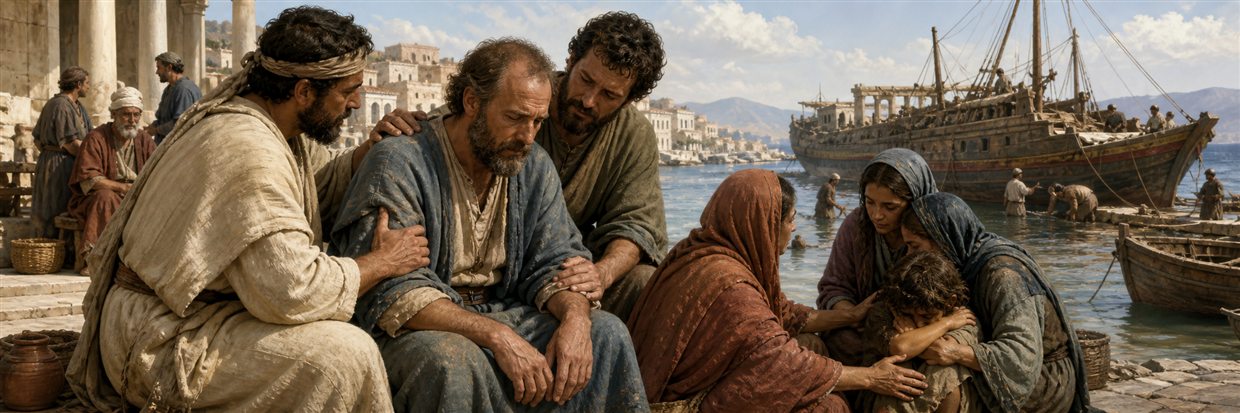
Prepared for BibleVerse · September 11, 2026. An initial editorial edition; independent specialist review is pending. Biblical references use the Berean Standard Bible. The illustration is interpretive artwork.