
The short summary
What is Daniel (Greek) about?
Greek Daniel includes the court stories and visions of Daniel together with the Prayer of Azariah and the Song of the Three, Susanna, and Bel and the Dragon. The added material develops themes of worship under pressure, unjust accusation, discernment, and divine deliverance. This overview follows the fourteen-chapter Catholic arrangement; the site’s Orthodox edition prints the final stories separately.
Daniel (Greek) 3:24–90; Daniel (Greek) 7; Daniel (Greek) 12; Daniel (Greek) 13; Daniel (Greek) 14.01 / Understand the whole
The book in context
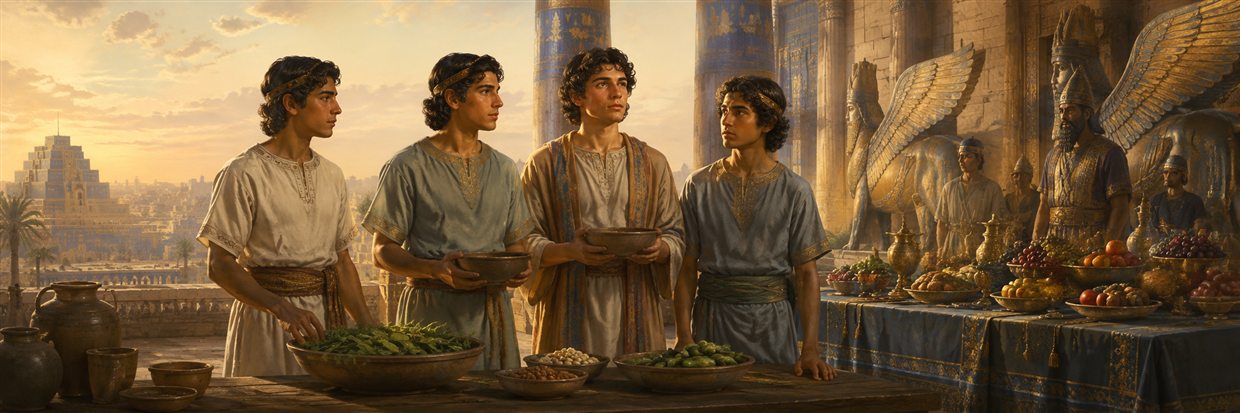
The opening stories portray Daniel and his companions under foreign kings, facing demands about food, worship, and loyalty. The Greek form expands the furnace episode with Azariah’s prayer and the three companions’ song. Confession, a plea for mercy, and a summons to creation to praise God unfold while the companions remain inside the furnace. Daniel (Greek) 1; Daniel (Greek) 2; Daniel (Greek) 3; Daniel (Greek) 4; Daniel (Greek) 5; Daniel (Greek) 6.
The visions in chapters 7–12 portray successive powers, conflict, judgment, and eventual deliverance. They include the figure like a son of man, symbolic animals, prayer concerning Jerusalem, and a final promise concerning those who sleep in the dust. The Greek additions are read alongside this larger concern with faithfulness and God’s rule. Daniel (Greek) 7; Daniel (Greek) 8; Daniel (Greek) 9; Daniel (Greek) 10; Daniel (Greek) 11; Daniel (Greek) 12.
In Susanna, two elders threaten and falsely accuse a woman who refuses them; Daniel’s separate questioning exposes their contradictory testimony. Bel and the Dragon challenges claims about objects and creatures treated as gods, first through the discovery of the priests’ deception and then through the destruction of the dragon. A further lions’ den episode ends with Daniel’s preservation. Daniel (Greek) 13; Daniel (Greek) 14.
02 / Follow the structure
A reading outline
A chapter-level reading guide; some literary movements cross these boundaries. Each link opens the section’s first chapter.
- 1–2Life at court and the king’s dreamIdentity, wisdom, and the interpretation of earthly power.
- 3The furnace, prayer, and songThe expanded account includes Azariah’s prayer and praise by the three companions.
- 4–6Kings, judgment, and loyaltyFurther court narratives and Daniel’s first lions’ den story.
- 7–12Visions of conflict and deliveranceSymbolic kingdoms, judgment, and hope beyond oppression.
- 13SusannaFalse accusation challenged through the examination of witnesses.
- 14Bel and the DragonDeception exposed, a dragon destroyed, and Daniel preserved.
03 / Notice the connections
Major themes
Praise amid danger
The expanded furnace narrative joins confession and petition with communal praise. The song calls on the created world to bless God. Daniel (Greek) 3:24–45; Daniel (Greek) 3:51–90.
The innocent heard
Susanna’s prayer precedes Daniel’s intervention. The narrative condemns both abuse of authority and a judgment reached without examining the testimony. Daniel (Greek) 13:22–23; Daniel (Greek) 13:42–62.
Discernment about worship
Bel and the Dragon contrasts claims of divine power with what Daniel demonstrates. The story uses observation and confrontation to expose false grounds for worship. Daniel (Greek) 14:1–27.
04 / Background
Background at a glance
- Literary form
- Court stories, apocalyptic visions, prayer, and didactic narratives
- Setting in the text
- Jewish life under foreign kings and visions of kingdoms and deliverance
More about the background
The USCCB introduction distinguishes the court narratives and visions from the added stories of Susanna, Bel, and the Dragon, describing the latter as instructive tales. It also identifies the substantial Greek expansion of the furnace scene. Its literary discussion treats the book’s named hero separately from the question of authorship. [1]
The linked Catholic edition has fourteen chapters, with Susanna as chapter 13 and Bel and the Dragon as chapter 14. Brenton’s Septuagint in the Orthodox library has twelve numbered chapters of Daniel, including the expanded furnace scene, and separate Susanna and Bel and the Dragon texts. A twelve-chapter count there does not mean that the Greek additions are absent. Daniel (Greek) 3:24–90; Daniel (Greek) 13; Daniel (Greek) 14.
05 / Return to the text
Passages to explore
Passage links open the World English Bible, Catholic Edition. These selections offer starting points for exploring the book.
Azariah’s prayer
Follow the movement from confession to a plea for acceptance and deliverance.
Daniel (Greek) 3:24–45 MemorizeSusanna and the witnesses
Notice why Daniel insists on questioning the accusers separately.
Daniel (Greek) 13:42–62 MemorizeThe footprints in the temple
Compare the king’s first conclusion with the evidence Daniel asks him to examine.
Daniel (Greek) 14:10–22 MemorizeWhat does Greek Daniel add to the shorter form?
It includes a prayer and song within the furnace story, the story of Susanna, and Bel and the Dragon. In this Catholic edition these appear in chapter 3 and chapters 13–14. The site’s Orthodox edition includes the furnace material within Daniel and presents Susanna and Bel and the Dragon as separate reader texts. Daniel (Greek) 3:24–90; Daniel (Greek) 13; Daniel (Greek) 14.
Read Daniel (Greek)
Sources and reading notes
The summaries describe the biblical text; passage references let you check them in context. Historical and authorship notes are attributed separately. The outlines and passage selections are editorial reading aids.
- United States Conference of Catholic Bishops. The Book of Daniel. New American Bible introduction; opening authorship discussion and final paragraphs on the Greek additions and book divisions. Catholic reference perspective. Accessed September 11, 2026. ↩
Prepared for BibleVerse · September 11, 2026. An initial editorial edition; independent specialist review is pending. Biblical references use the World English Bible, Catholic Edition. The illustration is interpretive artwork.