
The short summary
What is Judges about?
Judges describes Israel’s life in the land after Joshua, when worship of other gods is repeatedly followed by oppression and deliverance. Leaders including Deborah, Gideon, Jephthah, and Samson figure in accounts of rescue, conflict, and failure. The book ends with idolatry, violence against women, and war within Israel, emphasizing the disorder of a people without a king.
Judges 1:1; Judges 2:11–19; Judges 4:4–9; Judges 6:14; Judges 11:29–40; Judges 16:28–31; Judges 17:5–6; Judges 19:25–30; Judges 20:48; Judges 21:25.01 / Understand the whole
The book in context
The opening chapter describes campaigns and communities that Israel does not drive out. A second introduction explains the pattern that shapes many of the following stories: Israel turns to other gods, falls under enemies’ power, and receives deliverance through leaders raised up by God. When a judge dies, the people return to unfaithfulness. The narrative thus links political insecurity with covenant failure. Judges 1:27–36; Judges 2:10–19.
Othniel, Ehud, and Shamgar appear in the early deliverance accounts. Deborah, identified as a prophet and judge, summons Barak against Sisera; Jael kills the fleeing commander, and a song celebrates the victory. Gideon defeats Midian with a reduced force, but the ephod he later makes becomes a snare. His son Abimelech seizes power through the murder of his brothers, and his story ends in judgment rather than a lasting dynasty. Judges 3:7–31; Judges 4:4–9; Judges 4:17–22; Judges 5:1; Judges 7:7; Judges 8:22–27; Judges 9:1–6; Judges 9:56–57.
Jephthah’s victory over Ammon is accompanied by a disastrous vow involving his daughter and followed by deadly conflict with Ephraim. Samson’s encounters with the Philistines culminate in his capture and a final act that kills both him and his enemies. These accounts sit alongside shorter notices of other judges. The final chapters turn from external enemies to disorder within Israel: Micah’s shrine and the Danites’ migration are followed by sexual violence, civil war against Benjamin, and further killings and abductions. The book closes by repeating that there was no king and that people followed their own judgment. Judges 10:1–5; Judges 11:29–40; Judges 12:1–15; Judges 16:20–31; Judges 17:1–6; Judges 18:27–31; Judges 19:25–30; Judges 20:48; Judges 21:10–23; Judges 21:25.
02 / Follow the structure
A reading outline
A chapter-level reading guide; some literary movements cross these boundaries. Each link opens the section’s first chapter.
- 1–2The land and the recurring patternIncomplete possession and an account of covenant failure introduce the stories that follow.
- 3–5Early deliverers and DeborahOthniel, Ehud, Shamgar, Deborah, Barak, and Jael figure in accounts of rescue.
- 6–9Gideon and AbimelechDeliverance from Midian is followed by compromised worship and violent royal ambition.
- 10–12Jephthah and other leadersOppression, a costly vow, and conflict among tribes accompany the leadership accounts.
- 13–16Samson and the PhilistinesSamson’s birth, strength, conflicts, capture, and death form a sustained narrative.
- 17–21Disorder within IsraelIdolatry, sexual violence, civil war, and abductions bring the book to its bleak ending.
03 / Notice the connections
Major themes
Rescue without lasting faithfulness
The introductory pattern links repeated deliverance with renewed unfaithfulness after a judge’s death. Judges 2:16–19; Judges 8:33–35.
Leadership under scrutiny
Deborah’s leadership, Gideon’s ephod, and Abimelech’s violent ambition show why the figures in the book should not all be treated as interchangeable moral examples. Judges 4:4–9; Judges 8:27; Judges 9:56–57.
The cost of communal breakdown
The closing stories describe harm to vulnerable people and violence among the tribes themselves. Judges 19:25–30; Judges 20:48; Judges 21:20–25.
04 / Background
Background at a glance
- Literary form
- Narrative and poetry
- Setting in the text
- Israel’s tribal life in Canaan before the monarchy
More about the background
The USCCB introduction explains the title “Judges” as referring to leaders rather than only courtroom officials. It describes the book as older leadership traditions shaped by an editorial framework that evaluates Israel’s conduct in relation to God. This is an attributed account of the book’s formation, distinct from its narrative setting before the monarchy. [1]
The recurring statement that Israel had no king frames the final stories. It tells readers how the narrator presents this period; on its own, the refrain does not establish an exact composition date or identify an author. Judges 17:6; Judges 18:1; Judges 19:1; Judges 21:25.
05 / Return to the text
Passages to explore
Passage links open the Berean Standard Bible. These selections offer starting points for exploring the book.
The pattern behind the stories
Read the narrator’s explanation of unfaithfulness, oppression, rescue, and relapse.
Judges 2:10–19 MemorizeDeborah and Barak
Notice Deborah’s roles in judging, conveying instruction, and accompanying Barak.
Judges 4:4–10 MemorizeAfter Gideon’s victory
Consider the tension between refusing kingship and making an ephod that becomes a snare.
Judges 8:22–35 MemorizeAre all the judges presented as examples to imitate?
No. The book records deliverance alongside failures and destructive choices. Gideon’s ephod is explicitly called a snare, and Abimelech’s violence is described as wickedness repaid by God. A leader’s role in the narrative does not make every action an endorsement. Judges 8:27; Judges 9:56–57.
Read Judges
Sources and reading notes
The summaries describe the biblical text; passage references let you check them in context. Historical and authorship notes are attributed separately. The outlines and passage selections are editorial reading aids.
- United States Conference of Catholic Bishops. The Book of Judges. New American Bible introduction; Opening paragraph; thematic introduction; paragraph on the Deuteronomistic historian. Catholic reference perspective. Accessed September 11, 2026. ↩
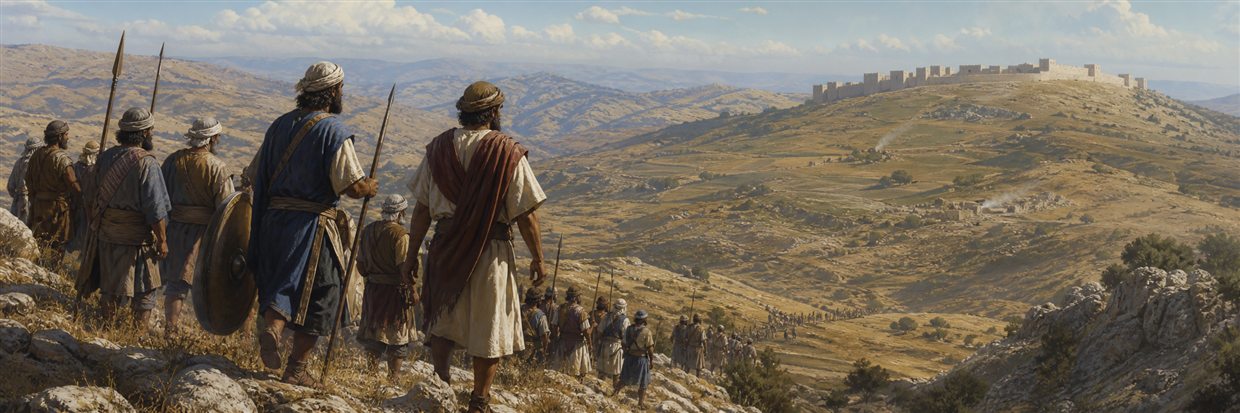
Prepared for BibleVerse · September 11, 2026. An initial editorial edition; independent specialist review is pending. Biblical references use the Berean Standard Bible. The illustration is interpretive artwork.