
The short summary
What is Epistle of Jeremiah about?
The Epistle of Jeremiah warns people facing exile in Babylon not to worship the images they will encounter there. Through repeated comparisons, it argues that objects made of wood, silver, and gold cannot protect themselves or help their worshipers. Its closing contrast commends the righteous person who has no idols.
Epistle of Jeremiah 1:1–7; Epistle of Jeremiah 1:64–73.01 / Understand the whole
The book in context
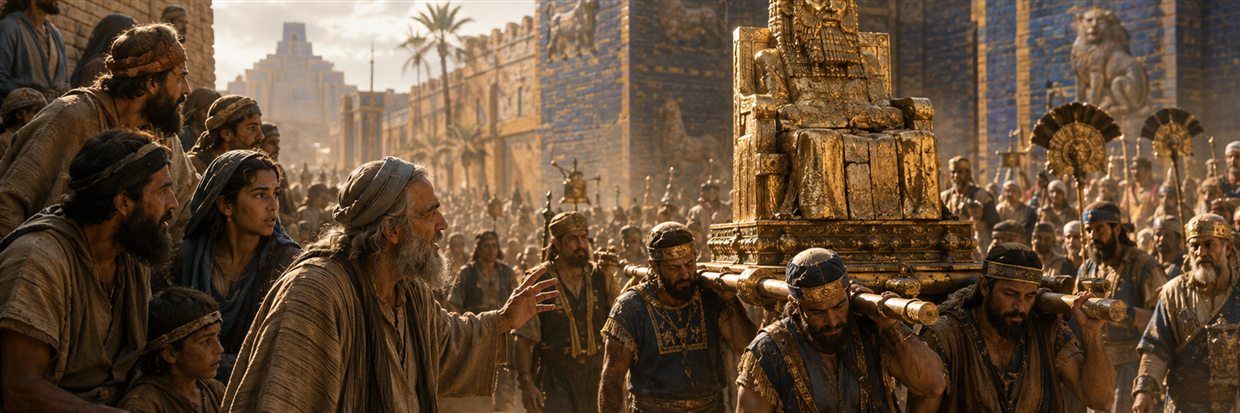
The work presents itself as a letter from Jeremiah to people about to be taken to Babylon. It anticipates their encounter with impressive religious images and urges them to remain faithful to the Lord rather than imitate the surrounding worship. Epistle of Jeremiah 1:1–7.
Most of the letter develops a sustained argument about the helplessness of manufactured gods. Their clothing, weapons, lamps, and costly materials give them an appearance of power, yet they cannot speak, move unaided, or rescue anyone. Repeated warnings invite the audience to draw the same conclusion. Epistle of Jeremiah 1:8–29.
The final comparisons set images beside the sun, moon, weather, animals, and a garden scarecrow. Creation performs its appointed tasks, whereas the images cannot judge or benefit people. The letter ends by praising an upright life free of idols. Epistle of Jeremiah 1:59–73.
02 / Follow the structure
A reading outline
A chapter-level reading guide; some literary movements cross these boundaries. Each link opens the section’s first chapter.
- 1:1–7A warning for the exilesThe opening identifies the imagined recipients and calls them to worship the Lord.
- 1:8–58Images without powerA sequence of examples challenges the apparent authority of manufactured gods.
- 1:59–73Creation and the closing contrastThe argument ends with comparisons and a commendation of the righteous.
03 / Notice the connections
Major themes
Faithfulness in exile
The audience is urged to retain its allegiance to the Lord amid unfamiliar public worship. Epistle of Jeremiah 1:1–7.
Appearance and ability
Expensive materials and elaborate decoration do not enable the images to speak, stand, or save. Epistle of Jeremiah 1:8–16; Epistle of Jeremiah 1:24–27.
Righteousness over display
The conclusion values the righteous person without idols above the objects whose prestige the letter has questioned. Epistle of Jeremiah 1:64–73.
04 / Background
Background at a glance
- Literary form
- Exhortation against idolatry
- Setting in the text
- An address to people facing exile in Babylon
More about the background
The USCCB introduction to Baruch identifies the Letter of Jeremiah as a work that circulated separately in major Greek manuscripts. Its attribution to Jeremiah is part of its literary presentation; it should not be confused with the letter to the exiles in Jeremiah 29. [1]
This overview uses the standalone, 73-verse Brenton text. The Catholic library includes the letter as Baruch 6, while the Orthodox library lists it separately. Verse numbering differs between editions; links here follow Brenton rather than silently applying Baruch’s numbering.
05 / Return to the text
Passages to explore
Passage links open the Brenton Septuagint Translation. These selections offer starting points for exploring the book.
Entering exile
What response to the surrounding worship does the opening ask for?
Epistle of Jeremiah 1:1–7 MemorizeCarried rather than carrying
How does dependence on human help develop the argument?
Epistle of Jeremiah 1:24–29 MemorizeThe final comparison
What distinguishes creation and the righteous person from the images?
Epistle of Jeremiah 1:59–73 MemorizeIs the Epistle of Jeremiah part of Baruch?
In the Catholic arrangement used on this site, it is Baruch 6. The Orthodox library presents it as a separate one-chapter work. This overview follows that standalone text, with Brenton verse references, while linking back to the appropriate library location. Epistle of Jeremiah 1:1; Epistle of Jeremiah 1:73.
Read Epistle of Jeremiah
Sources and reading notes
The summaries describe the biblical text; passage references let you check them in context. Historical and authorship notes are attributed separately. The outlines and passage selections are editorial reading aids.
- United States Conference of Catholic Bishops. Baruch: Introduction. New American Bible introduction; discussion of the Letter of Jeremiah. Catholic reference perspective. Accessed September 11, 2026. ↩
Prepared for BibleVerse · September 11, 2026. An initial editorial edition; independent specialist review is pending. Biblical references use the Brenton Septuagint Translation. The illustration is interpretive artwork.