
The short summary
What is 2 Maccabees about?
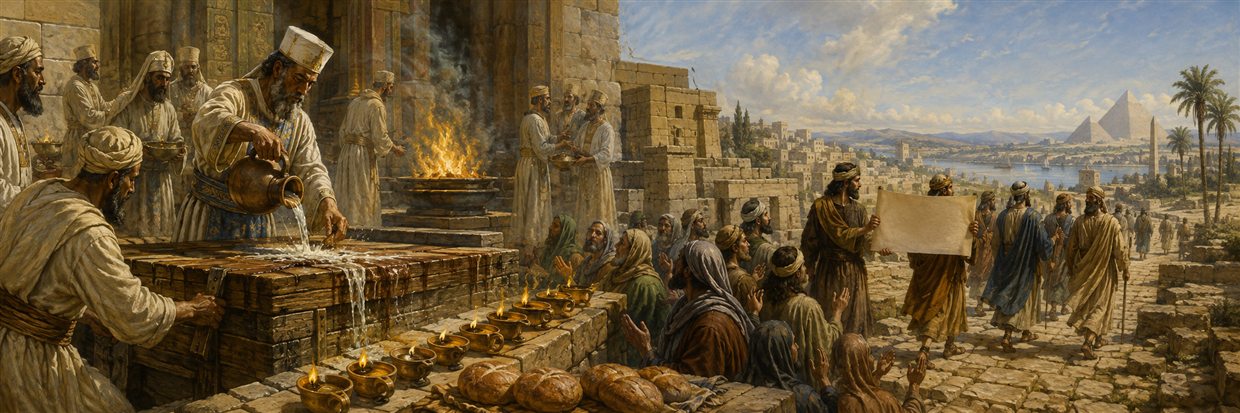
2 Maccabees recounts conflict over Jerusalem’s sanctuary and Jewish religious life, emphasizing divine help, faithful suffering, and hope of resurrection. It describes persecution, the deaths of martyrs, Judas Maccabaeus’ campaigns, and the temple’s rededication. The narrative ends with the defeat of Nicanor and the establishment of a commemorative day.
2 Maccabees 2:19–32; 2 Maccabees 6; 2 Maccabees 7; 2 Maccabees 10:1–8; 2 Maccabees 15:25–39.01 / Understand the whole
The book in context
Opening letters encourage the observance of the temple’s purification festival. A compiler then explains that the main narrative condenses Jason of Cyrene’s five-volume work. The story begins with a threat to the temple treasury and moves through struggles over the high priesthood, political ambition, and the violent intrusion of Seleucid power into Jerusalem. 2 Maccabees 1; 2 Maccabees 2; 2 Maccabees 3; 2 Maccabees 4; 2 Maccabees 5.
The persecution accounts focus on people who refuse to abandon the law, including Eleazar and a mother with seven sons. Their speeches express trust in God and hope of restored life beyond death. Judas and his supporters then gain victories, and the account of Antiochus’ death is followed by the cleansing of the temple and an eight-day celebration. 2 Maccabees 6; 2 Maccabees 7; 2 Maccabees 8; 2 Maccabees 9; 2 Maccabees 10:1–8.
Further campaigns and negotiations continue after the rededication. The writer connects prayer and sacrifice for fallen soldiers with belief in resurrection. The final conflict concerns Nicanor; Judas is encouraged by a dream, the enemy is defeated, and a festival is ordained. The compiler closes by reflecting on the craft of telling the story. 2 Maccabees 11; 2 Maccabees 12:39–45; 2 Maccabees 13; 2 Maccabees 14; 2 Maccabees 15.
02 / Follow the structure
A reading outline
A chapter-level reading guide; some literary movements cross these boundaries. Each link opens the section’s first chapter.
- 1–2Letters and the compiler’s purposeFestival invitations and an explanation of the abridged history.
- 3–5The sanctuary under threatTemple protection, rival leaders, and violence in Jerusalem.
- 6–7Faithfulness under persecutionEleazar, the seven brothers, and their mother.
- 8–10Victories and rededicationJudas’ campaigns, Antiochus’ death, and restoration of worship.
- 11–13Continued conflict and hopeNegotiations, campaigns, prayer for the dead, and renewed pressure.
- 14–15Nicanor’s defeatThreats to the sanctuary, Judas’ dream, victory, and the closing reflection.
03 / Notice the connections
Major themes
The sanctuary and the people
The temple stands at the center of threats, restoration, and remembrance. The narrative connects renewed worship with the people’s relationship to God. 2 Maccabees 3; 2 Maccabees 10:1–8; 2 Maccabees 15:1–5.
Resurrection and faithful endurance
The martyrs’ speeches look beyond the violence inflicted on their bodies. The book explicitly presents resurrection as a ground of hope. 2 Maccabees 7:9–14; 2 Maccabees 7:20–29.
Prayer amid responsibility
The account of fallen soldiers holds together acknowledgment of wrongdoing, prayer, and sacrifice. The writer explains these actions through an expectation of resurrection. 2 Maccabees 12:39–45.
04 / Background
Background at a glance
- Literary form
- Abridged historical narrative with letters and theological reflection
- Setting in the text
- Judea under Seleucid rule, centered on Jerusalem and Judas Maccabaeus
More about the background
The USCCB introduction to 1 Maccabees explains that the two Maccabean books are independent accounts with overlapping events. This distinction matters when reading their different emphases and endings. The compiler of 2 Maccabees gives a separate account of the work’s literary basis in the preface, identifying it as an abridgment of Jason of Cyrene. [1]
The compiler names Jason of Cyrene’s five books as the work being condensed and describes the aim of producing a readable, memorable account. The ending stops after Nicanor’s defeat. This is not a continuation after Simon’s death at the end of 1 Maccabees; it returns to events centered on Judas. 2 Maccabees 2:19–32; 2 Maccabees 15:36–39.
05 / Return to the text
Passages to explore
Passage links open the World English Bible, Catholic Edition. These selections offer starting points for exploring the book.
The compiler explains the work
Read the account of selection and abridgment before approaching the narrative.
2 Maccabees 2:19–32 MemorizeHope beyond death
Notice what the brothers’ speeches claim about God’s power to restore life.
2 Maccabees 7:9–14 MemorizeThe sanctuary restored
Follow the connections among cleansing, prayer, celebration, and annual remembrance.
2 Maccabees 10:1–8 MemorizeWhy does 2 Maccabees describe prayer for the dead?
After a battle, forbidden objects are found with fallen soldiers. Judas and his companions pray about the sin, and Judas sends a collection for a sacrifice. The narrator explicitly praises the action in connection with the hope that the dead will rise. The explanation belongs to the book’s own account of resurrection and responsibility. 2 Maccabees 12:39–45.
Read 2 Maccabees
Sources and reading notes
The summaries describe the biblical text; passage references let you check them in context. Historical and authorship notes are attributed separately. The outlines and passage selections are editorial reading aids.
- United States Conference of Catholic Bishops. The First Book of Maccabees. New American Bible introduction; opening comparison of the two books; used here for their relationship, not as the primary text of 2 Maccabees. Catholic reference perspective. Accessed September 11, 2026. ↩
Prepared for BibleVerse · September 11, 2026. An initial editorial edition; independent specialist review is pending. Biblical references use the World English Bible, Catholic Edition. The illustration is interpretive artwork.