The short summary
What is 2 Esdras about?
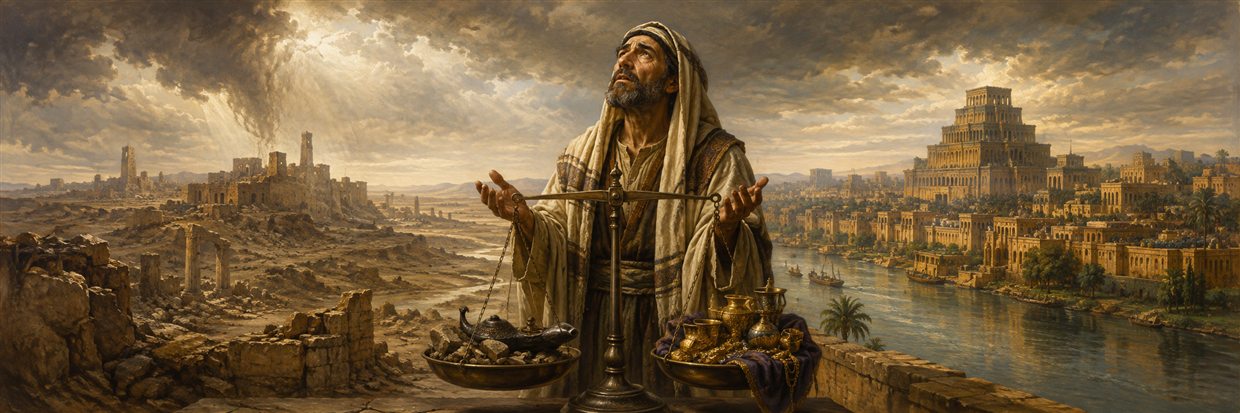
2 Esdras explores judgment, suffering, and hope through revelations associated with Ezra. Its central chapters follow his questions about Jerusalem’s ruin, human wrongdoing, and God’s justice. Angelic answers and symbolic visions lead toward judgment, restoration, and the preservation of sacred writings. Opening and closing sections add warnings, promises, and calls to endurance.
2 Esdras 3:1–12; 2 Esdras 4:1–11; 2 Esdras 10:40–50; 2 Esdras 14:19–26; 2 Esdras 16:73–78.01 / Understand the whole
The book in context
The opening chapters present rebuke, promises to a new people, practical commands to care for the vulnerable, and a vision of a crowned multitude. These chapters form a distinct introduction to the extended questions and revelations that begin with Ezra grieving in Babylon. 2 Esdras 1:24–37; 2 Esdras 2:15–23; 2 Esdras 2:42–48; 2 Esdras 3:1–3.
Ezra asks why Israel suffers while wrongdoing flourishes, and Uriel answers with comparisons, signs, and teaching about judgment. A grieving woman is revealed as Zion. Later visions portray an eagle challenged by a lion and a man from the sea overcoming hostile forces. The interpretations connect these images with oppressive rule, deliverance, and the coming judgment. 2 Esdras 3:28–36; 2 Esdras 4:1–11; 2 Esdras 10:40–50; 2 Esdras 12:10–13; 2 Esdras 12:31–34; 2 Esdras 13:25–38.
Ezra is then commissioned to restore writings with the help of five scribes. Some writings are to be made public and others reserved for the wise. The final two chapters announce calamities and call for endurance, warning against sin while assuring the faithful of God’s guidance through trouble. 2 Esdras 14:19–26; 2 Esdras 14:37–48; 2 Esdras 15:1–8; 2 Esdras 16:73–78.
02 / Follow the structure
A reading outline
A chapter-level reading guide; some literary movements cross these boundaries. Each link opens the section’s first chapter.
- 1–2Rebuke and a promised peopleAn introductory revelation combines warning, ethical instruction, and hope.
- 3–9Ezra’s questions and the angel’s answersDialogues consider human sin, Israel’s suffering, and the world to come.
- 9–10The grieving woman and ZionA lament becomes a revelation of Jerusalem.
- 11–13Visions of power and deliveranceThe eagle, the lion, and the man from the sea receive interpretations.
- 14Writings restoredEzra and five scribes preserve teachings for different audiences.
- 15–16Warnings and enduranceConcluding oracles announce distress and summon the faithful to persevere.
03 / Notice the connections
Major themes
Questions about justice
Ezra gives sustained voice to grief and moral perplexity, while the answers repeatedly challenge the limits of his understanding. 2 Esdras 3:28–36; 2 Esdras 4:1–11.
Grief and the hope of restoration
The vision of the woman transforms personal bereavement into an image of Zion’s suffering and revealed glory. 2 Esdras 10:40–50.
Revelation entrusted to readers
The commission to write distinguishes public instruction from teachings reserved for the wise. 2 Esdras 14:19–26; 2 Esdras 14:37–48.
04 / Background
Background at a glance
- Literary form
- Apocalyptic dialogues, visions, and exhortations
- Setting in the text
- Ezra’s narrated exile in Babylon and visions of judgment
More about the background
The United Bible Societies introduction distinguishes a Jewish core in chapters 3–14, often called 4 Ezra, from later Christian material in chapters 1–2 and 15–16. It also explains the shorter and longer numbering systems for chapter 7. These distinctions prevent the sixteen-chapter collection from being treated as a single work by the historical Ezra. [1]
This overview uses the local King James Apocrypha edition: sixteen chapters, with the shorter 70-verse chapter 7. All links follow that numbering. Its wording and book total in chapter 14 also differ from many modern editions. The library places this apocalypse on its Slavonic shelf; it is distinct from the Ezra entry labeled 2 Esdras elsewhere in the Orthodox collection.
05 / Return to the text
Passages to explore
Passage links open the King James Version with Apocrypha. These selections offer starting points for exploring the book.
The question after Jerusalem’s fall
What contrast troubles Ezra, and what does he ask God to consider?
2 Esdras 3:28–36 MemorizeA woman revealed as Zion
How does the interpretation recast the grief Ezra has witnessed?
2 Esdras 10:40–50 MemorizeInstruction for future readers
Why does Ezra ask for the writings to be restored?
2 Esdras 14:19–26 MemorizeIs 2 Esdras a continuation of 1 Esdras?
No. This sixteen-chapter work contains apocalyptic questions, visions, and warnings associated with Ezra. It is distinct from the return-and-rebuilding narrative of 1 Esdras and from the Ezra text also called 2 Esdras in the Greek naming system. 2 Esdras 3:1–3; 2 Esdras 11:1; 2 Esdras 14:19–26.
Read 2 Esdras
Sources and reading notes
The summaries describe the biblical text; passage references let you check them in context. Historical and authorship notes are attributed separately. The outlines and passage selections are editorial reading aids.
- United Bible Societies, hosted by TIPs. Translation introduction to 2 Esdras. Translation handbook introduction; “Name of the book” and “The textual history of the book”. Bible translation reference perspective. Accessed September 11, 2026. ↩
Prepared for BibleVerse · September 11, 2026. An initial editorial edition; independent specialist review is pending. Biblical references use the King James Version with Apocrypha. The illustration is interpretive artwork.