
The short summary
What is 1 Thessalonians about?
In 1 Thessalonians, Paul, Silvanus, and Timothy encourage a community whose faith and love endure amid affliction. Paul recalls the missionaries’ care and welcomes Timothy’s reassuring report. Instructions about holiness, mutual love, work, and life together lead into hope for believers who have died and a call to remain watchful while awaiting the Lord.
1 Thessalonians 1:1–10; 1 Thessalonians 2:1–12; 1 Thessalonians 3:6–13; 1 Thessalonians 4:1–18; 1 Thessalonians 5:1–15.01 / Understand the whole
The book in context
The opening thanksgiving remembers the Thessalonians’ faith, love, and hope, and describes their reception of the message amid suffering. Paul recalls the missionaries’ conduct: they sought neither flattery nor financial gain, worked to avoid burdening others, and cared for the community with familial affection. The relationship is presented as shared life as well as proclamation. 1 Thessalonians 1:1–10; 1 Thessalonians 2:1–12.
Separation has intensified the desire to see the Thessalonians again. Timothy is sent to strengthen them, and his return with news of their faith and love brings comfort. Prayer for growing love leads into instruction about sexual holiness, respect for others, brotherly love, and a quiet, responsible life supported by work. 1 Thessalonians 2:17–20; 1 Thessalonians 3:1–13; 1 Thessalonians 4:1–12.
The letter addresses concern about believers who have died, grounding hope in Jesus’ death and resurrection. The dead in Christ are included in the promised gathering with the Lord. A warning that the day comes unexpectedly leads to encouragement toward alertness, faith, love, and hope. Closing instructions call for patience, help for the weak, prayer, gratitude, and discernment. 1 Thessalonians 4:13–18; 1 Thessalonians 5:1–28.
02 / Follow the structure
A reading outline
A chapter-level reading guide; some literary movements cross these boundaries. Each link opens the section’s first chapter.
- 1–3Thanksgiving and continuing careThe missionaries recall their ministry, separation, and encouragement through Timothy’s report.
- 4Holiness, love, and hope for the deadDaily conduct and reassurance about deceased believers receive attention.
- 5Watchfulness and shared lifeExpectation of the Lord shapes encouragement, patience, prayer, and discernment.
03 / Notice the connections
Major themes
Faith sustained through relationship
Affliction does not end the community’s faith or the missionaries’ concern. Timothy’s report and continued prayer express their mutual dependence. 1 Thessalonians 3:1–13.
Hope that accompanies grief
The promise about those who have died is offered to encourage the living. It gives grief a horizon of hope rather than demanding the absence of sorrow. 1 Thessalonians 4:13–18.
Readiness in daily care
Watchfulness is joined to building others up, helping the weak, and refusing retaliation. Expectation is expressed in conduct toward neighbors. 1 Thessalonians 5:1–15.
04 / Background
Background at a glance
- Literary form
- Apostolic letter of encouragement and instruction
- Setting in the text
- The church in Thessalonica after Timothy’s visit
More about the background
The USCCB introduction connects the letter with Timothy’s return to Paul after visiting Thessalonica and places the correspondence in the early missionary period in Greece. It distinguishes the first section’s thanksgiving and explanation of the missionaries’ conduct from the later practical exhortations. [1]
The greeting names Paul, Silvanus, and Timothy. The report of Timothy’s return gives a direct textual reason for the letter’s encouragement. Its teaching about the coming of the Lord answers concern about deceased believers and urges readiness; it supplies no calendar date for that coming. 1 Thessalonians 1:1; 1 Thessalonians 3:6–8; 1 Thessalonians 4:13–18; 1 Thessalonians 5:1–11.
05 / Return to the text
Passages to explore
Passage links open the Berean Standard Bible. These selections offer starting points for exploring the book.
The character of the mission
Notice the relationship between the message, the missionaries’ motives, and their conduct.
1 Thessalonians 2:1–12 MemorizeEncouragement for grieving believers
Read the future hope in relation to the opening concern about those who have died.
1 Thessalonians 4:13–18 MemorizeA community’s daily practices
Follow the short appeals about patience, prayer, gratitude, and discernment.
1 Thessalonians 5:12–24 MemorizeWhat concern does 1 Thessalonians 4:13–18 address?
The passage concerns believers who have died before the Lord’s coming. It reassures the community that the dead in Christ will not be left behind and grounds that hope in Jesus’ death and resurrection. Its stated purpose is mutual encouragement. 1 Thessalonians 4:13–18.
Read 1 Thessalonians
Sources and reading notes
The summaries describe the biblical text; passage references let you check them in context. Historical and authorship notes are attributed separately. The outlines and passage selections are editorial reading aids.
- United States Conference of Catholic Bishops. The First Letter to the Thessalonians. New American Bible introduction; opening account of Timothy’s return and the following discussion of the letter’s two parts. Catholic reference perspective. Accessed September 11, 2026. ↩
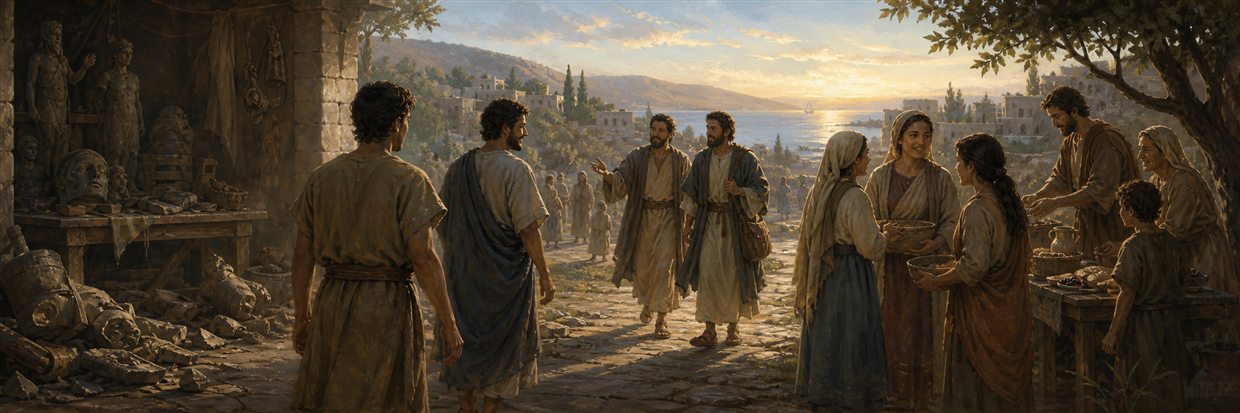
Prepared for BibleVerse · September 11, 2026. An initial editorial edition; independent specialist review is pending. Biblical references use the Berean Standard Bible. The illustration is interpretive artwork.