The short summary
What is 1 Esdras about?
1 Esdras recounts Josiah’s Passover, Jerusalem’s fall, and the return of exiles to rebuild the temple. A debate among three royal guards places Zerubbabel’s praise of truth at the center of the restoration story. The later chapters follow Ezra’s journey, a crisis over marriages, and the public reading and explanation of the law.
1 Esdras 1:1–22; 1 Esdras 1:53–58; 1 Esdras 4:33–47; 1 Esdras 9:37–55.01 / Understand the whole
The book in context
The opening moves from Josiah’s celebration of Passover to the collapse of Judah and the destruction of Jerusalem. Royal decrees then frame the possibility of return and the opposition to rebuilding. The narrative arranges these episodes in its own sequence rather than a continuous chronological order. 1 Esdras 1:1–22; 1 Esdras 1:53–58; 1 Esdras 2:1–15; 1 Esdras 2:16–30.
At Darius’s court, three guards debate the strength of wine, kings, women, and truth. Zerubbabel wins with his praise of truth and asks for the restoration of Jerusalem. The return, renewed worship, opposition, and royal authorization lead to the completion and dedication of the temple. 1 Esdras 3:4–17; 1 Esdras 4:33–47; 1 Esdras 5:1–6; 1 Esdras 7:1–15.
Ezra arrives with royal support and teaches the law. Reports of marriages with neighboring peoples prompt confession and a decision to separate wives and children from the community. The book’s final scene turns to public reading, explanation, and celebration of the law, including sharing food with those who have none. 1 Esdras 8:1–10; 1 Esdras 8:68–96; 1 Esdras 9:7–13; 1 Esdras 9:37–55.
02 / Follow the structure
A reading outline
A chapter-level reading guide; some literary movements cross these boundaries. Each link opens the section’s first chapter.
- 1–2From Passover to exile and returnJudah falls, and royal decrees introduce restoration and resistance.
- 3–4The debate before DariusZerubbabel’s argument about truth leads to a request for Jerusalem.
- 5–7Rebuilding the templeReturning families restore worship amid opposition, and the temple is dedicated.
- 8–9Ezra and the gathered communityA journey, confession, marriage proceedings, and public instruction conclude the surviving account.
03 / Notice the connections
Major themes
Truth above power
The winning speech contrasts truth’s enduring justice with the unstable power of rulers, appetite, and human influence. 1 Esdras 4:33–41.
Restoring communal worship
Passover, offerings, temple service, and dedication repeatedly mark the people’s life together. 1 Esdras 1:1–22; 1 Esdras 7:1–15.
Hearing and understanding
The final scene emphasizes attentive listening, explanation by the Levites, and a response that combines joy with provision for others. 1 Esdras 9:39–55.
04 / Background
Background at a glance
- Literary form
- Historical narrative with a court debate
- Setting in the text
- Judah and the Persian court, from Josiah to Ezra
More about the background
The United Bible Societies introduction explains that 1 Esdras shares much material with Chronicles, Ezra, and Nehemiah, while the guards’ debate has no parallel there. It describes the relationship between these works as debated and cautions against rearranging 1 Esdras to match their chronology. This guide preserves its narrative order. [1]
This nine-chapter overview uses the Orthodox library’s Brenton edition. Esdras is the Greek form of Ezra’s name, but this book is distinct from the reader’s Ezra and from the apocalyptic work called 2 Esdras. The separation of families is reported as part of the narrative’s response to its crisis, not offered here as advice for families today.
05 / Return to the text
Passages to explore
Passage links open the Brenton Septuagint Translation. These selections offer starting points for exploring the book.
Truth and the request for Jerusalem
How does the winning speech lead to a request that benefits the community?
1 Esdras 4:33–47 MemorizeA completed sanctuary
What forms of worship mark the completion of the building?
1 Esdras 7:1–15 MemorizeUnderstanding together
How do teaching, celebration, and sharing food belong together in this scene?
1 Esdras 9:39–55 MemorizeIs 1 Esdras the same book as Ezra?
No. The books overlap substantially, but 1 Esdras has its own arrangement and includes the debate of the three guards before Darius. This site presents it as a separate nine-chapter work in the Orthodox library, alongside a distinct Ezra overview. 1 Esdras 3:4–17; 1 Esdras 4:33–47.
Read 1 Esdras
Sources and reading notes
The summaries describe the biblical text; passage references let you check them in context. Historical and authorship notes are attributed separately. The outlines and passage selections are editorial reading aids.
- United Bible Societies, hosted by TIPs. Translation introduction to 1 Esdras. Translation handbook introduction; “Relationship to other books” and “Problems in translating 1 Esdras”. Bible translation reference perspective. Accessed September 11, 2026. ↩
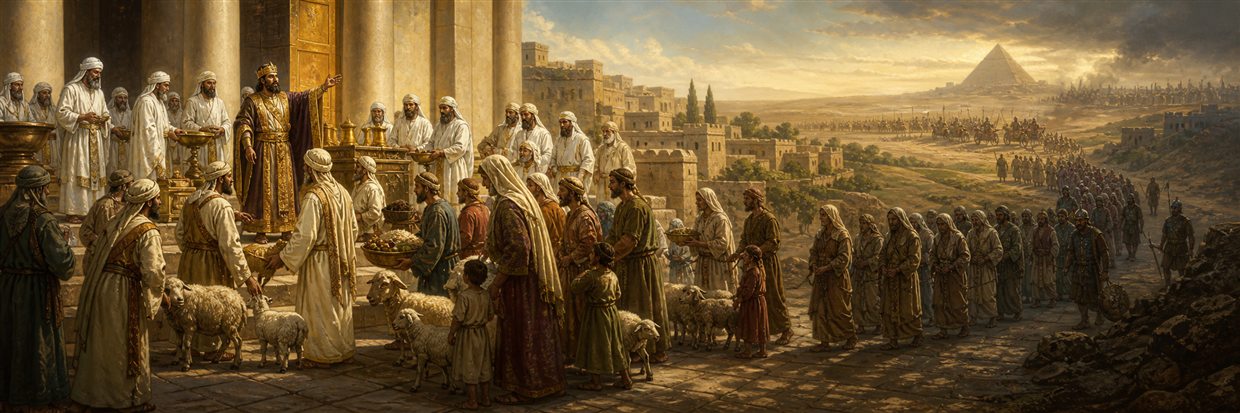
Prepared for BibleVerse · September 11, 2026. An initial editorial edition; independent specialist review is pending. Biblical references use the Brenton Septuagint Translation. The illustration is interpretive artwork.