
The short summary
What is Obadiah about?
Obadiah announces judgment against Edom for pride and violence toward its brother Jacob. It condemns standing aside, gloating, looting, and intercepting survivors during Jerusalem’s disaster. The oracle broadens to the day of the LORD for all nations, then promises deliverance on Mount Zion and restored possession for Jacob. Its final declaration places the kingdom under the LORD.
Obadiah 1:1–4; Obadiah 1:10–15; Obadiah 1:17–21.01 / Understand the whole
The book in context
The vision opens with a summons against Edom. Its confidence in high places and apparent security is exposed as deceptive. Images of thieves and grape gatherers emphasize the completeness of the threatened loss, while trusted allies prove unreliable. Neither wisdom nor warriors will prevent judgment. Obadiah 1:1–9.
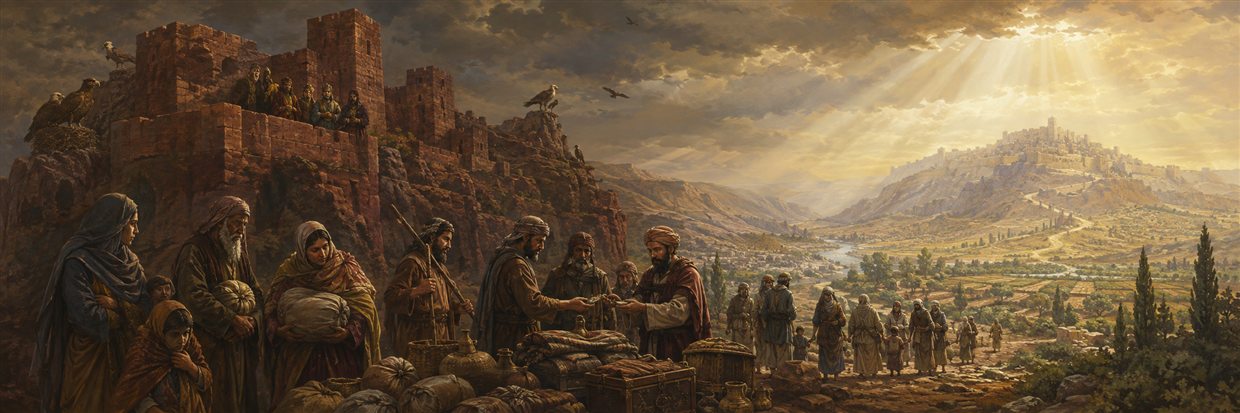
The central accusation names violence against Jacob and describes Edom’s behavior when foreigners entered Jerusalem. The sequence moves from standing aloof and rejoicing over disaster to looting and cutting off fugitives. The language presents betrayal of a related people, not simply a contest between neighboring powers. Obadiah 1:10–14.
The day of the LORD expands the scope to all nations and introduces the principle that deeds return upon those who commit them. Deliverance and holiness are promised on Mount Zion. The ending names recovered territories and returning exiles, while also using severe imagery for Edom’s destruction. The final statement assigns sovereignty to the LORD. Obadiah 1:15–21.
02 / Follow the structure
A reading outline
A chapter-level reading guide; some literary movements cross these boundaries. Each link opens the section’s first chapter.
- 1:1–9Edom’s security overturnedPride, alliances, wisdom, and strength are exposed as inadequate.
- 1:10–14Betrayal during Jerusalem’s disasterThe oracle condemns violence, gloating, plunder, and interference with survivors.
- 1:15–21Judgment and restorationThe day of the LORD leads into deliverance, recovered land, and divine kingship.
03 / Notice the connections
Major themes
Pride and false security
Edom’s elevated dwelling becomes an image of confidence that cannot withstand judgment. Obadiah 1:3–4.
Responsibility toward the vulnerable
The accusations include both participation in violence and taking advantage of others’ catastrophe. Obadiah 1:10–14.
Accountability and sovereignty
The announcement to all nations connects conduct with consequences and closes with the LORD’s kingdom. Obadiah 1:15; Obadiah 1:21.
04 / Background
Background at a glance
- Literary form
- Prophetic oracle
- Setting in the text
- Edom’s conduct during Jerusalem’s disaster
More about the background
The USCCB introduction associates the oracle with the aftermath of Babylon’s destruction of Jerusalem and notes that little is known about its author. It also identifies similarities with an oracle against Edom in Jeremiah. The historical connection is an attributed assessment; this overview does not assign a precise composition date. [1]
The title calls the work Obadiah’s vision but gives no genealogy or reigning king. Jerusalem, Edom, Jacob, and the treatment of fugitives provide the text’s central setting. They do not establish a detailed biography of the prophet. Obadiah 1:1; Obadiah 1:10–14.
05 / Return to the text
Passages to explore
Passage links open the Berean Standard Bible. These selections offer starting points for exploring the book.
The collapse of false security
Notice how the oracle challenges geographical advantage, alliances, and strength.
Obadiah 1:1–9 MemorizeThe charges against Edom
Follow the progression from standing aside to actively harming survivors.
Obadiah 1:10–14 MemorizeThe day of the LORD and the kingdom
Read the severe judgment imagery together with the promises concerning Zion.
Obadiah 1:15–21 MemorizeWhy does Obadiah have only one chapter?
The received book is a brief oracle of twenty-one verses in the BSB. Its outline therefore uses verse ranges within that single chapter, moving from Edom’s fall to its betrayal of Judah and the concluding vision of restoration. Obadiah 1:1–4; Obadiah 1:10–15; Obadiah 1:17–21.
Read Obadiah
Sources and reading notes
The summaries describe the biblical text; passage references let you check them in context. Historical and authorship notes are attributed separately. The outlines and passage selections are editorial reading aids.
- United States Conference of Catholic Bishops. The Book of Obadiah. New American Bible introduction; Opening discussion of authorship and historical setting; comparison with Jeremiah’s oracle against Edom. Catholic reference perspective. Accessed September 11, 2026. ↩
Prepared for BibleVerse · September 11, 2026. An initial editorial edition; independent specialist review is pending. Biblical references use the Berean Standard Bible. The illustration is interpretive artwork.