
The short summary
What is Habakkuk about?
Habakkuk asks why God allows violence and distorted justice. When the answer announces the rise of the Chaldeans, the prophet questions their cruelty too. The book moves through dialogue, a call to await God’s answer, and denunciations of oppressive power. It closes with a prayer that expresses trust even when crops and herds fail.
Habakkuk 1:2–6; Habakkuk 1:12–17; Habakkuk 2:1–8; Habakkuk 3:17–19.01 / Understand the whole
The book in context
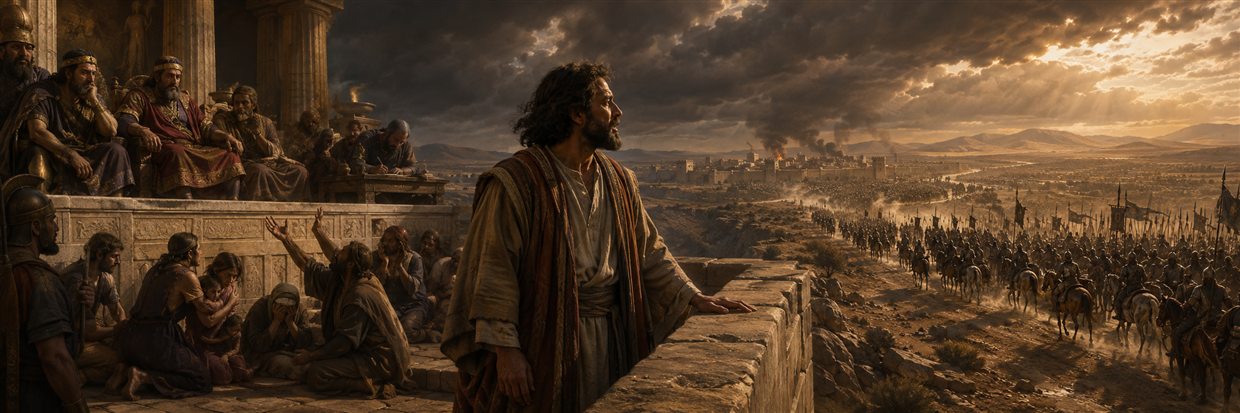
Habakkuk begins by bringing unresolved violence and injustice before the Lord. The divine response announces the rise of the Chaldeans, described as a ruthless conquering people. This answer deepens the prophet’s question: how can a holy God remain silent while the wicked swallow those more righteous than themselves? The chapter preserves the difficulty rather than dismissing it. Habakkuk 1:2–17.
The prophet takes his place to await an answer. He is told to record the vision and wait for its appointed fulfillment; the proud are contrasted with the righteous who live by faith. A series of woes then condemns plunder, unjust gain, bloodshed, humiliation, and lifeless idols. Conquest does not exempt the conqueror from accountability. Habakkuk 2:1–20.
The final chapter is identified as a prayer. Habakkuk asks God to remember mercy and pictures divine power moving through creation to save his people. Fear is still present as the prophet waits for trouble. Yet the ending imagines the loss of crops and livestock and declares joy in God as the source of salvation and strength. Habakkuk 3:1–2; Habakkuk 3:3–16; Habakkuk 3:17–19.
02 / Follow the structure
A reading outline
A chapter-level reading guide; some literary movements cross these boundaries. Each link opens the section’s first chapter.
- 1The prophet’s questionsViolence provokes a complaint; the announced Chaldean advance raises another.
- 2Waiting and accountabilityThe written vision calls for faith, followed by woes against exploitation and idolatry.
- 3A prayer amid uncertaintyA vision of God’s saving power ends with trust despite material loss.
03 / Notice the connections
Major themes
Questions within faith
Habakkuk directs his protest to God, asking about both injustice and the violence of those announced as agents of judgment. Habakkuk 1:2–4; Habakkuk 1:12–17.
Oppression cannot secure the future
The woes expose wealth and security built through plunder and bloodshed. Those who exploited others face the reversal of their power. Habakkuk 2:6–12.
Trust amid loss
The closing song expresses joy while imagining failed harvests and empty stalls. Its confidence rests in God rather than a claim that hardship has disappeared. Habakkuk 3:16–19.
04 / Background
Background at a glance
- Literary form
- Prophetic dialogue and prayer
- Setting in the text
- Violence and the rise of the Chaldeans
More about the background
The USCCB introduction presents Habakkuk as a sustained dialogue about divine justice. It situates the prophecy amid Babylonian pressure on Judah between the battle of Carchemish in 605 BCE and Jerusalem’s destruction in 587 BCE, and notes scholarly uncertainty about the compositional relationship of chapter 3 to the preceding speeches. [1]
The first verse names Habakkuk as a prophet but provides no royal reign or detailed biography. The Chaldeans appear in the first divine response. Chapter 3 names Habakkuk again in its prayer heading and closes with a musical direction, distinguishing its form from the earlier dialogue. Habakkuk 1:1; Habakkuk 1:6; Habakkuk 3:1; Habakkuk 3:19.
05 / Return to the text
Passages to explore
Passage links open the Berean Standard Bible. These selections offer starting points for exploring the book.
Two difficult questions
Read the first complaint, the response about the Chaldeans, and the prophet’s renewed protest.
Habakkuk 1:2–17 MemorizeWaiting for the vision
Keep the contrast between pride and faith within the call to await fulfillment.
Habakkuk 2:1–4 MemorizeJoy without an easy outcome
Notice that trembling and possible deprivation remain part of the closing confession.
Habakkuk 3:16–19 MemorizeWhat is the context of Habakkuk 2:4?
The verse belongs to God’s answer after Habakkuk questions the conqueror’s violence. The prophet is told to write the vision and wait for its fulfillment. The contrast between pride and the righteous living by faith leads into warnings that plunder and oppression will be judged. Habakkuk 1:12–17; Habakkuk 2:1–8.
Read Habakkuk
Sources and reading notes
The summaries describe the biblical text; passage references let you check them in context. Historical and authorship notes are attributed separately. The outlines and passage selections are editorial reading aids.
- United States Conference of Catholic Bishops. The Book of Habakkuk. New American Bible introduction; the three introductory paragraphs before the outline. Catholic reference perspective. Accessed September 11, 2026. ↩
Prepared for BibleVerse · September 11, 2026. An initial editorial edition; independent specialist review is pending. Biblical references use the Berean Standard Bible. The illustration is interpretive artwork.