
The short summary
What is Susanna about?
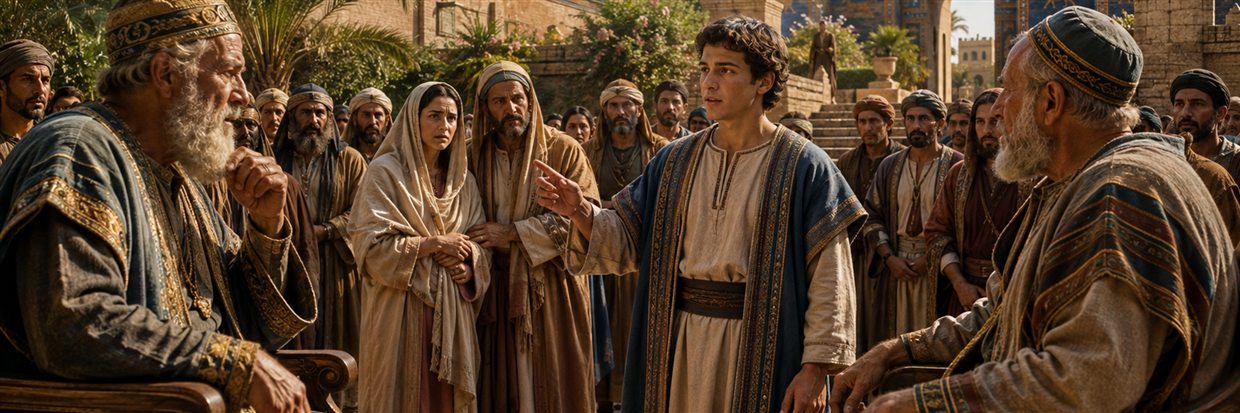
Susanna tells of a faithful woman threatened by two elders who demand sexual compliance and then falsely accuse her when she refuses. The assembly condemns her, but she appeals to God. Daniel challenges the verdict, questions the witnesses separately, and exposes their contradictory testimony. Susanna is vindicated, and her accusers receive judgment.
Susanna 1:19–23; Susanna 1:41–49; Susanna 1:51–64.01 / Understand the whole
The book in context
Susanna is introduced as a woman taught in the law, living with her husband in Babylon. Two elders who serve as judges watch her and plan to exploit their position. They threaten a false charge of adultery if she refuses their demands, and she chooses to resist. Susanna 1:1–6; Susanna 1:15–23.
The elders publicly accuse Susanna, and the assembly trusts them because of their standing. Facing death, she prays to the God who knows what is hidden. The narrative says God hears her, and Daniel intervenes to challenge a judgment reached without proper examination. Susanna 1:28–49.
Daniel separates the witnesses and asks each to identify the tree under which the alleged act occurred. Their answers conflict. The assembly recognizes the false accusation, the elders are punished, and Susanna’s family gives thanks for her deliverance. Susanna 1:51–64.
02 / Follow the structure
A reading outline
A chapter-level reading guide; some literary movements cross these boundaries. Each link opens the section’s first chapter.
03 / Notice the connections
Major themes
Integrity under coercion
Susanna’s refusal highlights her fidelity while the elders misuse the authority entrusted to them. Susanna 1:19–23.
Justice requires examination
Daniel challenges the assembly for condemning Susanna without examining the accusation, then tests the witnesses separately. Susanna 1:46–54; Susanna 1:58–62.
God hears the falsely accused
The account explicitly connects Susanna’s prayer with God’s response and her eventual vindication. Susanna 1:42–45; Susanna 1:60–64.
04 / Background
Background at a glance
- Literary form
- Narrative of accusation and vindication
- Setting in the text
- A Jewish household in Babylon
More about the background
The USCCB notes introduce Susanna among the stories preserved in Greek forms of Daniel but absent from the Hebrew-Aramaic text. Their discussion highlights the Greek wordplay connecting the witnesses’ tree names with their punishment. These literary features help explain how the questioning scene is told. [1]
The Catholic edition places Susanna in Daniel 13. This site’s Brenton edition prints it separately as one chapter of 64 verses, and that standalone numbering is used here. The Chapters & artwork link returns to Greek Daniel, where the related texts can be explored together.
05 / Return to the text
Passages to explore
Passage links open the Brenton Septuagint Translation. These selections offer starting points for exploring the book.
Resisting the threat
How do the elders try to turn their power into control over Susanna?
Susanna 1:19–23 MemorizeTesting the witnesses
How does separate questioning change the assembly’s understanding?
Susanna 1:51–64 MemorizeWhere does Susanna belong in Daniel?
In the Catholic edition on this site, Susanna is Daniel 13. The Brenton edition presents it as a separate one-chapter story. This overview links to that standalone text and returns readers to the Greek Daniel library page for the surrounding material. Susanna 1:1; Susanna 1:45–64.
Read Susanna
Sources and reading notes
The summaries describe the biblical text; passage references let you check them in context. Historical and authorship notes are attributed separately. The outlines and passage selections are editorial reading aids.
- United States Conference of Catholic Bishops. Daniel 13: Susanna. New American Bible chapter and notes; notes on 13:1–14:42 and 13:55–59. Catholic reference perspective. Accessed September 11, 2026. ↩
Prepared for BibleVerse · September 11, 2026. An initial editorial edition; independent specialist review is pending. Biblical references use the Brenton Septuagint Translation. The illustration is interpretive artwork.