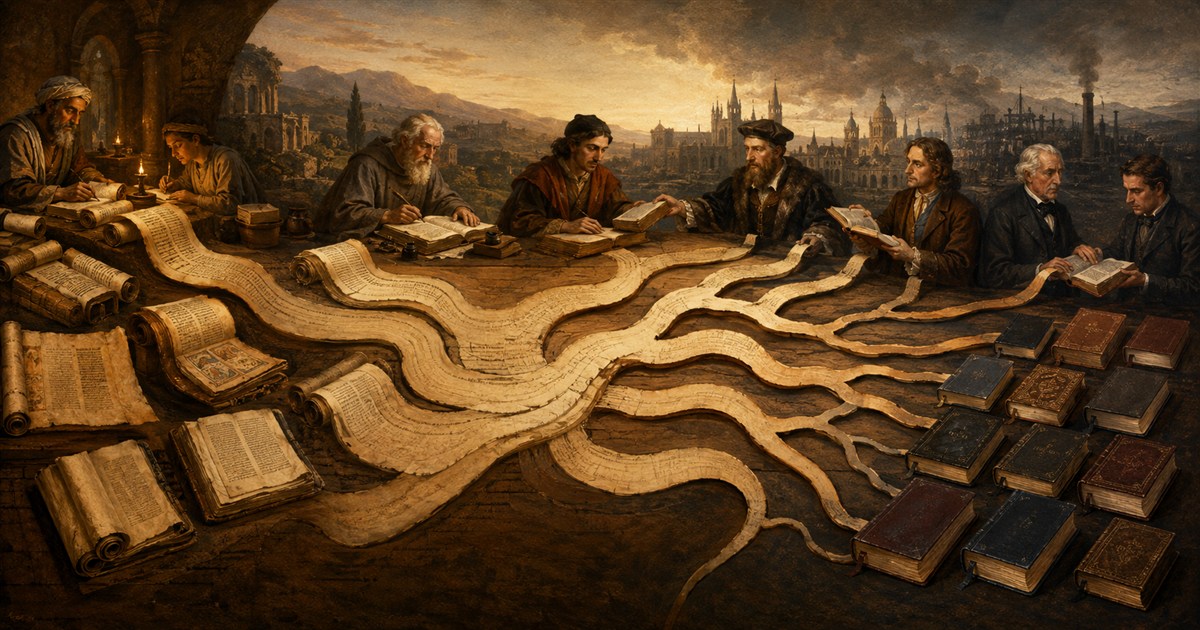
Explore the Bible translation family tree
Follow direct revisions and documented influences from early English Bibles to the JPS, NABRE, NRSVue, ESV, NIV and other modern editions.
There are thousands of translations and a few different book lists. Set them beside each other, though, and what stands out is how much is the same.
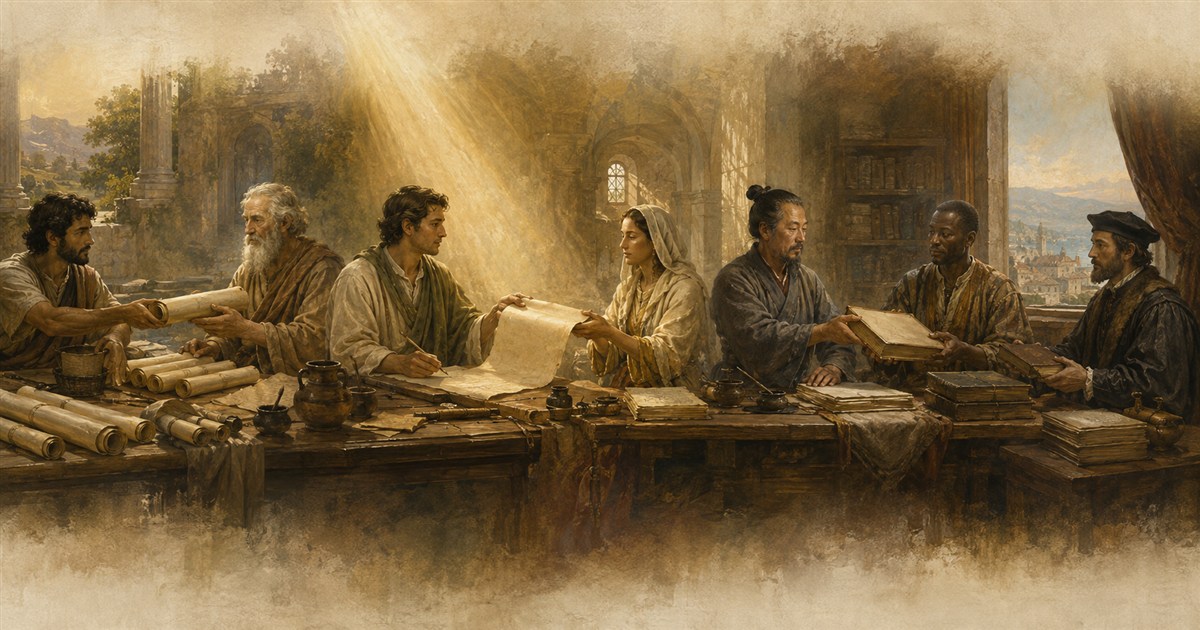
Across Jewish and Christian traditions, the largest part of the scriptural library is shared. The 24 books of the Jewish Tanakh correspond broadly to the same corpus divided into 39 books in Protestant Old Testaments. Catholic and Orthodox Bibles receive additional ancient Jewish writings, while arranging some shared material differently. Most Christian traditions also share the familiar 27-book New Testament; the Ethiopian Orthodox Tewahedo Church preserves a broader New Testament canon. The differences matter, but they sit within a much larger inheritance held in common.
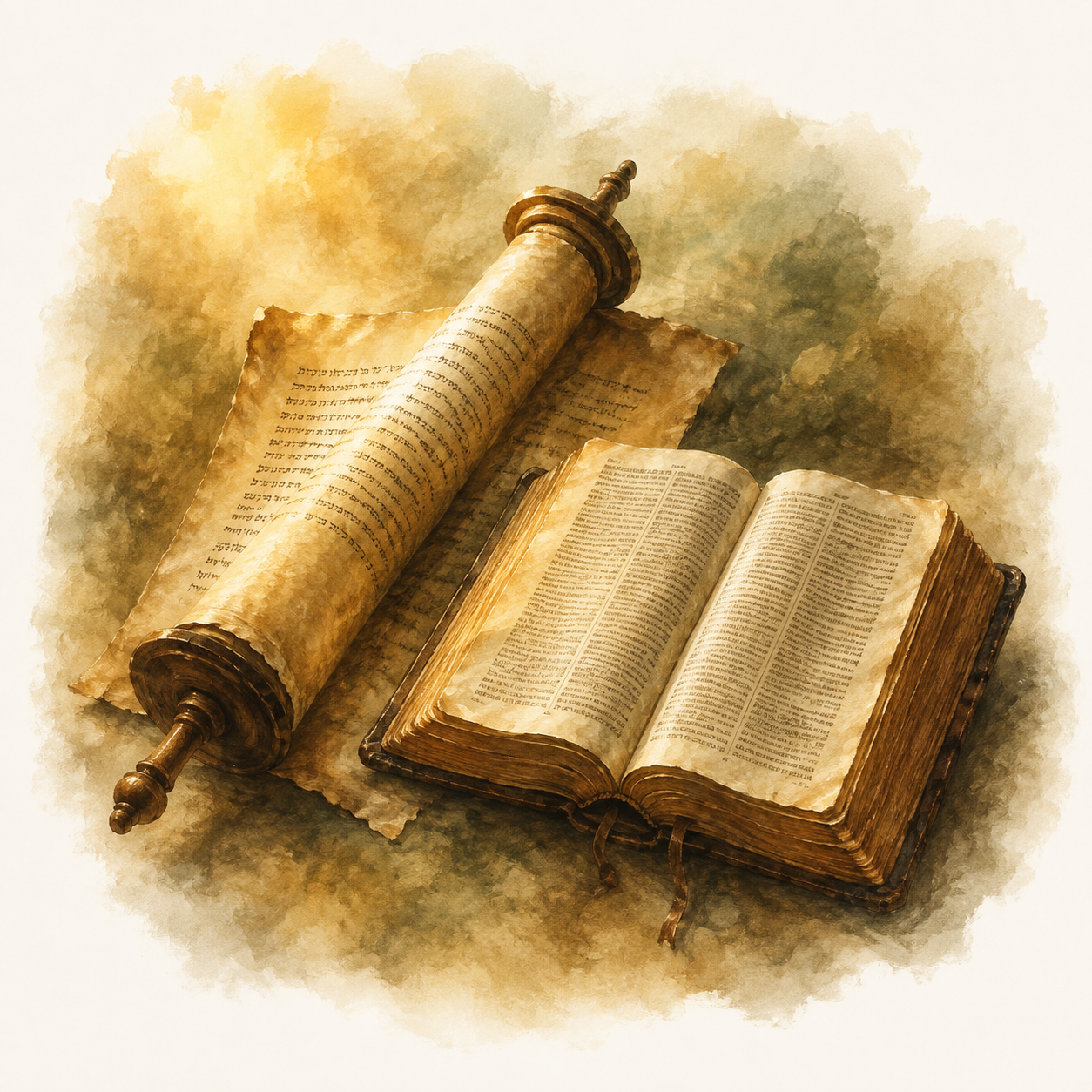
Each bar shows one broad family of canons. Matching dark segments represent shared scriptural corpora (not identical counting or ordering), and pale segments show books received in some Christian traditions beyond the Jewish canon.
Jewish tradition counts the same material as 24 books rather than 39, joining the twelve minor prophets into one and pairing books like 1 and 2 Samuel. Orthodox churches differ among themselves; the Ethiopian Orthodox Tewahedo canon is broader still, including additional books in both Testaments.
Catholic Bibles include seven books not in the Jewish or Protestant canon: Tobit, Judith, Wisdom of Solomon, Sirach, Baruch, 1 and 2 Maccabees, along with further passages in Esther and Daniel. Orthodox collections vary and also include works such as 3 Maccabees, 1 Esdras, the Prayer of Manasseh and Psalm 151. The King James Bible of 1611 also printed an Apocrypha section containing the Catholic deuterocanonical books and several additional works, though not every book found in Orthodox canons. Most later KJV printings left that section out, which is why many readers have never seen it.
Follow direct revisions and documented influences from early English Bibles to the JPS, NABRE, NRSVue, ESV, NIV and other modern editions.
Official policies, documented institutional use, reported practice and BibleVerse's editorial alternatives; and where those traditions came from, on one family tree.
The Tanakh's three parts, the Protestant, Catholic and Orthodox groupings, and the chapters of each book, with the same book traced across all four.
Languages do not stand still. The King James translators wrote for readers of 1611, in their English, not ours. Every generation that finds the old words growing dim has done the same thing: put the text back into the language people actually speak.
Older copies keep turning up. Codex Sinaiticus, a fourth-century manuscript, came to light in 1844. The Dead Sea Scrolls were found from 1947, carrying Hebrew texts a thousand years older than any then known. Many closely resemble the later Masoretic tradition, while others preserve variants, evidence of both remarkable continuity and real textual diversity. Translators who come later simply have more evidence to consider.
There is more than one way to be faithful. A translator can follow the form and wording closely, or give more priority to conveying meaning in natural contemporary language. Every approach involves interpretation and trade-offs; literalness alone does not establish accuracy. Comparing translations and their notes can help readers see where choices differ.
Most new versions are not rivals. Of the sixty-four editions on this site, most are not competing English Bibles at all. They serve readers in languages such as Hausa, Tamil, Vietnamese and Amharic. Counted that way, the growing number of versions is not chiefly a story about division. It is a story about communities hearing a shared inheritance in their own language.
Long before any modern translation, Jewish scholars began translating the Torah into Greek in third-century BC Alexandria. Other books followed over several centuries, and these Greek scriptures circulated with writings and additions beyond the later Jewish canon. Greek-speaking Christians made extensive use of them, while early Christian writers did not all draw the canonical boundary in exactly the same place. Jerome, translating and revising the Latin Bible around 400, distinguished books found in the Hebrew canon from several others that remained in Christian use. At the Reformation, Protestants followed the Jewish canon for the Old Testament; the Council of Trent in 1546 formally affirmed the Catholic canon. Eastern churches preserved their own related traditions. These histories explain real differences without erasing the scriptures all of them continued to share.
Among editions on this site that contain them, 59 of the commonly shared 66 books have exactly the same number of chapters, and 56 editions contain precisely 1,189 chapters. The handful of differences usually reflect old traditions of arrangement rather than different underlying stories.
| Book | Usually | Elsewhere | Why |
|---|---|---|---|
| Joel | 3 | 4 | Hebrew Bibles divide it into four |
| Malachi | 4 | 3 | Hebrew Bibles divide it into three |
| Psalms | 150 | 151 | The Septuagint carries one more psalm |
| Esther | 10 | 16 | The Greek additions printed as chapters |
| Daniel | 12 | 14 | Susanna and Bel printed as chapters |
| Ezra | 10 | 23 | The Septuagint joins Ezra and Nehemiah |
Everything else matches, book for book and chapter for chapter. One oddity on this site is not a tradition at all, and worth naming plainly: the digital text of the Korean Bible of 1910 is incomplete. Roughly a hundred verses are missing from the ends of chapters, and 1 Peter 5 is absent entirely. Those verses are in every printed Korean Bible, including that one. They were lost when the old printing was transcribed, and the publisher's own record shows it: 259 New Testament chapters where there should be 260. It is kept here because it is the only Korean edition currently available to this project under terms that allow redistribution, and it is labelled in the version list so nobody is caught out by it.
These are reference counts for the 66-book comparison set used here, not a universal canon or numbering system.
The familiar chapters spread through thirteenth-century Paris Bibles, and Robert Estienne's printed editions helped establish modern numbered verses in the sixteenth century. The system was adopted extraordinarily widely, though Hebrew, Greek, Catholic, Orthodox and Protestant editions sometimes number a passage, psalm or chapter differently.
Even with those exceptions, a reference such as John 3:16 usually brings readers using editions that contain the Gospel of John to the same passage. Tanakh-only editions do not contain the New Testament. The words may be translated differently and the surrounding book lists may vary, but the shared reference system makes it possible to read and learn together across those differences.
Languages change, translators make different choices about how closely to follow the form of the original, and manuscript discoveries give scholars more evidence to consider. Many versions also serve readers in different languages rather than competing with one another. Across those differences, translations draw from the same ancient scriptural traditions and share most of their contents.
They share far more than they differ, while counting and arranging some books differently. The 24-book Jewish Tanakh corresponds broadly to the same scriptural corpus divided into 39 books in Protestant Old Testaments. Catholic and Orthodox Old Testaments include additional deuterocanonical books, and Orthodox canons vary among churches. Most Christian traditions share the familiar 27-book New Testament; the Ethiopian Orthodox Tewahedo Church has a broader New Testament canon.
Almost entirely. Among the editions on this site that contain them, 59 of the commonly shared 66 books have the same chapter count. Of the editions here, 56 contain exactly 1,189 chapters. Differences include the division of Joel and Malachi in some Hebrew traditions, Psalm 151 in Septuagint traditions, and different arrangements of the Greek additions to Esther and Daniel. The familiar chapter system spread through thirteenth-century Paris Bibles, and the modern numbered-verse system through sixteenth-century printed Bibles, but some traditions number particular passages differently.
This site uses public-domain texts and editions distributed under publisher permissions or licences. The credited editions below have differing conditions; attribution alone does not describe every permission. Consult the listed terms before reusing a text.
Most are Creative Commons: the Biblica and Bridge Connectivity Solutions editions, the Free Bible Version, the Literal Standard Version, the Tagalog ULB and Bíblia Livre. A few carry their own terms: the NET Bible is used by the publisher's permission, and the Amharic by permission of the Bible Society of Ethiopia. Some editions have non-commercial or no-derivatives restrictions. Each licence above was read at its publisher's own record rather than assumed, and every copyright line is quoted as it was found there.