A guide to communities and their Bibles

Which Bible versions do different denominations use?

A sourced guide to translations authorized for worship, used in institutional publications or reported in congregational practice, with freely distributable alternatives available on this site.

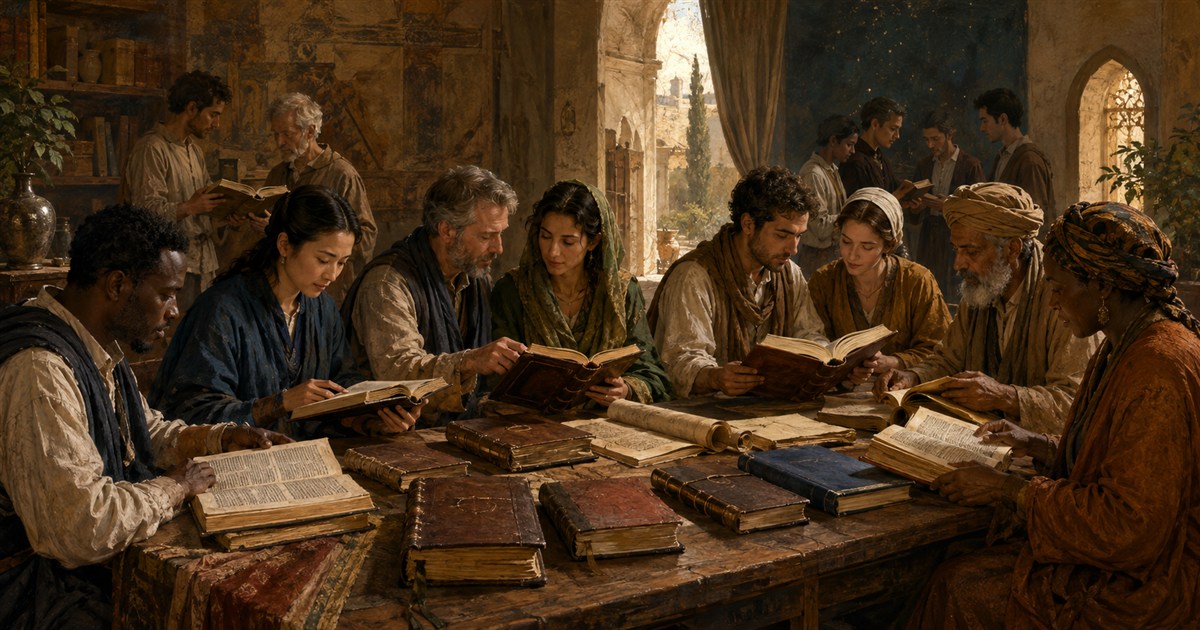
Readers from varied communities comparing differently bound Bibles around a shared table

Quick answer

No denomination has a universally used Bible translation. Catholic and Anglican churches may authorize versions for public worship, while many Protestant bodies leave the choice to congregations or clergy. The NAB tradition, NRSV/NRSVue, ESV, NIV, CSB, NLT, NKJV and KJV appear in different institutional and congregational settings.

Major traditions at a glance

Representative examples, not universal denominational rules. Looking for another community? Use the finder below or browse the complete guide below.

TraditionPublic worship or documented usePolicy
Catholic, USNAB tradition at Mass; NABRE and NRSV-CE approved for studyOfficial guidance
Eastern OrthodoxSeptuagint tradition; OSB, NKJV, KJV and RSV encountered in EnglishVaries by jurisdiction
EpiscopalNRSV, KJV, RSV, NIV and other versions authorizedOfficial list
LCMS LutheranESV in the lectionary and study publishingDocumented use
United MethodistCEB and NRSV in denominational curriculumNo official version
BaptistCSB, NIV, ESV, NKJV and KJV encounteredCongregational choice
PentecostalNIV, NLT, NKJV, ESV and KJV encounteredNo movement-wide standard
Latter-day SaintKJV preferred in English church meetingsOfficial guidance
Jewish communitiesHebrew Tanakh; JPS, Koren and ArtScroll editionsVaries by movement
How to interpret the evidence

Official guidance issued by an authorized church body.

Documented use in a lectionary, curriculum, publication or study Bible.

Reported practice described cautiously when representative survey evidence is unavailable.

BibleVerse suggestion a freely distributable reading option, not a denominational endorsement.

Scope. The emphasis is English-language practice in the United States and Britain, with selected global examples. Jewish communities are included as a distinct living tradition, not Christian denominations. Catholicism is part of Christianity. Readers need not belong to a faith community. Sales and publisher catalogs indicate availability, not how frequently a translation is read in congregations.

Terms. A lectionary is a book of readings assigned for public worship. A biblical canon is the collection of books a community receives as Scripture. The Septuagint is an ancient Greek translation of the Hebrew Scriptures and related books.

Deep dive: Bible translation evidence by community

This matrix summarizes selected English-language examples documented in the guide. It measures the kind of evidence, not popularity, quality or theological agreement. A blank cell means this guide makes no claim, not that the translation is unused.

Official guidance Documented institutional use Reported practice Historical association

Evidence is scoped to the institutions and settings named in each row. For example, Episcopal authorization does not establish usage throughout the Anglican Communion, and a denominational publisher does not determine every congregation's choice.

Preview or download the branded chartEvidence matrix connecting selected religious communities and Bible translations

This guide describes translation practices without ranking communities or translations. Communities are named according to their preferred institutional names wherever practical. Categories from demographic studies are attributed to their sources. Inclusion on one page does not imply a shared understanding of Scripture, canon, doctrine or religious identity.

Find a community

Filters the entries below as you type.

Show all traditions and sections

Catholic and Orthodox

Catholic and Orthodox churches both read an Old Testament larger than the Protestant one. That matters when you choose a version: a 66-book Bible will not contain every reading you hear at Mass or the Divine Liturgy.

Catholic

The world's largest Christian communion; 19% of American adults in Pew's 2023–24 survey3,43

Liturgical status
In the United States, the Roman Catholic lectionary is based on the New American Bible tradition5. England and Wales began using the ESV Catholic Edition with the Abbey Psalms and Canticles in Advent 20246.
Approved study
The US bishops list the NABRE, the NRSV Catholic Edition and Updated Edition, the Good News Translation and other texts as approved for private prayer and study4. This approval list does not measure their relative popularity.
Old Catholic
The Old Catholic churches of the Union of Utrecht, separate from Rome since 1870 over papal infallibility, read the ordinary Catholic Bibles of their languages: the Einheitsübersetzung in German, the Willibrord translation in Dutch29.
Free here
WEB Catholic Edition (modern English, all 73 books), Douay-Rheims 1899 (the historic English Catholic Bible, from the Vulgate). Spanish readers: Reina-Valera 1909 lacks the deuterocanon, so check the book list.

Why the difference in books: the Catholic canon, affirmed at Trent in 1546, keeps Tobit, Judith, Wisdom, Sirach, Baruch, 1 and 2 Maccabees and the Greek parts of Esther and Daniel. See the book lists side by side.

Eastern Orthodox

Eastern Orthodox jurisdictions; Pew's 12% estimate for 2010 combines Eastern and Oriental Orthodox Christians2

In church
The Old Testament is read from the Septuagint, the Greek translation the early Church used, and the New Testament from the Byzantine Greek text. Russian churches read the Synodal translation; Greek churches the original Greek.
In English
There is no single English translation authorized across all Orthodox jurisdictions. The Orthodox Study Bible combines an NKJV New Testament with an Old Testament translated from the Septuagint by St. Athanasius Academy7,8. Orthodox readers also encounter the NKJV, KJV and RSV, although these versions differ in textual basis and translation philosophy.
Old Believers
The Old Believers, who kept the Russian rite as it stood before Patriarch Nikon's reforms of the 1650s, still read the Church Slavonic Bible and service books in their pre-reform editions30.
Free here
Brenton's Septuagint (the Greek Old Testament in English, Psalm 151 included), KJV with the Apocrypha, Синодальный перевод (Russian Synodal).

Oriental Orthodox and the Church of the East

The Coptic, Ethiopian, Eritrean, Armenian, Syriac and Malankara churches, and the Assyrian Church of the East

In church
Each church keeps its ancient liturgical language: Coptic, Ge'ez, classical Armenian, Syriac (the Peshitta). The Ethiopian canon is the broadest in Christianity, with 81 books.
At home
The Protestant-produced Van Dyck translation of 1865 has circulated widely among Arabic-speaking Christians, including many Copts9. Ethiopians and Armenians also use modern vernacular editions alongside their historic liturgical languages.
Church of the East
The Assyrian Church of the East and the Ancient Church of the East preserve the Syriac Peshitta. Its Old Testament developed in the early centuries CE, while the standard Peshitta New Testament is generally associated with the late fourth or early fifth century. Modern Assyrian Aramaic and Arabic editions are also used31,51.
Free here
الكتاب المقدس، فان دايك (Arabic Van Dyck), መጽሐፍ ቅዱስ (the 1962 Amharic New Testament), Brenton's Septuagint for the Old Testament books these churches share with the Greek tradition.

Anglican, Lutheran, Reformed and Methodist

The churches that came out of the sixteenth-century Reformation and the eighteenth-century awakenings. Entries name particular institutions and publications; labels such as “mainline,” “confessional” and “evangelical” do not determine every congregation’s or household’s choice.

Anglican and Episcopal

The Church of England, the Episcopal Church, the Anglican Church in North America and the wider Communion

In church
The Church of England's lectionary is keyed to the NRSV, and the Authorized (King James) Version remains approved for reading in services10. The Episcopal Church lists its permitted versions in canon law: the KJV, RSV, NRSV, NIV, Jerusalem and New Jerusalem, REB, CEB and others, most recently the Revised New Jerusalem Bible11.
Reported use
The NRSV is prominent in Episcopal publishing, while the ESV and NIV appear in ACNA and evangelical Anglican settings. The KJV remains associated with communities that retain the 1662 Prayer Book. Representative congregational-use data are limited.
Free here
King James Version and KJV with the Apocrypha (the Apocrypha is read in Anglican lectionaries), WEB British Edition, Berean Standard Bible for readers used to the NRSV or ESV.

Lutheran

The Evangelical Lutheran Church in America, the Missouri and Wisconsin Synods, and the national churches of Germany and Scandinavia

In church
The Missouri Synod adopted the ESV for its hymnal and lectionary, the Lutheran Service Book, and Concordia prints its study Bible in it12. The ELCA's Lutheran Study Bible from Augsburg Fortress is in the NRSV, now the NRSVue13. German congregations read the Lutherbibel, most recently revised in 2017.
At home
Household choices vary. These institutional examples do not establish which translation Lutheran families use most often.
Free here
Lutherbibel 1912 (a historical revision of Luther's translation), Berean Standard Bible (a contemporary editorial alternative for ESV readers; ESV passages can be looked up and memorized on the home page), King James Version.

Presbyterian and Reformed

The PC(USA), PCA, OPC and EPC in America, the Church of Scotland, and the Dutch, Swiss, Hungarian and Korean Reformed churches

Documented use
The PC(USA) store publishes and sells NRSV pew and study Bibles, evidence of institutional availability rather than a universal rule15. The PCA, OPC and other conservative Reformed bodies generally prescribe no single version; the ESV, NIV, NKJV and NASB are encountered in their congregations. Dutch Reformed churches historically read the Statenvertaling of 1637.
Heritage
The Geneva Bible of 1560, made in Calvin's Geneva, was the Bible of the Scottish Reformation and of the Pilgrims.
Waldensian
Italy's Waldensian church, Reformed since 1532 and older than the Reformation itself, reads the Nuova Riveduta, the current revision of Diodati's Italian Bible; the Riveduta of 1927, made under the Waldensian scholar Giovanni Luzzi, is here32.
Free here
Riveduta 1927, Geneva Bible 1599, Berean Standard Bible (a contemporary editorial alternative for ESV readers; ESV passages can be looked up on the home page), NET Bible for study, De Heilige Schrift 1917 for Dutch readers, the Korean Bible of 1910.

Methodist and Wesleyan

The United Methodist and Global Methodist churches, the AME, AME Zion and CME churches, the Nazarenes, the Wesleyan and Free Methodist churches, the Salvation Army

In church
The United Methodist Church says plainly that it has no official translation; its publishing house prefers the CEB and the NRSV for curriculum because those are what most of its pastors and teachers use14.
At home
Household and congregational choices vary across Methodist and Wesleyan churches. Curriculum use does not establish a universal preference among members.
Free here
Berean Standard Bible, Free Bible Version (plain modern English, in the spirit of the CEB and NLT), King James Version, which Wesley himself preached from and annotated.

Baptist, Anabaptist, Pentecostal and evangelical

The free-church traditions decide congregation by congregation, so the same denomination can hold a King James pulpit in one town and an NLT pulpit in the next. The examples below distinguish documented use from broader reported practice.

Baptist

The Southern Baptist Convention is the largest Protestant body in the United States; the National Baptist conventions, American Baptists, Independent Baptists and many more

Documented use
The CSB is published by Holman Bible Publishers, a division of Lifeway, an entity associated with the SBC. Its interdenominational translation committee includes Southern Baptist and other conservative evangelical scholars; the CSB is not an official translation prescribed by the SBC16. The NIV, ESV, NKJV and KJV are also encountered in Baptist churches.
King James
KJV-only advocacy is especially associated with parts of the Independent Baptist tradition17. The KJV also retains an important place in some National Baptist and Primitive Baptist congregations, although representative usage data are limited.
Free here
New International Version, King James Version, Berean Standard Bible (an editorial alternative for CSB readers), Majority Standard Bible for readers seeking a modern translation based on the Byzantine majority text.

Mennonite, Amish and Brethren

Mennonite Church USA and Canada, the conservative Mennonite conferences, the Old Order Amish, the Hutterites, the Church of the Brethren

In church
The Amish use Luther's German Bible, with the King James Version used for English reading18. Practices among Mennonite and Brethren congregations are diverse, and no single English translation represents the whole Anabaptist tradition.
Free here
Lutherbibel 1912 (a historical Luther Bible edition; communities may use other editions), King James Version, Berean Standard Bible.

Quakers (Friends)

Friends General Conference, Friends United Meeting, Evangelical Friends and the unprogrammed yearly meetings

In meeting
Friends have no prescribed version and no common lectionary. In unprogrammed worship, a participant may read Scripture as led; programmed and Evangelical Friends churches include preaching and scheduled readings. The cited institutional sources do not establish a representative translation preference37.
Heritage
George Fox's contemporaries said that if the Bible were lost it could be recovered from his memory; the early Friends knew the King James Version by heart.

Pentecostal and charismatic

The Assemblies of God, the Church of God in Christ, the Church of God (Cleveland), the Foursquare Church, the United Pentecostal Church, and the charismatic networks

Documented use
The Assemblies of God prescribes no version; its website presents the NIV, and its Fire Bible is published in several translations19. The NIV, NLT, NKJV, ESV and KJV are encountered across Pentecostal settings, but the cited evidence does not establish representative rates of congregational use.
Worldwide
Pentecostal and charismatic Christianity has experienced substantial global growth. Its linguistic setting is predominantly non-English, so English-language translation preferences should not be generalized to the movement worldwide.
African churches
The African Initiated Churches, the Aladura, Zionist, Kimbanguist and Celestial churches among them, read the Bible in their own languages, Yoruba, Zulu, Lingala, Kikongo and Swahili, and several of those editions are here33.

Non-denominational and evangelical

Bible churches, community churches, Calvary Chapel, and the independent congregations that now hold a large share of American Protestants3

Available evidence
The NIV has frequently led industry sales rankings, with the NLT, ESV, KJV, CSB and NKJV also prominent26. Sales indicate availability and consumer demand, but do not directly measure congregational or pulpit use. Independent churches prescribe no common translation.
Free here
The NIV, NLT and NASB 2020 are here with their publishers' permission, and ESV passages can be looked up on the home page. Berean Standard Bible is BibleVerse's editorial alternative for readers accustomed to other contemporary evangelical translations. NET Bible offers extensive study notes; Free Bible Version uses plain modern English; Literal Standard Version takes a comparatively formal approach. None is an exact substitute for a copyrighted translation.

Restorationist and other Christian movements

These communities have distinct histories and self-understandings; they are grouped here only to make the guide easier to navigate.

Churches that set out, in different ways, to restore the faith of the New Testament. Several publish or prescribe their own edition, which makes the question easy to answer.

Churches of Christ and Christian Churches

The Stone-Campbell movement: the Churches of Christ, the independent Christian Churches, and the Disciples of Christ

In church
These churches have no single central authority or movement-wide translation. The American Standard Version of 1901 has an important historical association with Churches of Christ; contemporary congregations use a range of translations.
Free here
American Standard Version (a translation with a historical association with Churches of Christ), Literal Standard Version and Berean Standard Bible for NASB and ESV readers.

Seventh-day Adventist

About 22 million members, most of them outside North America

Documented use
No official translation is prescribed. The Andrews Study Bible, published by Andrews University Press, appeared first in the NKJV and later in the NIV20. Adventist publications also quote several other translations; the cited sources do not establish which version members use most often.
Free here
King James Version, Majority Standard Bible (a modern rendering of the text family behind the NKJV), Berean Standard Bible.

Latter-day Saints

The Church of Jesus Christ of Latter-day Saints, about 17 million members worldwide

In church
The King James Version is the church's preferred English Bible for classes and meetings and has appeared in a church-published study edition since 197921,22,23. Its Spanish edition, published in 2009, is a revision of the Reina-Valera23.
At home
In December 2025 the church added guidance recognising other translations for personal study, naming the ESV and NRSV for readers 14 and up, the NIV, NLT and NKJV for ages 11 to 13, and the NIrV for younger children, while keeping the KJV for classes and meetings22.
Free here
King James Version (the same text, without the church's study aids), Reina-Valera 1909 (the base the 2009 Spanish edition revised).

Jehovah's Witnesses

About 8.8 million active members worldwide

In church
The New World Translation of the Holy Scriptures, published by the Witnesses themselves since 1950 and now available in whole or in part in more than 300 languages, is used in all their meetings and literature24.
Heritage
Before 1950 the Bible Students read and printed the King James Version and the American Standard Version, valued for rendering the divine name as Jehovah throughout the Old Testament.
Free here
American Standard Version, King James Version. The New World Translation is copyrighted and is read online at jw.org.

Unitarian Universalist

The Unitarian Universalist Association, from the New England Unitarians of 1825 and the Universalists of 1793

In church
No scripture is prescribed. The Association names Jewish and Christian teachings as one of the six sources of its living tradition, alongside other world religions, humanism and direct experience, so a Sunday reading may come from the Bible or from anywhere38.
Heritage
The Unitarian Harvard of Channing and Emerson read the King James Version; twentieth-century Unitarians the RSV.

Christian Science

The Church of Christ, Scientist, founded in Boston in 1879

In church
The King James Version, read every Sunday alongside Mary Baker Eddy's Science and Health with Key to the Scriptures; the church calls the two books together its pastor, and the weekly Bible Lesson is drawn from both39.
Free here
King James Version, the same text the Lesson quotes.

New Apostolic Church

About nine million members, most of them in Africa; led by a Chief Apostle from Zurich

In church
The church prescribes no single version. German-speaking congregations, its historic heartland, read the Lutherbibel, and its catechism in German quotes the Luther text; congregations elsewhere read the standard translation of their own language40.
Free here
Lutherbibel 1912, Berean Standard Bible, Neno: Maandiko Matakatifu (Swahili), Bíblia Livre (Portuguese, for Angola and Mozambique).

Messianic Jewish

Communities centred on Yeshua (Jesus) and Jewish religious life, with differing congregational practices

Translation examples
The Complete Jewish Bible (David Stern, 1998) and the Tree of Life Version, both of which keep Hebrew names and the Tanakh's order of books. These are Messianic translation projects; their titles do not imply endorsement by all Jewish movements. The TLV's publisher describes its use of the Jewish book order and selected Hebrew terms63.
Free here
World Messianic Bible (Yeshua, Torah and the Hebrew names, built on the WEB), תנ״ך עברי מודרני (the Modern Hebrew Bible, all 66 books), JPS TaNaKH 1917.

Judaism

Jewish readers read the Tanakh, the 24 books that Christians call the Old Testament, in Hebrew first and in translation second. About 15 million Jews live in the world, nearly half of them in Israel1.

Orthodox, Hasidic, Conservative, Reform, Reconstructionist and Karaite

The major movements share the traditional 24-book Jewish canon while differing in translation, interpretation and commentary

In synagogue
In many synagogues, the Torah is chanted from a handwritten Hebrew scroll and a haftarah is read from the Prophets. Common English-language study and pew editions include the ArtScroll Stone Edition in Orthodox settings, Etz Hayim in Conservative settings and The Torah: A Modern Commentary (Plaut) in Reform settings. Local practice varies.
At home
The Jewish Publication Society describes its 1985 JPS Tanakh, produced with scholars from several Jewish movements, as the most widely read English translation of the Hebrew Bible25. Orthodox readers also use Koren and ArtScroll editions.
Hasidic
Hasidic communities read Hebrew first and, in English, the ArtScroll Tanakh and, in Chabad, the Kehot Chumash34.
Reconstructionist
Reconstructionist congregations use the JPS translation and the movement's own Kol Haneshamah prayer books35.
Karaite
Karaite Judaism gives the Hebrew Bible authority independent of the rabbinic Oral Torah. The Westminster Leningrad Codex provides a digital form of the Masoretic Hebrew text, but it should not be treated as a uniquely Karaite edition36.
Free here
JPS TaNaKH 1917 (the Jewish Publication Society's first translation, in Jewish canonical order), תנ״ך, Leningrad Codex (the base manuscript used by major critical editions including Biblia Hebraica Stuttgartensia), the Modern Hebrew Bible is a Christian translation that also contains the New Testament, not a Jewish Tanakh edition.

Reading the Tanakh here shows the books in the Jewish order, Torah, Nevi'im and Ketuvim, ending with Chronicles rather than Malachi. See the Tanakh's shelves.

Nothing matches that. Try a broader word (Baptist, Lutheran, Orthodox), or read straight down.

BibleVerse reading alternatives

Four copyrighted translations are here with their publishers' permission: the NIV, the NLT and the NASB 2020 to read in full, and the ESV to look up and memorize one passage at a time. For the rest, paste any lawfully obtained passage into the memorization path, so the wording you hear in worship can be the wording you learn. For reading and browsing, the table offers freely distributable editions with some comparable features. These are editorial suggestions, not exact substitutes or denominational endorsements.

If your church readsRead hereWhy
NIVNew International VersionThe NIV itself, by permission of Biblica
NLTNew Living TranslationThe NLT itself, by permission of Tyndale House
NASBNew American Standard Bible 2020The NASB itself, by permission of the Lockman Foundation
ESVESV passages on the home page, Berean Standard Bible for readingESV verses are quoted by permission of Crossway; chapter reading in the ESV is not yet licensed
CSB, NRSVBerean Standard BibleModern English; an editorial alternative, not identical wording or textual decisions
CEB, The MessageFree Bible VersionPlain contemporary English that reads at a similar level
NKJVMajority Standard Bible or KJVBuilt on the same Greek text family, in modern or classic English
LSBNASB 2020 or Literal Standard VersionThe LSB revises the NASB 1995; the NASB 2020 is its closest relative here
NABRE, RSV-2CE, NJBWEB Catholic EditionEvery book of the Catholic canon in modern English
Orthodox Study BibleBrenton's Septuagint + KJVSeptuagint Old Testament, Byzantine-family New Testament
JPS 1985, ArtScroll, KorenJPS TaNaKH 1917JPS's earlier Jewish translation; not an earlier edition of ArtScroll or Koren
Reina-Valera 1960Reina-Valera 1909The edition the 1960 revised; most verses read the same
Lutherbibel 2017, EinheitsübersetzungLutherbibel 1912Luther's text as German churches read it for a century
Segond 21, TOB, Bible de JérusalemLouis Segond 1910The base of most French Protestant Bibles
Almeida Revista e Atualizada, NVIBíblia LivreModern Portuguese, free to share
개역개정 (Korean Revised)한국어 성경 1910The translation the modern Korean editions descend from, though incomplete

Spanish-speaking Protestants overwhelmingly read the Reina-Valera 196028, and Spanish-speaking Catholics the Biblia de Jerusalén, the Biblia Latinoamérica or the Dios Habla Hoy; Chinese Protestants the Union Version of 1919, which is here as the 和合本. The full list of sixty editions, with each one's licence, is on the versions page.

Population context

These charts describe religious identity or institutional membership, not which Bible translation people read. Each dot chart represents one hundred people. Surveys measure self-identification, while religious bodies may count baptized members, active participants or another category; the source and measure appear with each chart.

If the world were 100 people2020
  • 29 Christians
  • 26 Muslims
  • 24 religiously unaffiliated atheist, agnostic, or nothing in particular
  • 15 Hindus
  • 4 Buddhists
  • 2 other religions folk religions, Sikhs, Baha'is, Jains and more

Christians round to 29 of the 100 (about 2.3 billion people in 2020)41. The Christian-tradition chart below uses 2010 estimates; its shares are not applied to this 2020 chart. Jewish people are 0.2 of the 100, one person in every 500, or 14.8 million, too few to show as a whole dot; they have their own figures below41.

Preview or download the branded chartIf the world were 100 people: a dot chart of global religious affiliation in 2020
Historical estimate
If the world's Christians were 100 peoplePew, 2010 estimates
  • 50 Catholic
  • 37 Protestant Anglicans, Baptists, Lutherans, Methodists, Pentecostals, Reformed, independents and more
  • 12 Orthodox Eastern and Oriental
  • 1 other Latter-day Saints, Jehovah's Witnesses, Christian Scientists

Pew's 2010 estimates, published in 2011; historical categories, not a current census2. A separate Catholic yearbook figure reports 1.406 billion baptized Catholics for 202343; Pentecostal and charismatic movements, which overlap Protestant, Catholic and other communities, is reckoned at nearly 600 million44.

Preview or download the branded chartIf the world's Christians were 100 people: Pew's 2010 Christian-affiliation estimates, published in 2011
If American adults were 100 peoplePew, 2023-24
  • 40 Protestant 23 evangelical, 11 mainline, 5 in historically Black churches
  • 19 Catholic
  • 3 other Christian Latter-day Saints, Orthodox, Jehovah's Witnesses
  • 29 religiously unaffiliated
  • 2 Jewish
  • 5 other faiths Muslim, Buddhist, Hindu, and others, about one each
  • 2 did not say

Pew's Religious Landscape Study of 36,908 adults3. Within the 40 Protestants, Baptists are 12 of the 100, non-denominational Christians 6, Pentecostals 4, Methodists and Lutherans 3 each, Presbyterians 23.

Preview or download the branded chartIf American adults were 100 people: a dot chart of religious affiliation in Pew's 2023–24 survey
If the world's Jewish people were 1002020
  • 46 in the Middle East and North Africa nearly all of them in Israel
  • 41 in North America nearly all in the United States
  • 13 elsewhere Europe, Latin America, Australia, the former Soviet Union

Israel's Jewish population grew from 5.8 to 6.8 million in the decade, in Pew's population estimates41.

Preview or download the branded chartIf the world's Jewish people were 100: a dot chart of their regional distribution in 2020
If American Jewish adults were 100 peoplePew, 2020
  • 37 Reform
  • 17 Conservative
  • 9 Orthodox including Hasidic and Modern Orthodox
  • 32 no particular branch
  • 4 another branch Reconstructionist, Humanistic, and others
  • 1 did not say

Pew's survey of 4,718 Jewish adults42. The three movements named at the top of this page's Judaism entry cover about two thirds of American Jews; about a third identify with no particular branch. This does not by itself describe personal beliefs or practices.

Preview or download the branded chartIf American Jewish adults were 100 people: a dot chart of Jewish movement identification in Pew's 2020 survey

Religious affiliation across world regions

Share of each region's total population in 2020. Pew Research Center combines 201 countries and territories into these regions; “other” below combines its smaller displayed categories for readability. Values are rounded independently and may total 99 or 101. North America here means the United States and Canada; Mexico is included in Latin America and the Caribbean.52

  1. Asia-Pacificabout 4.5 billion
    33% unaffiliated26% Muslim26% Hindu7% Buddhist6% Christian2% other
  2. Europeabout 753 million
    67% Christian25% unaffiliated6% Muslimabout 2% other
  3. Latin America and the Caribbeanabout 650 million
    85% Christian12% unaffiliated3% other religions
  4. Middle East and North Africaabout 440 million
    94% Muslim3% Christianunder 2% Jewishabout 1% other or unaffiliated
  5. North Americaabout 378 million
    63% Christian30% unaffiliatedabout 7% other religions
  6. Sub-Saharan Africaabout 1.1 billion
    62% Christian33% Muslimabout 3% unaffiliatedabout 3% other religions
ChristianMuslimHinduBuddhistJewishUnaffiliatedOther religions
Preview or download the branded chartReligious affiliation across six world regions in 2020

Selected population and membership estimates

Bars show selected figures on a common scale, not a ranking or a complete breakdown. These are different kinds of count from different years: institutions, overlapping movements and Pew’s estimate of Jewish religious affiliation. This is not a count of everyone with Jewish ancestry or identity; Jewish people are not a single religious body. Do not add these figures; read each source and definition.

  1. Catholic Church1.41 billion43Annuario Pontificio 2025, for 2023
  2. Pentecostal and charismatic Christians588 million44World Christian Database via WCC; reference year unspecified
  3. Eastern Orthodox churches300 million44WCC summary of church estimates; reference year unspecified
  4. Reformed and Presbyterian churches100 million45WCRC member churches; reference year unspecified
  5. Anglican Communionabout 85 million50widely cited estimate; reference year unspecified, not a current census
  6. Methodist and Wesleyan churches80 million45World Methodist Council member churches; reference year unspecified
  7. Lutheran churches78 million45LWF member churches; reference year unspecified
  8. Oriental Orthodox churches60 million44WCC summary; reference year unspecified
  9. Baptist World Alliance53 million45BWA member bodies; reference year unspecified; excludes Southern Baptist Convention
  10. Seventh-day Adventist Church24.4 million48year-end 2025 membership; 2026 advance report
  11. Latter-day Saints17.9 million47church-reported membership, 31 December 2025
  12. Jewish religious affiliation14.8 million41Pew Research Center, 2020
  13. Jehovah's Witnesses9.2 million46active preachers in the 2025 service year, the church's own measure
  14. Amishabout 400,00049Young Center, Elizabethtown College, 2024

A body that counts every baptised infant will look larger than one that counts participation in preaching, which is why the Witnesses' 9.2 million and the Latter-day Saints' 17.9 million are not directly comparable, and why the Orthodox figure has a range. These measures do not establish personal devotion, theological agreement or relative importance.

Questions people ask

What Bible version do Catholics use?

Usage varies by country and purpose. In the United States, the Roman Catholic lectionary is based on the New American Bible tradition, while the bishops approve the NABRE, NRSV Catholic Edition and other translations for private study4,5. England and Wales began using the ESV Catholic Edition with the Abbey Psalms and Canticles in Advent 20246. Catholic editions normally contain the 73-book Catholic canon.

What Bible version do most Protestant churches use?

There is no single Protestant translation. Some church bodies authorize particular versions for worship or use them in official publications, while many leave the choice to congregations and clergy. The NRSV or NRSVue appears frequently in mainline publications; the ESV, NIV, CSB, NLT, NKJV and KJV are prominent in evangelical publishing and congregational life. These are broad tendencies, not universal rules.

Do I have to memorize from the version my church uses?

Memorization is optional, whether you approach the Bible for faith, study or curiosity. If you choose to memorize, familiar wording may be useful. For religious services, follow your community’s guidance; for personal study, consider the translation’s canon, language and notes. Comparing versions can also be valuable. You can also explore the memorization tools.

Which copyrighted translations are on BibleVerse?

The NIV, the NLT and the NASB 2020 are read here with their publishers' permission through API.Bible, and the ESV can be looked up and memorized one passage at a time through Crossway's ESV API. Other copyrighted translations, such as the NRSV, the NABRE, the CSB and the NKJV, are not yet licensed for BibleVerse. For those the site carries freely distributable editions selected as editorial alternatives according to such features as canon, language register and translation approach. They are not exact substitutes and are not denominational endorsements. To memorize from another translation, paste the passage from your own Bible and every step works the same.

Sources

Each numbered mark above points here. Official church sources establish authorization or institutional practice, not necessarily how frequently members use a translation. Publisher catalogs and sales rankings are treated as evidence of availability, not as representative congregational surveys. Retrieved September 2026.

Browse all 62 sources
  1. Pew Research Center, How the Global Religious Landscape Changed From 2010 to 2020, 9 June 2025: 2.3 billion Christians in 2020; Jewish population and its distribution.
  2. Pew Research Center, Global Christianity: A Report on the Size and Distribution of the World's Christian Population, 19 December 2011: about 50% Catholic, 37% Protestant, 12% Orthodox, 1% other.
  3. Pew Research Center, 2023-24 Religious Landscape Study: executive summary, 26 February 2025: 62% of US adults Christian, 40% Protestant, 19% Catholic; evangelical, mainline and historically Black Protestant shares.
  4. United States Conference of Catholic Bishops, Approved Translations of the Bible: the list approved for private use and study, including the NABRE, the NRSV Catholic Edition and Updated Edition, and the Good News Translation.
  5. United States Conference of Catholic Bishops, New American Bible: the translation the US Lectionary for Mass is drawn from.
  6. Catholic Bishops' Conference of England and Wales, Lectionary: the ESV Catholic Edition and the Abbey Psalms and Canticles, in use from the First Sunday of Advent 2024.
  7. Saint John the Evangelist Orthodox Church (Antiochian Archdiocese), What Bible Do Orthodox Christians Use?: no officially endorsed English translation; the Orthodox Study Bible most common; KJV and NKJV preferred for their Byzantine text.
  8. Wikipedia, Orthodox Study Bible: NKJV New Testament, St. Athanasius Academy Septuagint Old Testament; Thomas Nelson, 1993 and 2008.
  9. Wikipedia, Bible translations into Arabic: the Van Dyck translation of 1865 and its use across Arabic-speaking churches.
  10. The Church of England, Common Worship: Lectionary: references are to the New Revised Standard Version; any version not prohibited by lawful authority may be read, the Authorized Version among them.
  11. The Episcopal Church, An Episcopal Dictionary of the Church: Bible, The, and General Convention resolution 2022-A144: the translations authorized by Canon II.2 for public worship.
  12. Concordia Theology (Concordia Seminary, St. Louis), Another New Bible in English, November 2010: the ESV adopted by the LCMS Commission on Worship for the Lutheran Service Book and its lectionary; and Concordia Publishing House, The Lutheran Study Bible (ESV).
  13. Augsburg Fortress (the ELCA's publishing house), Lutheran Study Bible: NRSV, and the NRSVue in the second edition.
  14. The United Methodist Church, Ask The UMC: Does The UMC have an official Bible translation?: no official version; the CEB and NRSV preferred for United Methodist Publishing House curriculum.
  15. Presbyterian Church (U.S.A.) Store, Bibles: the NRSV pew and study editions the denomination's publisher sells; and Wikipedia, Presbyterian Church (USA).
  16. Christian Standard Bible, About the CSB: published by Lifeway; revised from the Holman Christian Standard Bible by a committee whose co-chairs are Southern Baptist scholars.
  17. Wikipedia, King James Only movement: most common among Independent Baptist congregations, with adherents among conservative Holiness, Anabaptist and Pentecostal groups.
  18. Young Center for Anabaptist and Pietist Studies, Elizabethtown College, Amish Studies: Beliefs: Luther's German Bible as the Amish scripture, with the King James Version in English.
  19. Assemblies of God (USA), Bible Help (New International Version); the Fellowship prescribes no translation and its Fire Bible is issued in several.
  20. Andrews University, Andrews Study Bible, June 2010, and the North American Division, Andrews University Releases New Edition of Its Study Bible: NKJV first, then also NIV.
  21. Church News, Letter reaffirms use of King James Version of Bible, 20 June 1992.
  22. Newsroom, The Church of Jesus Christ of Latter-day Saints, New Guidance on Bible Translations for Latter-day Saints, 16 December 2025.
  23. Wikipedia, LDS edition of the Bible: the 1979 English edition (KJV) and the 2009 Spanish edition (revised Reina-Valera).
  24. Jehovah's Witnesses, Online Bible: New World Translation of the Holy Scriptures: published in whole or in part in more than 300 languages.
  25. The Jewish Publication Society, TANAKH: The Holy Scriptures: the 1985 translation, by scholars from the three largest branches of American Judaism, described as the most widely read English translation of the Hebrew Bible.
  26. Evangelical Christian Publishers Association, Bible Translations Bestsellers, January 2026: the monthly ranking of translations by unit sales.
  27. Christianity Today, The Most Popular and Fastest Growing Bible Translation Isn't What You Think It Is, March 2014, reporting the Center for the Study of Religion and American Culture's survey: 55% of Bible readers read the King James Version, 19% the NIV.
  28. Wikipedia, Reina-Valera: the 1960 revision as the standard Bible of Spanish-speaking Protestants.
  29. Encyclopaedia Britannica, Old Catholic church; Union of Utrecht of the Old Catholic Churches, official site.
  30. Encyclopaedia Britannica, Old Believers: the Nikonian reforms, the schism of 1666-67, and the communities that keep the older books.
  31. Encyclopaedia Britannica, Nestorianism; Assyrian Church of the East, official site; Catholic Near East Welfare Association, The Eastern Christian Churches.
  32. Encyclopaedia Britannica, Waldenses; Chiesa Evangelica Valdese, official site. The Riveduta's own record is in the text credits.
  33. World Council of Churches, African Instituted Churches; Encyclopaedia Britannica, Kimbanguist Church.
  34. My Jewish Learning, The Hasidic Movement: A History; Encyclopaedia Britannica, Baal Shem Tov.
  35. Reconstructing Judaism, official site; Encyclopaedia Britannica, Reconstructionism.
  36. Encyclopaedia Britannica, Karaism; Jewish Virtual Library, Karaites.
  37. Encyclopaedia Britannica, Society of Friends; Friends World Committee for Consultation, official site: the programmed, evangelical and unprogrammed branches of the Friends.
  38. Unitarian Universalist Association, Sources of Our Living Tradition; Encyclopaedia Britannica, Unitarianism.
  39. The First Church of Christ, Scientist, What we believe: the Bible and Science and Health as the church's pastor and the basis of the weekly Bible Lesson; Encyclopaedia Britannica, Christian Science.
  40. New Apostolic Church International, official site; Encyclopaedia Britannica, New Apostolic Church.
  41. Pew Research Center, The World's Religious Groups: How Their Sizes Changed from 2010 to 2020, 9 June 2025: 2.3 billion Christians (28.8% of the world), Muslims 25.6%, the religiously unaffiliated 24.2%, Hindus 14.9%, Buddhists 4.1%, other religions 2.2%, Jews 0.2% (14.8 million), and where Jews live.
  42. Pew Research Center, Jewish Americans in 2020, 11 May 2021: 37% Reform, 17% Conservative, 9% Orthodox, 32% no particular branch.
  43. Vatican News, New Church statistics reveal growing Catholic population, fewer pastoral workers, March 2025, reporting the Annuario Pontificio 2025: 1.406 billion Catholics at the end of 2023.
  44. World Council of Churches, church families: Pentecostal churches (78 million classical Pentecostals, 192 million charismatics and 318 million neo-charismatics, from the World Christian Database), Orthodox churches (Eastern) (300 million by the churches' own count) and Orthodox churches (Oriental) (some 60 million).
  45. The world communions' own figures: Lutheran World Federation (over 78 million in 99 countries), World Methodist Council (over 80 million in 138 countries), World Communion of Reformed Churches (100 million in 109 countries), Baptist World Alliance (53 million in 138 countries and territories).
  46. Jehovah's Witnesses, How Many of Jehovah's Witnesses Are There Worldwide?: 9,205,326 in the 2025 service year, counting those who preach each month.
  47. The Church of Jesus Christ of Latter-day Saints, Facts and Statistics: 17,887,212 members, 31 December 2025.
  48. Seventh-day Adventist Church, Office of Archives, Statistics and Research, 2026 Annual Statistical Report, advance release, p. 22: 24,372,139 members at the end of 2025.
  49. Young Center for Anabaptist and Pietist Studies, Elizabethtown College, Amish Population, 2024.
  50. Anglican Communion, Member Churches (tens of millions of people across more than 165 countries); the 85 million estimate is the one given in Wikipedia's Anglican Communion article and widely repeated.
  51. John Barton, ed., The Oxford Handbook of Biblical Studies (Oxford University Press, 2006), discussion of the early Syriac versions and the distinct development of the Peshitta Old and New Testaments.
  52. Pew Research Center, How the Global Religious Landscape Changed From 2010 to 2020, regional chapters and accompanying religious-composition data. The study synthesizes more than 2,700 censuses, surveys and population registers across 201 countries and territories. Published 9 June 2025; dataset updated 12 February 2026. The North America chapter reports 378 million residents, 63% Christian and 30% unaffiliated in the United States and Canada; this chart groups the remaining roughly 7% as other religions.
  53. The Jewish Publication Society, The Holy Scriptures, Tanakh 1917 edition and Tanakh customer guide: JPS 1917 drew on the English Revised Version; NJPS was a new translation completed in 1985; RJPS revised NJPS in 2023.
  54. National Council of Churches, announcement approving the NRSVue, and Friendship Press, About the NRSVue: the NRSVue continues the KJV–RV/ASV–RSV–NRSV revision tradition and was prepared for broad ecumenical use.
  55. United States Conference of Catholic Bishops, Preface to the revised New American Bible Old Testament and NABRE information: the Confraternity project began with a proposed Challoner–Rheims revision, expanded to translation from original languages, produced the NAB, and continued through the NABRE.
  56. St. Athanasius Academy of Orthodox Theology, Orthodox Study Bible, introductory materials: its Old Testament is an English translation of the Septuagint tradition and its New Testament uses the NKJV. The chart shows textual relationship, not universal Orthodox authorization.
  57. The Lockman Foundation, NASB history: the NASB was translated from the original languages and modeled on the 1901 ASV; the complete Bible appeared in 1971 and was later revised.
  58. Crossway, ESV translation history: the 1971 RSV text was the starting point for the ESV translation work.
  59. Biblica, The NIV story: an interdenominational evangelical project chose a new translation from Hebrew, Aramaic and Greek rather than an update of the KJV; the complete Bible appeared in 1978.
  60. Tyndale House Publishers, How to translate a Bible and NLT translation process: the NLT preserved the Living Bible's accessibility goal but was produced as a committee translation from the original languages, first published in 1996.
  61. Holman Bible Publishers, History of the CSB: the CSB resulted from a review and revision of the HCSB text.
  62. Thomas Nelson Bibles, New King James Version: the NKJV updates the vocabulary and grammar of the KJV while retaining its literary form.
  63. Tree of Life Bible Society, Translation FAQ: source texts, Jewish book order and selected Hebrew vocabulary.

These figures use different definitions and reference years. Some institutional summaries do not state a reference year; those are labelled and must not be treated as current censuses. Church-reported membership, preaching activity and population estimates are not equivalent. A correction is welcome: the sources are linked so they can be checked.

Memorize a verse in your version ›