
The short summary
What is 4 Maccabees about?
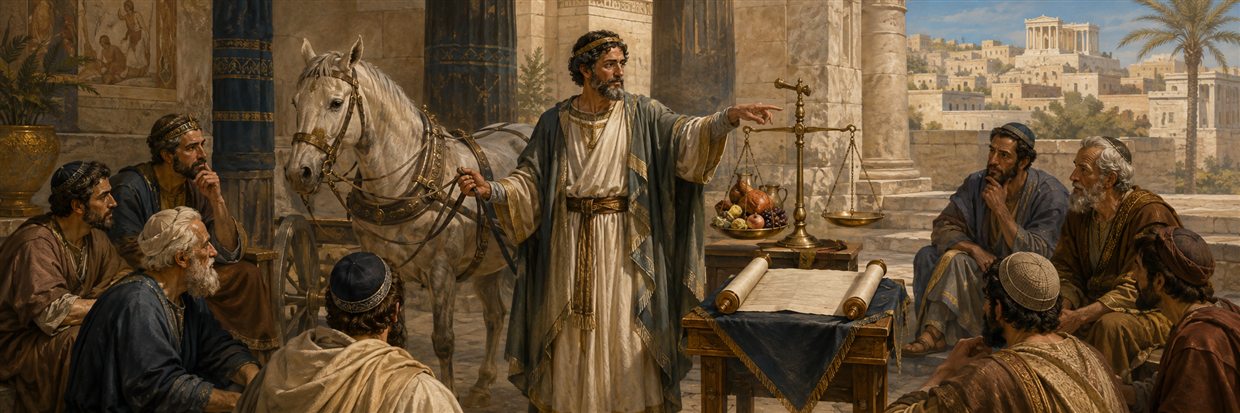
4 Maccabees argues that religious reason can govern the passions. It develops this claim through the law and ancestral examples, then through the suffering of Eleazar, seven brothers, and their mother under Antiochus. Their refusal to abandon their faith becomes the author’s central demonstration of disciplined conviction, with a concluding appeal to remain faithful to the law.
4 Maccabees 1:1–9; 4 Maccabees 4:24–26; 4 Maccabees 13:1–5; 4 Maccabees 18:1–5.01 / Understand the whole
The book in context
The opening sets out a philosophical proposition about reason and the passions. The author associates wisdom with education in the law and uses examples of restraint to illustrate the argument. These reflections prepare readers for the more demanding examples of endurance that follow. 4 Maccabees 1:1–19; 4 Maccabees 2:1–23; 4 Maccabees 3:6–18.
The narrative turns to persecution under Antiochus. Eleazar rejects both forbidden food and a proposed pretense of compliance. Seven brothers likewise resist threats and offers of favor, enduring torture and death. Their speeches repeatedly defend the ancestral law and challenge the tyrant’s claim to control their allegiance. 4 Maccabees 4:24–26; 4 Maccabees 5:14–38; 4 Maccabees 6:15–23; 4 Maccabees 8:1–27; 4 Maccabees 9:1–9.
The final chapters reflect on the brothers’ mutual affection and their mother’s endurance. The author praises their faithfulness and interprets their deaths as benefiting the nation. The closing exhortation recalls the scriptural teaching received in their household and the hope of life with God. 4 Maccabees 13:19–27; 4 Maccabees 16:16–25; 4 Maccabees 17:17–22; 4 Maccabees 18:1–24.
02 / Follow the structure
A reading outline
A chapter-level reading guide; some literary movements cross these boundaries. Each link opens the section’s first chapter.
- 1–3Reason and the passionsThe argument is stated and illustrated through the law and ancestral examples.
- 4–7Persecution and EleazarThe setting of oppression leads to Eleazar’s refusal and the author’s reflection on his endurance.
- 8–12The seven brothersThreats, inducements, and torture test the brothers’ allegiance.
- 13–16Family affection and convictionThe argument considers brotherly love and the mother’s response to her children’s suffering.
- 17–18The meaning of their witnessPraise of the martyrs leads to instruction, remembrance, and hope.
03 / Notice the connections
Major themes
Reason formed by the law
The book’s reason is explicitly religious: education in the law shapes the judgment and self-control it commends. 4 Maccabees 1:15–19; 4 Maccabees 2:21–23.
Conviction beyond compulsion
Eleazar distinguishes the ruler’s power over the body from the allegiance of a mind committed to God. 4 Maccabees 5:34–38; 4 Maccabees 6:26–30.
Family teaching and enduring hope
The conclusion connects the family’s endurance with remembered scripture and the author’s assurance of life with God. 4 Maccabees 16:25; 4 Maccabees 18:10–24.
04 / Background
Background at a glance
- Literary form
- Philosophical discourse illustrated by martyr narratives
- Setting in the text
- An argument drawing on persecution under Antiochus
More about the background
David A. deSilva describes 4 Maccabees as a work that uses Greek rhetoric and philosophical ethics to defend a Jewish way of life. His introduction emphasizes its positive account of the law as moral training. This helps explain why stories of suffering are framed by an argument about disciplined reasoning. [1]
The local Brenton edition has eighteen chapters. The Orthodox library places this work in its appendix, outside the display’s numbered book total. Its claims about the martyrs’ deaths and the nation are the author’s theological interpretation, which the overview attributes to the text.
05 / Return to the text
Passages to explore
Passage links open the Brenton Septuagint Translation. These selections offer starting points for exploring the book.
The governing argument
What does the author mean by reason, wisdom, and religious education?
4 Maccabees 1:1–19 MemorizeWhat the family remembers
Which scriptural memories support the conclusion’s hope?
4 Maccabees 18:10–24 MemorizeIs 4 Maccabees mainly a history of battles?
No. It is an argument about religious reason and the passions, illustrated especially through Eleazar, seven brothers, and their mother. The author presents their endurance under persecution as evidence for the proposition announced at the beginning. 4 Maccabees 1:1–9; 4 Maccabees 13:1–5.
Read 4 Maccabees
Sources and reading notes
The summaries describe the biblical text; passage references let you check them in context. Historical and authorship notes are attributed separately. The outlines and passage selections are editorial reading aids.
- David A. deSilva; James Clarke & Co., 2022. Fourth Maccabees: Introduction (publisher excerpt). Scholarly introduction; pages 1–2. Historical and literary research perspective. Accessed September 11, 2026. ↩
Prepared for BibleVerse · September 11, 2026. An initial editorial edition; independent specialist review is pending. Biblical references use the Brenton Septuagint Translation. The illustration is interpretive artwork.