
The short summary
What is 2 Samuel about?
2 Samuel recounts David’s reign, first over Judah and then over all Israel. Jerusalem becomes his royal city, and God promises an enduring dynasty through Nathan. Military successes give way to David’s wrongdoing against Bathsheba and Uriah, violence within his family, and Absalom’s rebellion. The closing chapters gather further accounts and songs from his reign.
2 Samuel 2:1–4; 2 Samuel 5:1–12; 2 Samuel 7:8–16; 2 Samuel 11:2–27; 2 Samuel 13:1–29; 2 Samuel 15:1–14; 2 Samuel 22:1.01 / Understand the whole
The book in context
After mourning Saul and Jonathan, David is anointed king over Judah at Hebron. Saul’s son Ish-bosheth rules over much of Israel, and conflict divides the two houses. David eventually becomes king over all Israel and captures Jerusalem. He brings the ark to the city, and Nathan delivers God’s promise concerning David’s descendants. Accounts of military victories and David’s care for Jonathan’s son Mephibosheth follow. 2 Samuel 1:17–27; 2 Samuel 2:1–11; 2 Samuel 3:1; 2 Samuel 5:1–12; 2 Samuel 6:12–19; 2 Samuel 7:8–16; 2 Samuel 8:1–14; 2 Samuel 9:1–13.
The narrative also exposes David’s misuse of power. He takes Bathsheba, Uriah’s wife, and arranges Uriah’s death in battle. Nathan confronts him, and David acknowledges his sin; forgiveness does not remove the announced consequences for his household. Amnon rapes his half-sister Tamar, and Absalom later has Amnon killed. Absalom eventually wins support for a revolt, forcing David to leave Jerusalem. 2 Samuel 11:2–27; 2 Samuel 12:1–14; 2 Samuel 13:1–29; 2 Samuel 15:1–14.
Absalom’s rebellion ends in his death, which David receives with grief rather than celebration. David returns to Jerusalem, but tensions continue and Sheba leads another revolt. The final chapters include a famine, battles, David’s song of deliverance and last words, and lists of warriors. The book closes with a census, a plague, and David’s purchase of a threshing floor where he builds an altar; it does not end with his death. 2 Samuel 18:9–17; 2 Samuel 18:31–33; 2 Samuel 19:9–15; 2 Samuel 20:1–22; 2 Samuel 21:1–14; 2 Samuel 22:1; 2 Samuel 23:1–8; 2 Samuel 24:1–25.
02 / Follow the structure
A reading outline
A chapter-level reading guide; some literary movements cross these boundaries. Each link opens the section’s first chapter.
- 1–4A contested successionDavid mourns Saul and Jonathan as rival houses struggle over Israel.
- 5–7Jerusalem and the promise to DavidDavid rules all Israel, brings the ark to Jerusalem, and receives a dynastic promise.
- 8–10Victories and royal relationshipsMilitary expansion and kindness to Mephibosheth precede war with the Ammonites.
- 11–12David’s wrongdoing and Nathan’s rebukeBathsheba and Uriah’s story exposes royal abuse and its consequences.
- 13–20Family violence and rebellionTamar’s violation, Absalom’s revolt, and Sheba’s rebellion fracture the kingdom.
- 21–24Further accounts, songs, and the altarThe closing collection reflects on David’s reign through crisis, poetry, and worship.
03 / Notice the connections
Major themes
Promise and responsibility
God’s promise to David concerns his house, kingdom, and descendants. The same passage includes discipline for wrongdoing; royal favor does not make misconduct harmless. 2 Samuel 7:8–16.
Power under judgment
Nathan confronts the king directly over Uriah’s death and Bathsheba. David’s confession and the announced consequences stand together in the account. 2 Samuel 12:7–14.
Loyalty amid conflict
David honors his bond with Jonathan by providing for Mephibosheth. Later, Ittai pledges loyalty when David is fleeing Jerusalem. 2 Samuel 9:1–13; 2 Samuel 15:19–22.
04 / Background
Background at a glance
- Literary form
- Narrative, poetry, and royal traditions
- Setting in the text
- David’s reign in Hebron and Jerusalem
More about the background
The USCCB introduction discusses 1 and 2 Samuel as an edited collection of narrative blocks, including material about David’s succession. It cautions that the books do not provide a continuous, systematic history of the period. This overview follows the narrative’s arrangement without assigning every episode a place in a modern chronological reconstruction. [1]
The book contains more than prose narrative: it identifies a lament for Saul and Jonathan, a song of deliverance, and David’s last words. These labels help explain the variety of material. They do not identify a single author for the whole book, and no precise composition date is assigned here. 2 Samuel 1:17–18; 2 Samuel 22:1; 2 Samuel 23:1.
05 / Return to the text
Passages to explore
Passage links open the Berean Standard Bible. These selections offer starting points for exploring the book.
The promise to David
Follow the movement from David’s past to the promise concerning his descendants and kingdom.
2 Samuel 7:8–16 MemorizeNathan confronts the king
Read the parable together with its application to David and his response.
2 Samuel 12:1–14 MemorizeKindness to Mephibosheth
Notice how David’s relationship with Jonathan shapes his treatment of Jonathan’s son.
2 Samuel 9:1–13 MemorizeDoes 2 Samuel end with David’s death?
No. Its final chapter recounts the census, the resulting plague, and David’s altar at Araunah’s threshing floor. David’s death is narrated in the opening chapters of 1 Kings. The closing section of 2 Samuel includes poetry and further episodes from his reign. 2 Samuel 23:1; 2 Samuel 24:18–25.
Read 2 Samuel
Sources and reading notes
The summaries describe the biblical text; passage references let you check them in context. Historical and authorship notes are attributed separately. The outlines and passage selections are editorial reading aids.
- United States Conference of Catholic Bishops. The Books of Samuel. New American Bible introduction; Paragraphs on the character of the history and the editing of independent narrative blocks. Catholic reference perspective. Accessed September 11, 2026. ↩
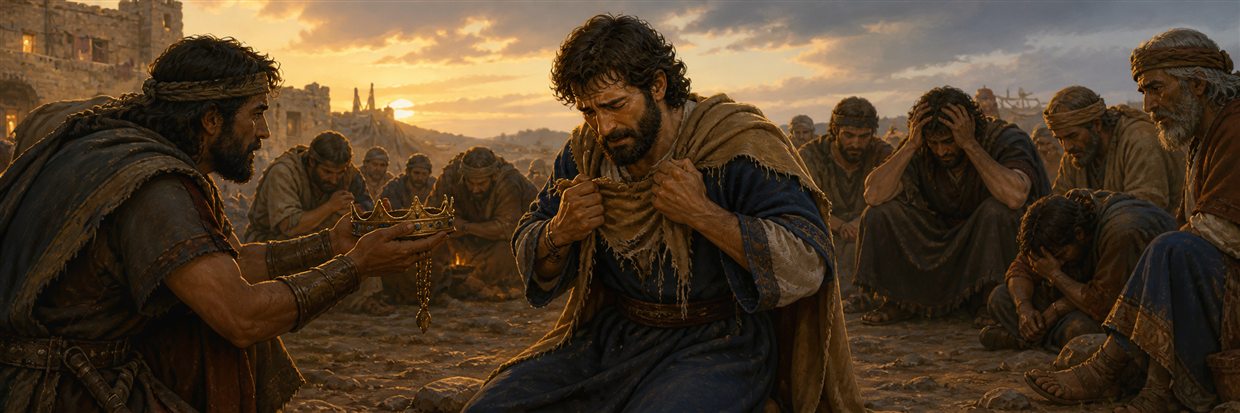
Prepared for BibleVerse · September 11, 2026. An initial editorial edition; independent specialist review is pending. Biblical references use the Berean Standard Bible. The illustration is interpretive artwork.