
The short summary
What is Daniel about?
In the twelve-chapter Hebrew and Aramaic form summarized here, Daniel combines stories of Jewish exiles at foreign courts with visions of kingdoms, persecution, judgment, and deliverance. Daniel and his companions face pressure over food, worship, and prayer. Dreams and visions portray human empires as temporary and God’s rule as enduring, ending with hope of resurrection and a charge to persevere.
Daniel 1:1–20; Daniel 3:16–18; Daniel 6:10–23; Daniel 7:9–14; Daniel 12:1–13.01 / Understand the whole
The book in context
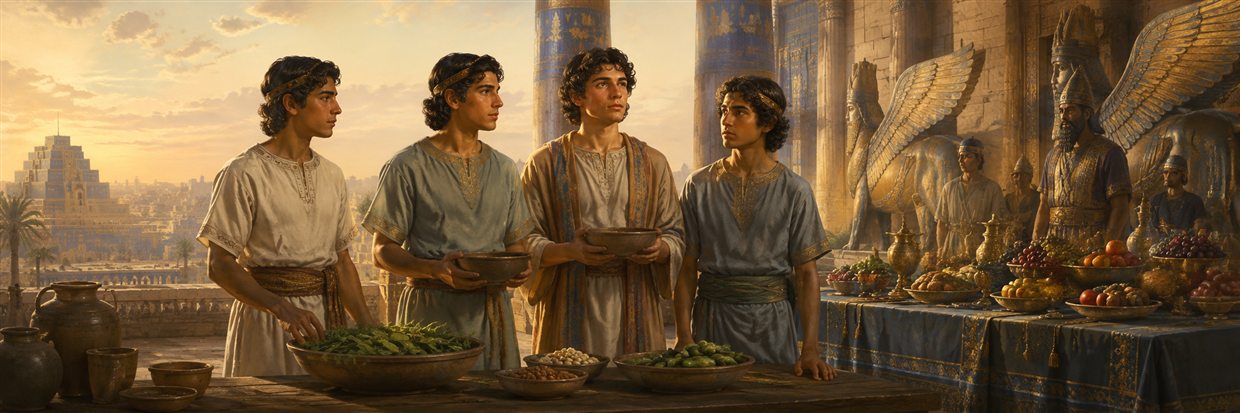
The court stories introduce Daniel and three companions taken into royal service in Babylon. They negotiate the king’s food and receive wisdom. Daniel interprets a dream of a statue and a kingdom that will endure. His companions refuse to worship a royal image and survive the furnace. Further episodes concern Nebuchadnezzar’s humiliation, writing at Belshazzar’s feast, and Daniel’s continued prayer despite a decree that leads to the lions’ den. Daniel 1:1–20; Daniel 2:31–45; Daniel 3:1–30; Daniel 4:28–37; Daniel 5:1–31; Daniel 6:1–28.
From chapter 7, Daniel’s own visions become central. Beasts represent kingdoms, and a heavenly court announces judgment and enduring dominion. A ram and goat are interpreted in relation to Media, Persia, and Greece. Daniel’s prayer over Jerusalem’s desolation is followed by a message about seventy weeks. These passages use symbolic images and interpreted visions, whose application to later events is understood differently across interpretive traditions. Daniel 7:1–28; Daniel 8:1–27; Daniel 9:1–27.
The final vision describes conflicts between rulers, desecration, and pressure on the faithful. Its conclusion speaks of deliverance, resurrection, and the vindication of the wise, while Daniel is told to seal the words and go his way. The Greek additions—including Susanna, Bel and the Dragon, and the prayer and song associated with the furnace—belong to other forms of Daniel and are not summarized in this twelve-chapter overview. Daniel 10:1–14; Daniel 11:21–35; Daniel 12:1–13.
02 / Follow the structure
A reading outline
A chapter-level reading guide; some literary movements cross these boundaries. Each link opens the section’s first chapter.
- 1–2Exiles and royal wisdomDaniel and his companions enter service, and a royal dream reveals the limits of earthly kingdoms.
- 3–4Worship and royal prideThe furnace narrative and Nebuchadnezzar’s humiliation challenge royal claims.
- 5–6Judgment and faithful prayerBelshazzar’s feast and the lions’ den continue the court stories.
- 7–8Visions of kingdomsBeasts, a heavenly court, a ram, and a goat portray successive powers and judgment.
- 9Prayer and seventy weeksConfession over Jerusalem’s desolation leads to an interpreted message.
- 10–12Conflict and final hopeA long vision culminates in deliverance, resurrection, and a charge to persevere.
03 / Notice the connections
Major themes
Faithfulness without guaranteed escape
The three companions refuse the image even while allowing that they might not be rescued. Their response should be read before the narrative of deliverance. Daniel 3:16–18.
The limits of imperial power
The statue dream and heavenly court contrast passing kingdoms with enduring divine rule. Daniel 2:44–45; Daniel 7:9–14.
Hope amid persecution
The final vision names suffering among the wise while promising deliverance and resurrection. Daniel 11:31–35; Daniel 12:1–3.
04 / Background
Background at a glance
- Literary form
- Court narratives and apocalyptic visions
- Setting in the text
- Babylonian and Persian courts in the narrative; visions of later conflict
More about the background
The USCCB introduction distinguishes the court tales from apocalyptic visions and places the book’s composition in the persecution under Antiochus IV. That is an attributed scholarly dating, distinct from the earlier setting of its stories. It also identifies the Greek additions retained in Catholic and Orthodox traditions; their chapter collections here preserve those texts and their own counts. [1]
The narrative names rulers of Babylon and Persia, while an interpretation within a vision explicitly names Media, Persia, and Greece. These different horizons help distinguish the setting of Daniel’s narrated life from the kingdoms addressed in the visions. This overview uses BSB references and does not claim that all interpretations are settled. Daniel 1:1; Daniel 6:28; Daniel 8:20–22.
05 / Return to the text
Passages to explore
Passage links open the Berean Standard Bible. These selections offer starting points for exploring the book.
The companions’ refusal
Notice the distinction between God’s ability to rescue and their commitment even without rescue.
Daniel 3:16–18 MemorizeThe heavenly court
Read the judgment scene and the grant of enduring dominion together.
Daniel 7:9–14 MemorizeDeliverance and the final charge
Keep resurrection hope alongside distress, limited understanding, and the instruction to persevere.
Daniel 12:1–13 MemorizeDoes every Bible contain the same form of Daniel?
No. This overview follows the BSB’s twelve chapters. Greek forms include additional material, such as Susanna, Bel and the Dragon, and prayer and praise in the furnace narrative. The USCCB introduction cited in Sources explains this distinction; the selected library tradition keeps its own edition and chapter collection.
Read Daniel
Sources and reading notes
The summaries describe the biblical text; passage references let you check them in context. Historical and authorship notes are attributed separately. The outlines and passage selections are editorial reading aids.
- United States Conference of Catholic Bishops. The Book of Daniel. New American Bible introduction; Discussion of composition under Antiochus IV; distinction between court stories, visions, and Greek additions. Catholic reference perspective. Accessed September 11, 2026. ↩
Prepared for BibleVerse · September 11, 2026. An initial editorial edition; independent specialist review is pending. Biblical references use the Berean Standard Bible. The illustration is interpretive artwork.