
The short summary
What is Psalm 151 about?
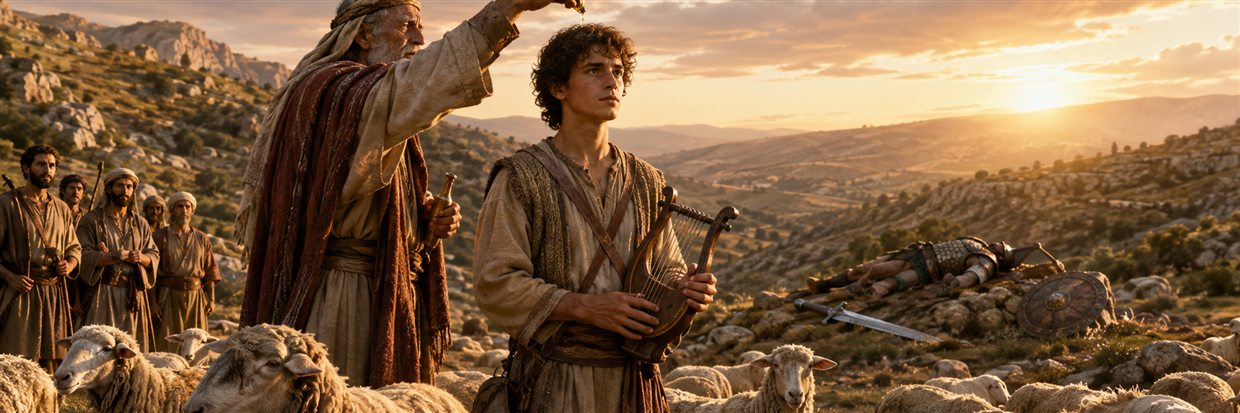
Psalm 151 recalls David’s humble place in his family, his care for sheep, and his music. He describes God choosing and anointing him rather than his tall and handsome brothers. The closing verses turn to his encounter with the Philistine and the removal of Israel’s disgrace through victory.
Psalm 151:1–7.01 / Understand the whole
The book in context
The speaker begins as the youngest and small among his brothers, occupied with his father’s sheep. His hands make a musical instrument. This modest opening places the future victor in the ordinary life of a shepherd and musician. Psalm 151:1–2.
The psalm then turns to the Lord who hears and acts. David is taken from the sheep and anointed, while the outward impressiveness of his brothers does not determine God’s choice. Psalm 151:3–5.
The final movement compresses the confrontation with the Philistine into two verses. The opponent curses by his idols, but David defeats him with his own sword. The conclusion interprets the victory as removing reproach from Israel. Psalm 151:6–7.
02 / Follow the structure
A reading outline
A verse-level guide to this seven-verse psalm. Each link opens Psalm 151.
03 / Notice the connections
Major themes
An unexpected choice
The contrast between David and his brothers emphasizes the Lord’s initiative. Psalm 151:1–5.
Music and attention
The shepherd’s music appears beside the assurance that the Lord hears. Psalm 151:2–3.
A personal victory for Israel
The ending connects David’s encounter with the honor of the wider people. Psalm 151:6–7.
04 / Background
Background at a glance
- Literary form
- A brief first-person psalm
- Setting in the text
- David’s youth, anointing, and encounter with the Philistine
More about the background
The Society for Old Testament Study notes that Psalm 151 appears in the Septuagint but is absent from the Masoretic Psalter, and that a related Hebrew text was found at Qumran. It identifies the author as unknown. The psalm speaks in David’s voice; that literary attribution does not establish who composed it. [1]
This overview follows the seven verses of Brenton’s Greek-based translation, including its heading within verse 1. It is a guide to one additional psalm, not a separate 151-chapter book. The reading links open Psalm 151 within the Orthodox Psalter.
05 / Return to the text
Passages to explore
Passage links open the Brenton Septuagint Translation. These selections offer starting points for exploring the book.
Before the victory
What details describe David before he is presented as a victor?
Psalm 151:1–2 MemorizeWhy is this called Psalm 151?
It is an additional psalm following the usual collection of 150. On this site it appears at the end of the Brenton Psalter in the Orthodox library. This overview follows that seven-verse text rather than treating it as an independent book. Psalm 151:1–7.
Read Psalm 151
Sources and reading notes
The summaries describe the biblical text; passage references let you check them in context. Historical and authorship notes are attributed separately. The outlines and passage selections are editorial reading aids.
- The Society for Old Testament Study. Psalm 151. Scholarly reference article; “Name” and “Date and authorship”. Hebrew Bible research perspective. Accessed September 11, 2026. ↩
Prepared for BibleVerse · September 11, 2026. An initial editorial edition; independent specialist review is pending. Biblical references use the Brenton Septuagint Translation. The illustration is interpretive artwork.