Holidays in the Bible
See which Jewish, Christian and Islamic holidays the Bible commands, tells or names, and where the rest come from.

Holidays in the Bible · Christian
Ascension Thursday · Holy Thursday (older English use)
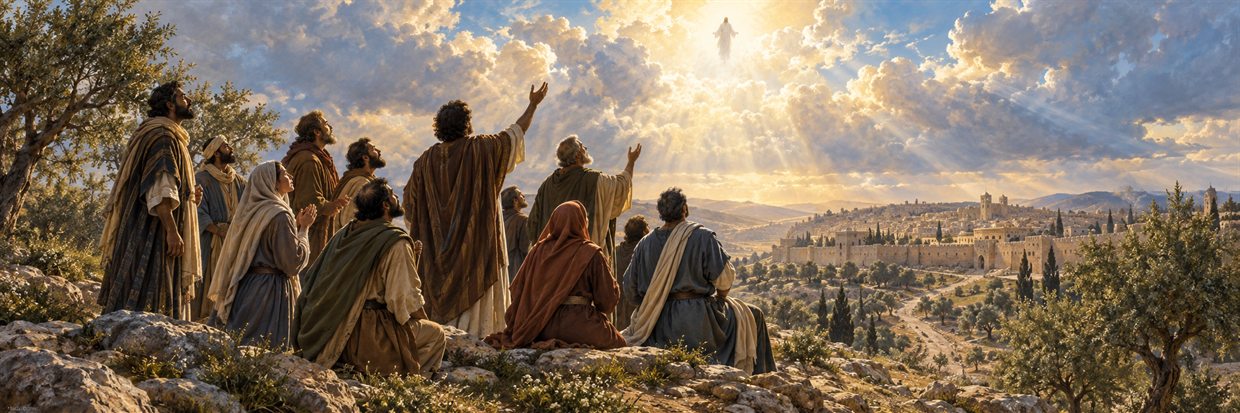
Ascension Day commemorates Jesus being taken up into heaven. It traditionally falls on the fortieth day of Easter, a Thursday, though some churches celebrate it on the following Sunday.
When The fortieth day of Easter, a Thursday. 2026 14 May (Orthodox 21 May); the following Sunday where transferred.
Ascension Day commemorates Jesus being taken up into heaven. It traditionally falls on the fortieth day of Easter, a Thursday, though some churches celebrate it on the following Sunday. 11
The story is told twice by the same writer. Luke's Gospel ends with it: Jesus leads the eleven out as far as Bethany, lifts his hands, blesses them, and is carried up into heaven while he blesses them, and they return to Jerusalem with great joy (Luke 24:50-53). The Acts of the Apostles opens with it, and gives the forty days: Jesus appeared to them over forty days, told them to wait for the Spirit, was taken up as they watched, and the two men in white promised his return (Acts 1:1-11). The longer ending of Mark says he was taken up into heaven and sat at the right hand of God (Mark 16:19-20), and John has Jesus tell Mary Magdalene on Easter morning "I am ascending to my Father" (John 20:17) 3.
The day is kept by Catholic, Orthodox, Anglican, Lutheran, Methodist and Reformed churches and is one of the feasts nearly all Christians share; it is a holy day of obligation for Catholics and a public holiday in a number of countries, and in many countries where it is not a holiday the Catholic Church has moved it to the following Sunday 4. The Orthodox churches count it among the twelve Great Feasts 4.
Ascension Day draws on the New Testament accounts of Jesus being taken up into heaven. Its development as a separate annual feast is documented in early church writings.
Luke 24:50–53 and Acts 1:1–11 describe the ascension. Mark 16:19 also describes it in the Gospel's longer ending. Other New Testament passages speak of Jesus' exaltation (Romans 8:34, Philippians 2:9-11, 1 Peter 3:21-22) 3. Luke's Gospel, read on its own, seems to place the ascension on Easter evening, and Acts places it forty days later; the church follows Acts for the day and reads both 3. Paul reads the ascension through Psalm 68:18, "you have ascended on high, you have led captives away" (Ephesians 4:8-10), and the letter to the Hebrews calls Jesus the high priest who has passed through the heavens (Hebrews 4:14); the churches sing Psalm 47, "God has ascended amid shouts of joy," and read Psalm 110:1, "sit at my right hand," and Daniel's Son of Man coming with the clouds (Daniel 7:13-14). These interpretations belong to Christian tradition.
The Catholic Encyclopedia's historical account points to fourth- and early fifth-century evidence for the feast. It also records Augustine's belief that the observance came from the apostles. Augustine's attribution is evidence of his understanding of the feast, rather than proof of an apostolic institution. The precise stages by which Ascension became a separate feast are less certain 1,4.
The place is the Mount of Olives. Before Constantine, Christians honoured the ascension in a cave on the mount; by 384, when Egeria came, the feast was kept at an open hillock uphill from it, and between 384 and 390 a Roman noblewoman, Poimenia, built a round church open to the sky there, the Imbomon, around what were held to be Christ's last footprints 5. Persians destroyed it in 614, it was rebuilt, the Crusaders built it again, and after 1187 Saladin made the mount a waqf and the small octagonal chapel that survived was made a mosque with a mihrab, which it remains 5. The Western feast gained a vigil, and in the fifteenth century an octave set apart as a novena of preparation for Pentecost 1,4.
| Passage | What it is | Edition |
|---|---|---|
| Acts 1:1-11 | Tells the event | Berean Standard Bible |
| Luke 24:50-53 | Tells the event | Berean Standard Bible |
| Mark 16:19-20 | Tells the event | Berean Standard Bible |
| Ephesians 1:17-23 | Read on the day | Berean Standard Bible |
| Matthew 28:16-20 | Read on the day | Berean Standard Bible |
| Ephesians 4:7-10 | Read on the day | Berean Standard Bible |
| Psalm 47 | A Christian reading | Berean Standard Bible |
Who keeps it Catholic, Orthodox, Anglican, Lutheran and many other churches, forty days after Easter; many Catholic dioceses in the United States move it to the following Sunday.
Western churches keep the day with Mass and the reading of Acts 1, the three Rogation days of prayer for the crops before it, and the paschal candle put out or moved after the Gospel; the Orthodox keep an all-night vigil after taking leave of Pascha the day before.
In the Catholic Church the Ascension is a solemnity and a holy day of obligation; in Australia since 1992, Ireland since 1997, Canada and most of the United States since the late 1990s, and other countries where the Thursday is not a public holiday, the bishops have moved it with Rome's permission to the following Sunday, the seventh Sunday of Easter, and the United Methodist Church allows the same 4. England and Wales moved it to Sunday from 2007 and put it back on the Thursday in 2018 4. The Book of Common Prayer lists Holy Thursday as another name for the day, which is why William Blake's poem of that name is about Ascension Day and not the Thursday before Easter 4. Ascensiontide, the ten days to Pentecost, is kept by Anglicans and others as a time of waiting for the Spirit, and the Sunday within it is the Sunday after Ascension Day in the Prayer Book 4.
Older customs made the day's picture visible. The Catholic Encyclopedia lists processions with torches and banners going out from the church to imitate Christ's journey to the Mount of Olives, the blessing of beans and grapes at the Mass, the putting out of the paschal candle that had burned since the Easter Vigil, and in some churches the figure of Christ raised above the altar through an opening in the roof 1. Today the paschal candle stays lit at the more solemn services until Pentecost, though some traditions still put it out after the Gospel on Ascension Day 9. The three days before the feast are the Rogation days, introduced around 470 by Mamertus, bishop of Vienne, ordered by the Council of Orleans in 511 and taken into the Roman rite under Leo III; they are days of litany and procession for the crops, kept in England as beating the bounds, when the parish walked its boundary and prayed for its protection, a custom the Church of England kept after the Reformation and some parishes keep still 6.
In the Orthodox churches the day before is the leave-taking of Pascha, when the Paschal Hours are said and the Easter greeting exchanged for the last time; the Ascension is kept with an all-night vigil, the epitaphios that has lain on the altar since Holy Saturday is carried in procession and put away, and the Liturgy reads Acts 1:1-12 and Luke 24:36-53 4. The hymn of the day sings "Thou hast ascended in glory, O Christ our God, granting joy to thy disciples by the promise of the Holy Spirit," and the Orthodox Church explains the feast as Christ's going to the Father in order to be glorified with him and to glorify us with himself, opening the way for all flesh into the sanctuary of heaven 2. The feast has an afterfeast of eight days, and the Sunday after it is the Sunday of the Fathers of the First Council of Nicaea, whose creed carries the words "he ascended into heaven and sits at the right hand of the Father" 4.
Most Baptist, Pentecostal and non-denominational churches keep no Ascension Day, though the ascension itself is in every Christian creed and the story is read in the week's sermons where the church follows a lectionary; Lutheran churches count it a feast, and Bach wrote cantatas and an Ascension Oratorio for the day 4.
These passages offer a starting point for study. Service readings and verse numbering can differ by tradition, Bible edition and year; use the relevant community's calendar for a particular service.
Acts 1 is a central reading for Ascension. Other readings vary with the church and its annual cycle.
The Roman lectionary, shared by Anglican and Lutheran churches, reads Acts 1:1-11 as the first reading, Psalm 47, "God has ascended amid shouts of joy," Ephesians 1:17-23, Christ seated at God's right hand far above every rule, and the Gospel of the year: the great commission in Matthew 28:16-20 (A), the longer ending in Mark 16:15-20 (B), and Luke's own account in Luke 24:46-53 (C). Year B may read Ephesians 4:1-13 instead, with Paul's "when he ascended on high." The Byzantine Liturgy reads Acts 1:1-12 and Luke 24:36-53, and the vigil Gospel is Mark 16:9-20 4.
The two men in white and their promise that "this same Jesus will come back in the same way you have seen him go" (Acts 1:11) make the feast look forward as well as up; the creeds put the ascension and the coming again in one breath, and the Orthodox afterfeast ends on the Sunday that remembers the council that wrote those words 4.
For an example with precise references, the U.S. Roman calendar for 2027 (Year B) lists Acts 1:1–11; Ephesians 1:17–23 or the specified alternatives from Ephesians 4; and Mark 16:15–20. The same readings apply where the feast transfers to Sunday. 11
In brief Acts 1:1-11; Ephesians 1:17-23; Matthew 28:16-20 (A), Mark 16:15-20 (B), Luke 24:46-53 (C).
Jewish Scripture includes accounts of Enoch being taken by God and Elijah being taken up in a whirlwind. These provide background for studying the New Testament ascension accounts.
The Bible a Jew and a Christian share tells of Enoch and Elijah: Enoch, who "walked with God, and then he was no more, because God had taken him away" (Genesis 5:24), and Elijah, taken up in a whirlwind as a chariot and horses of fire separated him from Elisha while Elisha watched and took up his mantle (2 Kings 2:11) 7. Jewish tradition looks for Elijah's return before the day of the Lord (Malachi 4:5), sets a cup for him at the Passover seder, names him at Havdalah as Shabbat ends and at every circumcision 7; readers of Luke's day knew those stories and others like them, and Acts' account of a man taken up in the sight of his disciples, who will return, is told in their shape 3. The Gospels say some people took Jesus for Elijah, and answer that John the Baptist was the Elijah who was to come 7.
Zechariah 14:4 also gives the Mount of Olives a place in Jewish scriptural hope. Its significance in Jewish tradition should be understood in its own terms, alongside its importance in the Christian account of the Ascension 10.
Muslims do not keep Ascension Day, but the Qur'an says God raised Jesus up to himself, and most Muslim scholars hold that Jesus was taken to heaven alive and will return.
The Qur'an says of Jesus that "they did not kill him, nor did they crucify him, but it was made to appear to them so," and that "God raised him up to himself" (Qur'an 4:157-158, with 3:55); most Islamic scholars have understood this to mean that Jesus was not crucified but was taken bodily into heaven, though some Muslim thinkers, early and modern, have read the verses otherwise 8. Islamic tradition holds that Jesus will return at the end of days, defeat the false messiah, rule in justice and then die a natural death 8. Christian teaching places the Ascension after Jesus' crucifixion and resurrection. The Qur'anic passage presents a different account of what happened to Jesus 8.
The traditional date is the fortieth day of Easter, counting Easter Sunday as day one: 39 days later, on a Thursday. Some churches transfer the celebration to the following Sunday.
Because Easter moves with the moon, Ascension Thursday falls between 30 April and 3 June in the West, and the Orthodox feast, counted from the Julian Pascha, between 13 May and 16 June, usually one, four or five weeks after the Western day and occasionally on the same day 4. Where a bishops' conference has moved the feast to Sunday, it is kept on the seventh Sunday of Easter, three days later, and the Thursday is an ordinary weekday; in the countries that keep the Thursday as a public holiday it is a day off work 4.
Pentecost is ten days after the Thursday, on the fiftieth day of Easter, so the two feasts always fall in the same fortnight; the Shavuot and Pentecost page has that day, and the Easter page explains why the Eastern and Western dates differ.
| Rule | 2026 | 2027 |
|---|---|---|
| The fortieth day of Easter, a Thursday | 14 May (Orthodox 21 May); the following Sunday where transferred | 6 May (Orthodox 10 June); the following Sunday where transferred |
Luke 24:50–53 and Acts 1:1–11 describe Jesus being taken up into heaven. Mark 16:19 also describes it in the Gospel's longer ending. The annual feast developed through church tradition 1,3,4.
Counting Easter Sunday as day one places the fortieth day on a Thursday. Some churches retain that date and others transfer the celebration to Sunday. The U.S. Roman calendar, for example, specifies different arrangements by ecclesiastical province 11.
Luke's Gospel, read on its own, runs from Easter morning to the ascension without a break, and Acts says forty days passed. The same author wrote both. The church follows Acts for the day and reads both accounts; scholars have proposed various ways of fitting them together 3.
The Monday, Tuesday and Wednesday before Ascension Thursday, days of litany and procession asking God's blessing on the crops, begun around 470 by Bishop Mamertus of Vienne. In England the parish walked its boundary, beating the bounds, a custom some parishes keep still 6.
Qur'an 4:158 says God raised Jesus to himself. A widespread Islamic interpretation holds that Jesus was raised alive and will return, though interpretations differ. Christian teaching places the Ascension after the crucifixion and resurrection 8.
Quoted from the Berean Standard Bible; each links to its chapter and carries a Memorize button that starts the five-step path. Switch the edition to read them in another Bible here.
After He had said this, they watched as He was taken up, and a cloud hid Him from their sight.
The moment itself: taken up as they watched, and a cloud hid him from their sight. The feast is this verse.
“Men of Galilee,” they said, “why do you stand here looking into the sky? This same Jesus, who has been taken from you into heaven, will come back in the same way you have seen Him go into heaven.”
The two men in white: this same Jesus will come back in the same way you have seen him go. The feast looks forward as well as up.
When Jesus had led them out as far as Bethany, He lifted up His hands and blessed them. While He was blessing them, He left them and was carried up into heaven.
Luke's telling: led out to Bethany, blessing them, carried up into heaven while he blessed them.
God has ascended amid shouts of joy, the LORD with the sound of the horn.
God has ascended amid shouts of joy. The psalm the churches sing on the day, read by Christians of Christ's ascending.
Make it part of your day
Optional further reading: you can explore the text without sharing its beliefs or taking part in the observance.
The last words the disciples heard on the mount, and the reason the feast looks forward.
The numbers match the references in the article. Links include religious texts, community explanations and historical studies. Read more about how this guide was researched.
BibleVerse Editorial, "Ascension: What It Marks, Where It Comes From, and How It Is Kept", BibleVerse, published 2026-09-12, updated 2026-09-12, https://bibleverse.site/holidays/ascension/
Version 1.0. Awaiting review by a member of the community it describes. Dates in the table are for 2026 and 2027 and are refreshed yearly. Corrections are welcome through the contact page.
See which Jewish, Christian and Islamic holidays the Bible commands, tells or names, and where the rest come from.
Shavuot celebrates the wheat harvest and, in rabbinic Jewish tradition, the giving of the Torah at Sinai. Christian Pentecost commemorates the coming of the Holy Spirit. Their histories are connected, but each has its own meaning and calendar.
Explore shared roots, distinct scriptures and differences in belief.