Holidays in the Bible
See which Jewish, Christian and Islamic holidays the Bible commands, tells or names, and where the rest come from.
Holidays in the Bible · Jewish and Christian
Shavuot celebrates the wheat harvest and, in rabbinic Jewish tradition, the giving of the Torah at Sinai. Christian Pentecost commemorates the coming of the Holy Spirit. Their histories are connected, but each has its own meaning and calendar.
When Shavuot follows the Jewish calendar; Christian Pentecost is the fiftieth day of Easter. 2026 Shavuot: Evening of 21 May to 23 May; one day in Israel and many Reform communities; two days in many diaspora communities; Christian Pentecost: 24 May (Orthodox 31 May).
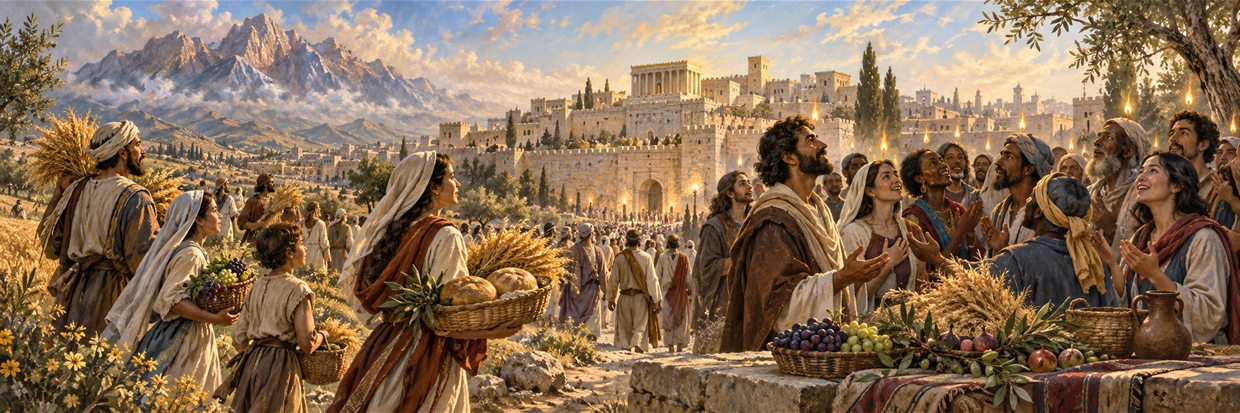
Shavuot celebrates the wheat harvest and, in rabbinic Jewish tradition, the giving of the Torah at Sinai. Christian Pentecost commemorates the coming of the Holy Spirit. Their histories are connected, but each has its own meaning and calendar.
For Jews the day has two layers. The Torah gives it as a harvest festival, the Feast of Weeks, when the first wheat was brought to the Temple (Exodus 34:22, Numbers 28:26). The rabbis added the second layer: counting the days from the exodus in Exodus 19, they placed the giving of the Ten Commandments on the sixth of Sivan, the day of Shavuot, and the festival became the anniversary of Sinai, the day Israel received the Torah (Talmud Shabbat 86b) 1,2. That is what the synagogue celebrates now: the covenant, with the Ten Commandments read aloud and the congregation standing.
For Christians the day is the one Acts 2 tells. When the day of Pentecost came the disciples were together in Jerusalem, a sound like wind filled the house, tongues of fire rested on each of them, and they spoke in languages that the pilgrims from every nation, in the city for the festival, could understand. Peter preached, about three thousand people were baptised, and the churches call the day the birthday of the church 3. The Greek word Pentecost, the fiftieth, is simply the name Greek-speaking Jews used for Shavuot, and Luke uses it as a date 3.
The Torah describes Shavuot as a harvest festival after a seven-week count. Rabbinic tradition connects it with the giving of the Torah at Sinai. Acts 2 places the coming of the Holy Spirit at this Jewish festival.
Leviticus 23:15-22 commands the count: from the day the first sheaf of barley was offered at Passover, seven full weeks, and on the fiftieth day a new offering of two loaves of the wheat harvest, a holy convocation and no work. Deuteronomy 16:9-12 calls it the Feast of Weeks, Shavuot, and makes it one of the three pilgrimages; Exodus 23:16 calls it the feast of harvest. Leviticus dates the festival by a count rather than a day of the month, which is why the counting of the omer runs between Passover and Shavuot to this day 1.
The Torah does not say when the Ten Commandments were given. The rabbis worked it out from Exodus 19:1, which places Israel at Sinai in the third month, and concluded that the Torah was given on the sixth of Sivan, or, in Rabbi Yosei's view, the seventh, reflecting a rabbinic discussion of the chronology (Talmud Shabbat 86b). The prayer book calls the day the season of the giving of our Torah, and the giving of the Torah is a central theme in its prayers and study customs 1,2.
Luke sets Acts 2 on the day of Pentecost without saying more about the festival than its name and the crowds it drew; the pilgrims he lists, from Parthia to Rome, were in Jerusalem because Shavuot was a pilgrimage. Peter's sermon reads the event through Joel 2:28-32, in the last days I will pour out my Spirit on all people, and the churches have kept the day as the coming of the Spirit ever since; Tertullian, about the year 200, already treats it as an established season for baptism 4. Christian preaching often pairs the Torah given at Sinai with the Spirit given in Jerusalem. This is a Christian theological comparison, drawing on the Jewish association of Shavuot with Sinai.
| Passage | What it is | Edition |
|---|---|---|
| Exodus 23:16 | Institutes the day | JPS TaNaKH 1917 |
| Exodus 34:22 | Institutes the day | JPS TaNaKH 1917 |
| Leviticus 23:15-22 | Institutes the day | JPS TaNaKH 1917 |
| Numbers 28:26-31 | Institutes the day | JPS TaNaKH 1917 |
| Deuteronomy 16:9-12 | Institutes the day | JPS TaNaKH 1917 |
| 2 Chronicles 8:13 | Names the holiday | JPS TaNaKH 1917 |
| Acts 20:16 | Names the holiday | Berean Standard Bible |
| 1 Corinthians 16:8 | Names the holiday | Berean Standard Bible |
| Exodus 19 | Read on the day | JPS TaNaKH 1917 |
| Exodus 20 | Read on the day | JPS TaNaKH 1917 |
| the Book of Ruth | Read on the day | JPS TaNaKH 1917 |
| Ezekiel 1 | Read on the day | JPS TaNaKH 1917 |
| Habakkuk 3 | Read on the day | JPS TaNaKH 1917 |
| Acts 2:1-41 | A Christian reading | Berean Standard Bible |
Who keeps it Many Rabbinic Jewish communities; one day in Israel and in Reform practice, two in Orthodox and Conservative communities outside Israel, with all-night Torah study, the reading of Ruth and dairy meals.
Jews keep Shavuot with a night of Torah study, the Ten Commandments read aloud, the Book of Ruth and dairy food. Many Western churches use red vestments and read Acts 2 at Pentecost; baptismal and other customs vary, on the fiftieth day of Easter.
In the synagogue: on the eve, many communities study all night, a custom from the sixteenth-century mystics of Safed called tikkun leil Shavuot, so as to be awake for the giving of the Torah at dawn; in the morning the Ten Commandments are read from Exodus 19 and 20 with the congregation standing, and the Book of Ruth is read, because Ruth's story is set at the barley and wheat harvest and because her choosing of Israel's God is read as a picture of Israel accepting the Torah. Homes are decorated with greenery and flowers for the harvest, and the meals are dairy, cheesecake and blintzes, a custom given several explanations 1,2. Yizkor, the memorial prayer, is said. Shavuot is one day in Israel and in Reform practice and two days in Orthodox and Conservative communities outside Israel, for the same reason as the second day of Passover 5.
In the churches: Pentecost Sunday is kept in red, for the tongues of fire, and is the second great day for baptism after Easter; in the Catholic Church the season of Easter ends with it, a vigil is kept the night before with readings from Genesis 11, Exodus 19, Ezekiel 37 and Joel, and the sequence Veni Sancte Spiritus is sung at Mass 4,3. In England the day was Whitsunday, from the white garments of the newly baptised 4. Anglican, Lutheran, Methodist and Presbyterian churches keep the day with the same readings; many decorate the church in red and read Acts 2 in as many languages as the congregation speaks.
The Orthodox Church keeps Pentecost as the feast of the Holy Trinity, with icons of the Trinity brought out, the church filled with green branches and flowers, and, at vespers on the afternoon of the feast, three long kneeling prayers, the first time the faithful kneel since Easter; the Monday after is the Day of the Holy Spirit, and the Sunday after is All Saints, because the Spirit's gifts are shown in the saints 6. The Pentecostal churches take their name from the day: the movement that began at Azusa Street in Los Angeles in 1906 holds that the gifts of Acts 2, speaking in tongues among them, are given to believers now, and its page on this site tells that story 3.
These passages offer a starting point for study. Service readings and verse numbering can differ by tradition, Bible edition and year; use the relevant community's calendar for a particular service.
Shavuot readings focus on Sinai and the Torah; Christian Pentecost readings focus on the Holy Spirit. The passages below are examples, with local and annual variations.
Synagogue, first day: Exodus 19:1 to 20:23, the arrival at Sinai and the Ten Commandments, with Numbers 28:26-31 as the maftir; haftarah Ezekiel 1, the vision of the chariot, another appearance of God's glory. Second day, outside Israel: Deuteronomy 15:19 to 16:17, the calendar of the pilgrimages; haftarah Habakkuk 3. The Book of Ruth is read before the Torah reading, and in Ashkenazi synagogues the Aramaic poem Akdamut is chanted before it 1.
For Roman Pentecost Mass during the day, the 2027 U.S. calendar lists Acts 2:1–11; 1 Corinthians 12:3b–7, 12–13 or Galatians 5:16–25; and John 20:19–23 or John 15:26–27; 16:12–15. The vigil has a separate set of readings and an extended form. Consult the linked calendar for those options. 11
The Orthodox Church in America's handbook identifies John 7:37–52 and 8:12 as the Pentecost Gospel. The final verse is part of the selection, even though it comes from the next chapter. 12
In brief First day: Exodus 19 to 20 (the giving of the Torah) and Numbers 28:26-31, haftarah Ezekiel 1. Second day: Deuteronomy 15:19 to 16:17, haftarah Habakkuk 3. The Book of Ruth.
The historical connection is clearest in Acts 2, which places its account of the Holy Spirit during the Jewish festival. Shavuot continues to have its own Jewish meaning, independent of Christian Pentecost.
Christian preaching often compares the giving of the Torah at Sinai with the giving of the Spirit in Jerusalem. Such comparisons express Christian interpretation; they do not replace Jewish understandings of Shavuot.
Acts is Christian scripture, not part of the Tanakh. Shavuot centers on Jewish themes of harvest and Torah; Christian Pentecost centers on the coming of the Holy Spirit. Their Gregorian dates may coincide or be weeks apart because they are calculated separately.
Counting practices need to be described community by community. Karaite Jews begin the Omer on the Sunday during the Festival of Unleavened Bread, placing Shavuot on a Sunday. The Union of Messianic Jewish Congregations instead instructs its participants to begin on Passover's second evening. A Sunday-based count should therefore not be assigned to all Messianic congregations. 9,10
In the fixed rabbinic calendar Shavuot begins on 6 Sivan, after the forty-nine-day Omer count beginning on 16 Nisan. Christian Pentecost is the fiftieth day of Easter, counting Easter Sunday as day one.
Both days are counts, not dates. The Torah says to count seven weeks from the day after the sabbath of Passover (Leviticus 23:15-16); the rabbis read that sabbath as the first festival day, so the count begins on the sixteenth of Nisan and ends on the sixth of Sivan, and the fixed calendar makes that a set date. Sadducees, and Karaites today, read the sabbath as the weekly Sabbath, so their fiftieth day is always a Sunday 7. The churches count fifty days inclusively from Easter Sunday, so Pentecost is always a Sunday and moves with Easter between 10 May and 13 June in the West; the Orthodox count from their own Pascha, so their Pentecost can be a week or more later 3.
Outside Israel, Orthodox and Conservative communities keep a second day of Shavuot on the seventh of Sivan; Israel and Reform practice keep one 5. The table gives the Jewish dates; Pentecost's own dates are on its card on the overview, and in 2026 the two fall two days apart.
| Rule | 2026 | 2027 |
|---|---|---|
| 6 Sivan in the fixed rabbinic calendar, after the forty-nine-day Omer count; a second festival day is observed in many diaspora communities | Evening of 21 May to 23 May; one day in Israel and many Reform communities; two days in many diaspora communities | Evening of 10 June to 12 June; one day in Israel and many Reform communities; two days in many diaspora communities |
They are historically connected but are distinct observances today. Pentecost is a Greek name for the Jewish Feast of Weeks, the setting of Acts 2. Christian Pentecost commemorates that account on the fiftieth day of Easter, while Shavuot follows the Jewish calendar. Their dates need not coincide 1,2.
Yes: Leviticus 23:15-22, Numbers 28:26-31, Deuteronomy 16:9-12 and Exodus 23:16 and 34:22 command it as the Feast of Weeks, the wheat harvest festival after the seven-week count from Passover. The Torah does not connect it to Mount Sinai; the rabbis made that connection from the dates in Exodus 19, and it is now the heart of the day 1,2.
The expression refers to Acts 2, where the Holy Spirit comes upon the disciples and about three thousand people are baptized after Peter's sermon. 'Birthday of the church' is a Christian description of this event, rather than a name used in Acts itself 3,4.
Dairy foods are a widespread Shavuot custom, with several traditional explanations. One connects the Torah with the imagery of milk and honey; others link it with the giving of the Torah at Sinai. Foods and customs vary by community 1,8.
Because its story is set at the barley and wheat harvest, the season of the festival; because Ruth's choosing of Israel's God is read as a picture of Israel accepting the Torah at Sinai; and because Ruth was the great-grandmother of King David, who tradition says was born and died on Shavuot 1,8.
Quoted from the JPS TaNaKH 1917; each links to its chapter and carries a Memorize button that starts the five-step path. Switch the edition to read them in another Bible here.
even unto the morrow after the seventh week shall ye number fifty days; and ye shall present a new meal-offering unto the LORD.
The Torah's count: number fifty days, and bring a new offering. Both traditions keep this arithmetic.
Now therefore, if ye will hearken unto My voice indeed, and keep My covenant, then ye shall be Mine own treasure from among all peoples; for all the earth is Mine; and ye shall be unto Me a kingdom of priests, and a holy nation. These are the words which thou shalt speak unto the children of Israel.'
God's words at Sinai before the Ten Commandments, read on Shavuot morning: a kingdom of priests and a holy nation.
And Ruth said: 'Entreat me not to leave thee, and to return from following after thee; for whither thou goest, I will go; and where thou lodgest, I will lodge; thy people shall be my people, and thy God my God;
Ruth's choice, read on Shavuot as a picture of taking on the covenant: thy people shall be my people, and thy God my God.
And thou shalt keep the feast of weeks unto the LORD thy God after the measure of the freewill-offering of thy hand, which thou shalt give, according as the LORD thy God blesseth thee.
The Feast of Weeks named and commanded, with the freewill offering of a people who have just brought in the harvest.
Make it part of your day
Optional further reading: you can explore the text without sharing its beliefs or taking part in the observance.
The words spoken at Sinai before the commandments, which the synagogue stands to hear every Shavuot.
Now therefore, if ye will hearken unto My voice indeed, and keep My covenant, then ye shall be Mine own treasure from among all peoples; for all the earth is Mine; and ye shall be unto Me a kingdom of priests, and a holy nation. These are the words which thou shalt speak unto the children of Israel.'
The numbers match the references in the article. Links include religious texts, community explanations and historical studies. Read more about how this guide was researched.
BibleVerse Editorial, "Shavuot and Pentecost: One Day, Two Traditions, and Where It Comes From", BibleVerse, published 2026-09-11, updated 2026-09-12, https://bibleverse.site/holidays/shavuot-pentecost/
Version 1.1. Awaiting review by a member of the community it describes. Dates in the table are for 2026 and 2027 and are refreshed yearly. Corrections are welcome through the contact page.
See which Jewish, Christian and Islamic holidays the Bible commands, tells or names, and where the rest come from.
Passover, or Pesach, is the Jewish festival commemorating the Israelites' freedom from slavery in Egypt. The seder meal brings families and friends together to tell the Exodus story.
Follow the branching histories of Christian and Jewish traditions.