Holidays in the Bible
See which Jewish, Christian and Islamic holidays the Bible commands, tells or names, and where the rest come from.

Holidays in the Bible · Jewish
Passover
Passover, or Pesach, is the Jewish festival commemorating the Israelites' freedom from slavery in Egypt. The seder meal brings families and friends together to tell the Exodus story.
When 15 to 21 Nisan (22 outside Israel), beginning at the full moon of the first month. 2026 Evening of 1 April to 9 April; eighth day only outside Israel.
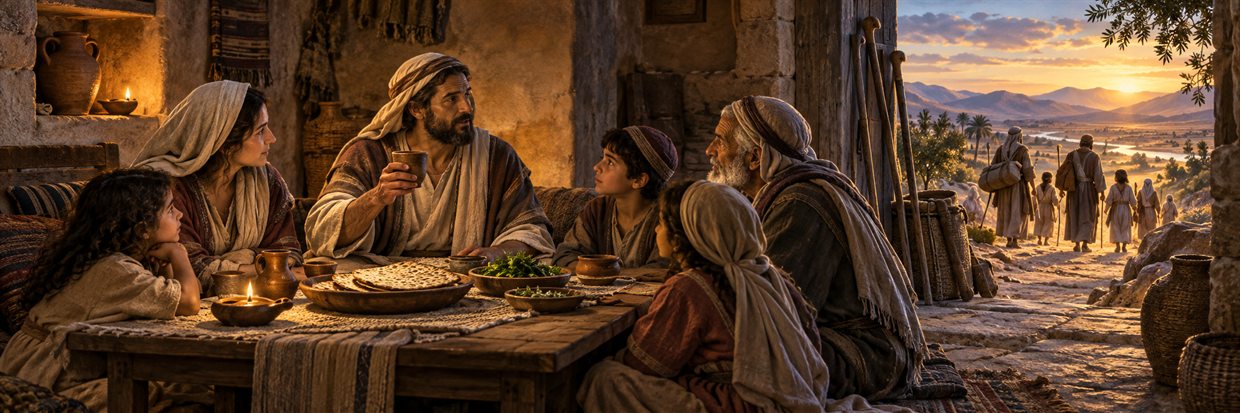
Passover, or Pesach, is the Jewish festival commemorating the Israelites' freedom from slavery in Egypt. The seder meal brings families and friends together to tell the Exodus story.
The story is in the Book of Exodus. Ten plagues fall on Egypt. Before the last one, each Israelite family kills a lamb, puts its blood on the doorposts, and eats the lamb in haste with unleavened bread and bitter herbs. That night death passes over the marked houses, and by morning Pharaoh has sent the people away (Exodus 12:1-42). The Hebrew name Pesach comes from that passing over; the English name Passover is a translation of it 3.
Jewish tradition counts the exodus as the year 2448 from creation, which is 1313 BCE by that reckoning 4. Historians give no firm date, and the page does not choose one. What the festival keeps is not a date but a memory: the Torah's command that the story be told to the next generation as if each person had come out of Egypt themselves (Exodus 13:8), and the Haggadah says exactly that at the seder 2.
Exodus describes the Passover offering, matzah and bitter herbs, along with the command to remember the deliverance from Egypt. Rabbinic tradition developed the seder's structure of readings, questions, blessings and symbolic foods.
The commandment is given in the middle of the story itself: this day is to be a memorial and a feast for ever (Exodus 12:14-20). Leviticus 23 sets the date, the fourteenth of the first month at dusk for the Passover offering and the fifteenth for seven days of unleavened bread; Numbers 28 gives the offerings; Deuteronomy 16 makes it a pilgrimage, to be kept only in the place God would choose. Numbers 9 adds a second Passover a month later for anyone who was unclean or far away 1.
The Bible then records the festival being kept at the turning points of Israel's story: at Gilgal after the crossing of the Jordan (Joshua 5), by Hezekiah after the fall of the northern kingdom (2 Chronicles 30), by Josiah in a Passover the writer says had no equal since the judges (2 Kings 23, 2 Chronicles 35), and by the returned exiles at the newly rebuilt Temple (Ezra 6) 1.
The Mishnah preserves a developed description of the seder, including four cups of wine that even the poorest must be given, a child's question about why this night is different, a telling that begins with disgrace and ends with praise, Rabban Gamliel's rule that whoever has not explained the Passover lamb, the matzah and the bitter herbs has not fulfilled the duty, and Hallel (Psalms 113 to 118) to close (Mishnah Pesachim 10) 2. The Haggadah grew from that chapter over the following centuries. The seder brings biblical instructions together with rabbinic interpretation and later customs 3.
| Passage | What it is | Edition |
|---|---|---|
| Exodus 12:1-28 | Institutes the day | JPS TaNaKH 1917 |
| Exodus 12:43-51 | Institutes the day | JPS TaNaKH 1917 |
| Exodus 13:3-10 | Institutes the day | JPS TaNaKH 1917 |
| Leviticus 23:4-8 | Institutes the day | JPS TaNaKH 1917 |
| Numbers 28:16-25 | Institutes the day | JPS TaNaKH 1917 |
| Deuteronomy 16:1-8 | Institutes the day | JPS TaNaKH 1917 |
| Numbers 9:1-14 (the second Passover) | Tells the event | JPS TaNaKH 1917 |
| Joshua 5:10-12 | Tells the event | JPS TaNaKH 1917 |
| 2 Kings 23:21-23 | Tells the event | JPS TaNaKH 1917 |
| 2 Chronicles 30 | Tells the event | JPS TaNaKH 1917 |
| 2 Chronicles 35:1-19 | Tells the event | JPS TaNaKH 1917 |
| Ezra 6:19-22 | Tells the event | JPS TaNaKH 1917 |
| John 2:13 | Names the holiday | Berean Standard Bible |
| Acts 12:3-4 | Names the holiday | Berean Standard Bible |
| the Song of Songs | Read on the day | JPS TaNaKH 1917 |
| Luke 22:7-20 | A Christian reading | Berean Standard Bible |
| Mark 14:12-26 | A Christian reading | Berean Standard Bible |
| John 19:14 | A Christian reading | Berean Standard Bible |
| 1 Corinthians 5:7-8 | A Christian reading | Berean Standard Bible |
Who keeps it Many Rabbinic Jewish communities: seven days in Israel and in Reform practice, eight in Orthodox and Conservative communities outside Israel, with a seder on the first night (and the second, outside Israel) and no leaven for the whole festival. Samaritans keep their own Passover with a lamb sacrifice on Mount Gerizim.
The house is cleaned of leaven, families gather for the seder on the first night, and for a week bread is replaced by matzah.
Before the festival every trace of chametz, leaven made from wheat, barley, oats, spelt or rye, is removed from the home or sold, and matzah baked in under eighteen minutes takes its place (Exodus 12:15) 3. The seder follows the Haggadah through its fixed order: kiddush, the washing of hands, greens dipped in salt water, the breaking of the middle matzah, the four questions, the telling, the meal, the hidden afikoman, grace, Hallel and the closing wish for next year in Jerusalem 3,4.
How long the festival lasts depends on where you are and which movement you belong to. In Israel Pesach is seven days, as Leviticus 23:6 says, with a single seder. Outside Israel, Orthodox and most Conservative communities keep eight days and two seders. The extra day is rabbinic: in Temple times the new month was fixed by witnesses in Jerusalem, distant communities could not be sure which day was the fifteenth, and they kept two to be safe; when the calendar was fixed the Talmud told them to keep the custom of their ancestors anyway (Talmud Beitzah 4b) 5,6. Reform Judaism set the second day aside, following the Breslau rabbinical conference of 1846, and generally keeps seven days; some Reform households nevertheless hold two seders. Reconstructionist congregations may choose one- or two-day festival observance 7,6,7.
The first and last days are Yom Tov, days of rest like the Sabbath (two at each end outside Israel in Orthodox and Conservative practice); the middle days are chol ha-moed, ordinary days inside the festival on which most work is allowed 4. The seventh day remembers the crossing of the sea, and Yizkor, the memorial prayer, is said on the last day.
The Israelite Samaritan community observes its own Passover tradition, including a sheep sacrifice on Mount Gerizim. Its community account describes the ceremony and the festival's pilgrimage. This is distinct from the rabbinic Jewish seder 13.
These passages offer a starting point for study. Service readings and verse numbering can differ by tradition, Bible edition and year; use the relevant community's calendar for a particular service.
On the first morning the synagogue reads the story of the night itself, and on the seventh the song at the sea.
First day: Exodus 12:21-51, the lamb, the blood on the doorposts and the departure, with Numbers 28:16-25 as the maftir and Joshua 5 as the haftarah, the first Passover in the land. Second day, outside Israel: Leviticus 22:26 to 23:44, the calendar of the festivals, and 2 Kings 23, Josiah's Passover. Seventh day: Exodus 13:17 to 15:26, the crossing of the sea and the song, with 2 Samuel 22, David's song. On the Sabbath of the festival the Song of Songs is read, because the rabbis heard in it the love between God and Israel that began in Egypt 3.
At home the reading is the Haggadah, whose heart is the passage that begins 'A wandering Aramean was my father' (Deuteronomy 26:5-8), expounded line by line as the Mishnah directs 2.
In brief First day: Exodus 12:21-51 and Numbers 28:16-25, haftarah Joshua 5:2 to 6:1. Seventh day: Exodus 13:17 to 15:26 (the song at the sea), haftarah 2 Samuel 22. The Song of Songs on the Sabbath of the festival. The Haggadah at the seder.
Christians read the Last Supper as a Passover meal, and Easter grew out of Passover before the church set it on a Sunday of its own.
In Matthew, Mark and Luke the Last Supper is the Passover meal, eaten on the night of the fifteenth of Nisan; in John Jesus dies on the day of preparation, when the lambs were being killed, before the meal. The two chronologies stand side by side in the New Testament, scholars have argued for each and for ways of reconciling them, and this page does not choose between them 11. Paul, writing to Corinth, told the church that 'Christ, our Passover lamb, has been sacrificed' and to keep the feast with the unleavened bread of sincerity (1 Corinthians 5:7-8); that is a Christian reading of the festival, and Christians hold it as one of the oldest they have.
The earliest Christians kept a yearly Pascha, and in most languages Easter is still called by that name, from Pesach. Churches in Asia Minor kept it on the fourteenth of Nisan by the Jewish calendar, whatever the day of the week; Rome kept the Sunday after. Polycrates of Ephesus wrote to Victor of Rome about the year 190 that his churches observed the exact day, neither adding nor taking away, and Victor tried to cut them off for it; Irenaeus wrote to Victor urging peace, and the churches went on differing until the Council of Nicaea in 325 asked them all to keep one Sunday reckoned without the Jewish calendar 12. How that was decided, and why Eastern and Western Easter still differ, is told on the holidays overview.
Some Messianic congregations and Christian groups also observe Passover, but their services and interpretations vary. A seder should not be assigned a single date or meaning across all these communities. In Jewish practice, Passover continues to commemorate the Exodus.
Pesach begins at the full moon of Nisan, the first month of spring, and falls in March or April.
The Torah fixes the fourteenth of the first month for the offering and the fifteenth for the feast (Leviticus 23:5-6), and names the month Aviv, the month of ripening barley (Deuteronomy 16:1). Because the Hebrew calendar's months follow the moon, a thirteenth month is added in seven years of every nineteen so that Nisan stays in spring; that is why the festival moves against the Gregorian calendar but never leaves March or April 1. Jewish days begin at sunset, so the first seder is on the evening before the date in the table.
The fixed calendar in use today is traditionally attributed to Hillel II in the fourth century CE. Its rules keep the first day of Pesach off Monday, Wednesday and Friday, which in turn keeps Yom Kippur off Friday and Sunday, so the whole year's festivals depend on where Pesach falls 1.
| Rule | 2026 | 2027 |
|---|---|---|
| 15 to 21 Nisan (22 outside Israel), beginning at the full moon of the first month | Evening of 1 April to 9 April; eighth day only outside Israel | Evening of 21 April to 29 April; eighth day only outside Israel |
Yes. Exodus 12 describes the departure from Egypt and commands an annual commemoration. Leviticus 23, Numbers 28 and Deuteronomy 16 give further instructions. The seder's prayers and rituals developed over time; the Mishnah records practices such as the four cups and questions about the meal. 1,2
The Torah says seven. Outside Israel, Orthodox and most Conservative communities keep eight, because in Temple times distant communities could not be sure of the new moon and kept an extra day to be safe, and the Talmud told them to keep that custom even after the calendar was fixed. In Israel, and in Reform practice since 1846, the festival is generally seven days; the number of seders may vary among Reform households 5,6,7.
No, but they are related. The Gospels place the death and resurrection of Jesus at Passover, and the earliest Christians kept their yearly Pascha, which is Easter's name in most languages, by the Jewish calendar. The Council of Nicaea in 325 set Easter on a Sunday reckoned without the Jewish calendar, so the two now usually fall in the same week and sometimes, as in 2027, in different months 11,12.
Yes. The Samaritan community, a small community of people, gathers on Mount Gerizim at twilight on the fourteenth of the first month by its own calendar, slaughters and roasts the sheep, and eats them at midnight with unleavened bread and bitter herbs, as Exodus 12 describes. Jews stopped offering the lamb when the Temple fell in 70 CE and tell the story instead 8,9.
Matzah instead of bread for the whole festival, and nothing made with leaven from the five grains. At the seder: matzah, bitter herbs, greens dipped in salt water, charoset, a roasted shank bone and an egg on the seder plate, and four cups of wine or grape juice. Customs about rice and beans differ between Ashkenazi and Sephardi communities 3,4.
Quoted from the JPS TaNaKH 1917; each links to its chapter and carries a Memorize button that starts the five-step path. Switch the edition to read them in another Bible here.
And this day shall be unto you for a memorial, and ye shall keep it a feast to the LORD; throughout your generations ye shall keep it a feast by an ordinance for ever.
The command in the middle of the story: a memorial and a feast for ever, which is why the festival has never lapsed.
And thou shalt tell thy son in that day, saying: It is because of that which the LORD did for me when I came forth out of Egypt.
The verse the Haggadah is built on. The seder is a father, or a mother, telling a child what God did for me.
Thou shalt eat no leavened bread with it; seven days shalt thou eat unleavened bread therewith, even the bread of affliction; for in haste didst thou come forth out of the land of Egypt; that thou mayest remember the day when thou camest forth out of the land of Egypt all the days of thy life.
The bread of affliction: matzah is eaten so that the day of leaving Egypt is remembered all the days of your life.
And it shall come to pass, when your children shall say unto you: What mean ye by this service? that ye shall say: It is the sacrifice of the LORD'S passover, for that He passed over the houses of the children of Israel in Egypt, when He smote the Egyptians, and delivered our houses.' And the people bowed the head and worshipped.
The child's question and the answer, from which the four questions of the seder grew.
Make it part of your day
Optional further reading: you can explore the text without sharing its beliefs or taking part in the observance.
One verse to memorize out of Egypt with you, the one every seder is built on.
And thou shalt tell thy son in that day, saying: It is because of that which the LORD did for me when I came forth out of Egypt.
The numbers match the references in the article. Links include religious texts, community explanations and historical studies. Read more about how this guide was researched.
BibleVerse Editorial, "Passover: What It Marks, Where It Comes From, and How It Is Kept", BibleVerse, published 2026-09-11, updated 2026-09-12, https://bibleverse.site/holidays/passover/
Version 1.1. Awaiting review by a member of the community it describes. Dates in the table are for 2026 and 2027 and are refreshed yearly. Corrections are welcome through the contact page.
See which Jewish, Christian and Islamic holidays the Bible commands, tells or names, and where the rest come from.
Easter celebrates the resurrection of Jesus. It falls on a Sunday, though Eastern and Western churches often celebrate on different dates.
Explore shared roots, distinct scriptures and differences in belief.