Shared inheritance
Each teaches worship of one God and gives Abraham and Moses an important place. Prayer, repentance, justice, charity and divine mercy matter in all three.
Comparative religion reference
A respectful guide to shared roots, distinct scriptures, and the beliefs that bring three Abrahamic traditions together and set them apart.
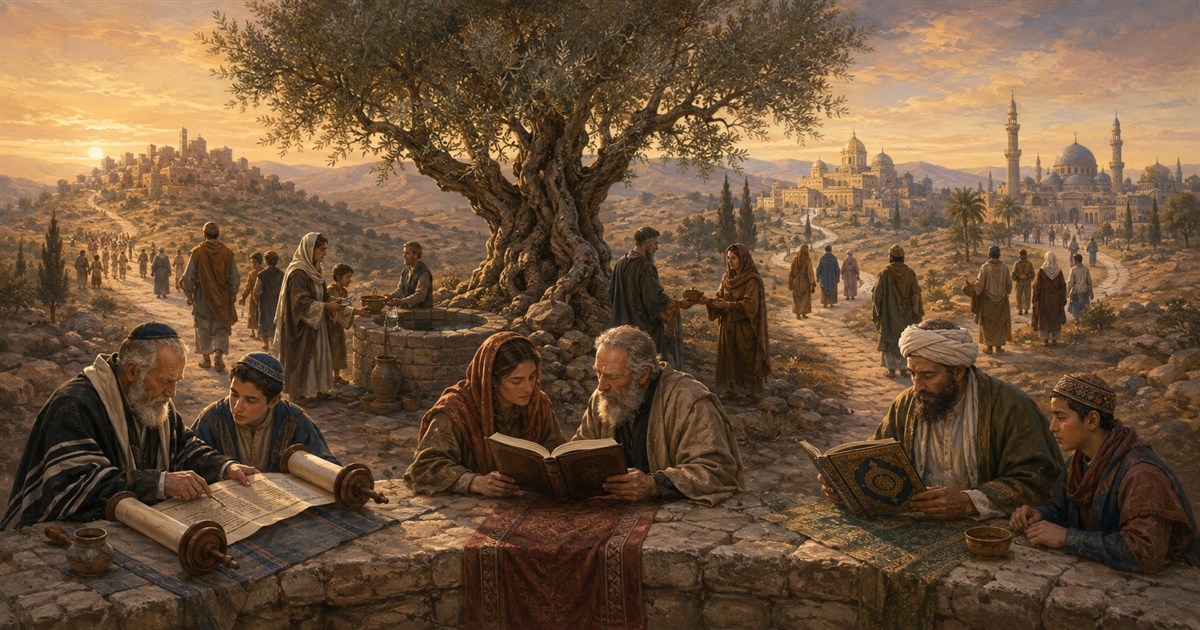
The traditions overlap because they draw on related people and stories. They differ because each locates religious authority and the culmination of revelation differently.
Each teaches worship of one God and gives Abraham and Moses an important place. Prayer, repentance, justice, charity and divine mercy matter in all three.
Judaism centers Torah and the Jewish interpretive tradition; Christianity reads Old and New Testaments in light of Christ; Islam receives the Qur’an as final revelation and the Sunnah as authoritative guidance.
Mainstream Judaism does not receive Jesus as Messiah. Christianity confesses him as Messiah and divine. Islam honors him as Messiah and prophet, but not as God or God’s son.
This matrix samples influential movements and communities. It compares the questions each tradition actually asks: who God is, how Jesus is understood, and where religious authority and practice are located.
| Community | God | Jesus | Authority & practice | Comparison bridge |
|---|---|---|---|---|
| Jewish movements · labels are most common in North America | ||||
| Orthodox JudaismRabbinic · halakhic | One and indivisible. Classical Jewish descriptions stress God’s unity and incomparability. | No doctrinal or devotional role; not received as Messiah or divine. | Written and Oral Torah interpreted through rabbinic tradition; halakhah is normative. | Its sustained legal interpretation is structurally comparable to Islamic fiqh; the sources, claims and rulings are distinct. [1] [11] [20] |
| Conservative / Masorti JudaismTradition and change | One God; the movement permits substantial theological diversity. | No doctrinal or devotional role; not received as Messiah or divine. | Halakhah remains authoritative and is interpreted as historically developing through rabbinic reasoning. | Balances inherited law with formal processes of change, a pattern found in other legal traditions without identical conclusions. [21] |
| Reform / Progressive JudaismLiberal Jewish movement | Affirms God, Torah and Israel while explicitly allowing diverse beliefs and doubt. | No doctrinal or devotional role; not received as Messiah or divine. | Torah is treated as living and God-inspired; informed individual and communal choice shapes observance. | Its contextual reading and ethical emphasis resemble some modern approaches elsewhere; its covenantal identity remains specifically Jewish. [22] |
| Reconstructionist JudaismEvolving religious civilization | Intentionally diverse. Many describe God in non-supernatural or transnatural terms and emphasize “Godliness.” | No normative doctrinal or devotional role. | Torah is understood as the Jewish people’s evolving response to the sacred; inherited practice is valued but not binding law. | Community, memory and evolving practice receive special emphasis; this should not be reduced to a creed about God. [23] |
| Christian communities · Trinitarian and non-Trinitarian distinctions named in each row | ||||
| Roman CatholicNicene · sacramental | One God in three distinct divine persons: Father, Son and Holy Spirit. | Eternal Son, fully divine and fully human; crucified and risen. | Scripture and apostolic Tradition, authoritatively interpreted by the Magisterium; seven sacraments. | Shares Nicene Christology with Orthodox and most Protestant churches; differs in papal and Magisterial authority. [2] [24] |
| Eastern OrthodoxNicene · conciliar | One God in three distinct divine persons; Father, Son and Holy Spirit share one divine being. | Eternal Son, fully divine and fully human; crucified and risen. | Scripture within Holy Tradition; councils, bishops, liturgy and patristic witness; sacramental or “mysterial” life. | Shares the Nicene center with Catholicism and most Protestants while retaining a distinct conciliar and liturgical tradition. [25] |
| Confessional LutheranLCMS as a documented example | Nicene Trinity: three distinct divine persons of one divine essence. | Divine and human Savior; his death and resurrection reconcile humanity to God. | Scripture is the final norm; Lutheran confessions summarize its teaching; Baptism and the Lord’s Supper are means of grace. | Shares Nicene doctrine while distinguishing law and gospel and emphasizing justification by grace through faith. [26] |
| BaptistSBC as a documented example | Trinitarian in the representative confession used here. | Divine Son, crucified and risen Savior. | Bible as supreme written authority; believer’s baptism and the Lord’s Supper as ordinances; local-church autonomy. | Shares the classic Christian doctrine of the Trinity with many Christians; believer’s baptism and congregational governance distinguish Baptist practice. [27] |
| Trinitarian PentecostalAssemblies of God example | One God as Father, Son and Holy Spirit. | Eternal divine Son; crucified, bodily raised and returning. | Bible as all-sufficient rule; conversion, water baptism, Communion, Spirit baptism and spiritual gifts receive strong emphasis. | Shares Trinitarian doctrine with most Christians; Pentecostal experience and continuing spiritual gifts are distinctive emphases. [28] |
| Oneness PentecostalUPCI example · non-Nicene | One God, not three eternal persons; revealed as Father, through the Son, and as Holy Spirit. | God manifested in flesh and genuinely human; his death and resurrection are saving events. | Bible as infallible authority; repentance, baptism in Jesus’ name and Spirit baptism with tongues emphasized. | Like Islam, rejects the Nicene three-person formulation; unlike Islam, confesses Jesus as God manifested in flesh. [29] [32] |
| Jehovah’s WitnessesChristian self-identification · non-Nicene | Jehovah alone is Almighty God; the Trinity is rejected. | Messiah, Savior and preexistent Son, understood as God’s first creation, not Almighty God. | The 66-book Bible is inspired; worldwide teaching and organization are directed through a Governing Body. | Shares with Islam rejection of the Trinity and of Jesus as Almighty God; its created, prehuman Son Christology is not Islamic. [30] [32] |
| Latter-day SaintsChristian self-identification · non-Nicene | Father, Son and Holy Ghost are three separate divine beings, perfectly united in purpose and doctrine. | Divine Son, Lord and Redeemer, distinct from the Father. | Bible, Book of Mormon, Doctrine and Covenants and Pearl of Great Price; continuing revelation and saving ordinances. | Its “Godhead” differs from both one-being Nicene doctrine and Islamic tawhid; the shared vocabulary should not hide that. [31] [32] |
| Muslim branches · Sufism can occur across branches and is not a separate row | ||||
| Sunni IslamMultiple theological and legal schools | Tawhid: God is absolutely one, without partner or offspring; the Trinity is rejected. | Honored Messiah, prophet and messenger of God, miraculously born; understood as human, not God or God’s son. | Qur’an and Prophetic Sunnah; scholarly interpretation and four major schools of law, alongside substantial internal diversity. | Shares Qur’an, prophecy, core ritual obligations and divine oneness with other Muslim branches; authority after Muhammad differs. [3] [32] |
| Twelver Shia IslamImami · Ja‘fari | Tawhid: God is one; the Trinity and divine sonship are rejected. | Honored Messiah, prophet and messenger of God; understood as human, not God. | Qur’an and Prophetic teaching as transmitted with the guidance of the Twelve Imams; Ja‘fari jurisprudence and learned maraji‘. | Shares Islam’s scripture and core confession; the divinely guided Imamate and its transmitted teaching distinguish Twelver authority. [32] [33] |
| Nizari Ismaili Shia IslamLiving hereditary Imam | God is one and transcendent. | Honored Messiah and messenger within the Qur’anic prophetic tradition; understood as human, not God. | The Qur’an is interpreted through the teaching authority of a living hereditary Imam; outward and inward meanings are held together. | Shares Shia emphasis on the Imamate. Nizari Ismailis follow a publicly present hereditary Imam; Twelvers believe their twelfth Imam remains alive in occultation (hidden from public presence). [33] [34] |
| Ibadi IslamHistorically distinct branch | Tawhid: God is one; the Trinity and divine sonship are rejected. | Honored prophet, Messiah and messenger of God; understood as human, not God. | Qur’an, Sunnah and a distinct Ibadi tradition of theology and jurisprudence; historically associated with an elected imamate. | Shares foundational Islamic beliefs with Sunni and Shia Muslims while preserving a separate legal, theological and political history. [32] [35] |
How to read it: the final column identifies one limited point of comparison, then names the difference that comparison can hide. The chart is representative, not exhaustive. “Orthodox,” “Conservative” and “Reform” are especially North American labels; “Baptist,” “Lutheran” and “Pentecostal” each contain more diversity than one row can show; and many Muslims identify simply as Muslim rather than by branch.
Familiar names recur across the three traditions, but a shared figure does not always have the same role or meaning.
God is one and incomparable. The Shema, “the LORD is our God, the LORD alone,” stands at the heart of Jewish confession and prayer.
Nicene Christianity teaches one God in three distinct divine persons: Father, Son and Holy Spirit. “Persons” means real distinctions within the one divine being, not three separate gods or simply three roles or representations of God.
God (Allah) is one, unique and without partner or offspring. This divine oneness is commonly called tawhid.
Abraham is a foundational patriarch. Jewish covenantal identity is narrated through Abraham, Isaac and Jacob, also called Israel.
Christian scripture receives Abraham’s story and also presents him as an exemplar of faith for both Jewish and gentile believers.
Abraham (Ibrahim) is a prophet and model of faithful submission to God. Islamic tradition connects him and Ishmael with the Kaaba.
All three claim a relationship to Abraham, while interpreting covenant, descent and religious continuity in different ways. [4]
Moses is the preeminent prophet and teacher of Torah. The exodus and covenant at Sinai are foundational to Jewish sacred history.
Moses is a prophet and the Torah is Christian scripture. Christians interpret Mosaic law and covenant through Jesus and the New Testament.
Moses (Musa) is among the most frequently named Qur’anic prophets and is associated with the revelation of the Tawrat.
All three affirm Moses and revelation associated with him; they differ over the continuing authority and interpretation of Mosaic law. [5]
David and Solomon are major kings in the Bible. David’s dynasty becomes important to many Jewish expectations of a future messianic age.
Christians receive their biblical stories and identify Jesus with Davidic messianic hopes.
David (Dawud) and Solomon (Sulayman) are honored as prophets and rulers. The Qur’an associates David with the Zabur, or Psalms.
The figures are shared, but their place within prophecy, kingship and messianic expectation is not identical. [6]
The three traditions are related through stories and revelation claims, but they do not share one canon or one method of interpretation.
The Tanakh comprises Torah, Prophets (Nevi’im) and Writings (Ketuvim). Rabbinic Judaism also depends on an extensive tradition of interpretation and legal reasoning.
Christians receive Israel’s Scriptures as the Old Testament. The order, number of books and textual traditions vary among Catholic, Orthodox and Protestant canons.
The Qur’an speaks of revelations given before it, including the Torah, Psalms and Gospel. Muslims do not, however, receive the Jewish or Christian biblical canon as their own final authority.
Judaism does not receive the New Testament or Qur’an as scripture. The Mishnah, Talmuds, midrash and later rabbinic literature are authoritative in differing ways, but are not simply additional books of the Tanakh.
The New Testament is received with the Old Testament. Churches differ over how scripture relates to apostolic tradition, councils and teaching authority.
The Qur’an is the final revelation. Hadith report words and actions associated with Muhammad, and the Sunnah provides an authoritative model; neither is identical with the Qur’an.
Halakhah develops through written Torah, rabbinic tradition and continuing legal interpretation, shaping ritual, ethical and communal life.
Christians interpret Mosaic law through Jesus and the New Covenant. Moral teaching, canon law and church discipline take different forms across traditions.
Islamic law and ethics develop from the Qur’an and Sunnah through jurisprudential traditions. Schools differ in method and application.
All connect worship with conduct. Judaism and Islam developed especially extensive traditions of religious jurisprudence; Christian approaches to biblical law vary widely. [11]
The prophets belong to Israel’s covenantal history. Classical Jewish tradition generally places the close of the prophetic age in antiquity.
Christians receive Israel’s prophets and understand God’s revelation as reaching its decisive fullness in Jesus Christ.
Islam teaches a long sequence of prophets, including Abraham, Moses, David and Jesus, culminating in Muhammad as the “seal of the prophets.”
The traditions share many prophetic figures but differ over where the sequence ends and how later claims of revelation should be judged. [12]
Agreement that Jesus existed or that he matters does not imply agreement about who he is.
Mary has no doctrinal or devotional role in Judaism comparable to her role in Christianity or Islam.
Mary is the mother of Jesus, and the virgin conception is part of mainstream Christian confession. Forms of devotion and doctrinal emphasis vary among churches.
Mary (Maryam) is highly honored. The Qur’an narrates Jesus’ miraculous conception and names a surah for her.
Christianity and Islam both affirm Jesus’ virginal conception, while giving Mary different theological roles. [13]
Jesus is not part of Jewish worship or covenantal theology and is not received in mainstream Judaism as Messiah or divine.
Jesus is the Messiah (Christ), Son of God and divine Word made flesh. His identity and work are the center of Christian faith.
The title “Messiah” itself does not create agreement: its meaning, and Jesus’ identity, differ fundamentally. [14]
Jesus’ death has no saving or covenantal role in Jewish theology.
Jesus’ death, burial and bodily resurrection are foundational. Christian traditions describe their saving significance in several related ways.
Qur’an 4:157–158 says Jesus’ opponents did not kill or crucify him and that God raised him. Muslim interpretations of precisely what occurred are not uniform.
Christianity makes the cross and resurrection central to salvation; Islam’s scripture describes the event differently; Judaism assigns it no theological role. [15]
Traditional Jewish hopes include a future messianic redemption, often associated with a human Davidic ruler. Beliefs about person, age and events vary.
Jesus is the promised Messiah. Christians await his return and the full realization of God’s reign.
The Qur’an honors Jesus as the Messiah; in Islamic teaching, this title does not mean that he is God. Many Islamic traditions also anticipate his future return.
All three contain messianic or end-time hopes, but the person, meaning and work of the Messiah are understood differently. [16]
Muhammad is not received as a prophet within Judaism.
Muhammad is not received as a prophet within mainstream Christianity.
Muhammad is God’s messenger and the “seal of the prophets,” through whom the Qur’an was proclaimed.
Muhammad’s prophethood and the authority of the Qur’an are defining Islamic claims that Judaism and Christianity do not share. [12]
Theological differences are substantial, yet the traditions often use a shared moral vocabulary of justice, mercy, repentance and responsibility.
Justice, mercy, repentance, faithfulness to God, study and the commandments are recurring priorities.
Love of God and neighbor, repentance, mercy, justice, holiness and care for others are central.
Worship of God, prayer, charity, justice, faithfulness, patience and care for vulnerable people are central.
There is wide ethical overlap, but similar moral language sits within different accounts of revelation, covenant, worship and salvation. [17]
Jewish life is framed by covenant, Torah, prayer, repentance (teshuvah), ethical action and trust in God’s justice and mercy.
Christians understand reconciliation with God through Jesus Christ. Traditions differ in how they explain grace, faith, works, sacraments and justification.
Believers respond to God through faith, worship, repentance and righteous action, while depending on God’s justice and mercy.
All teach human responsibility and divine mercy. Christianity uniquely places Christ’s death and resurrection at the center of reconciliation with God. [18]
Jewish sources contain ideas of judgment, resurrection and the World to Come, but Jewish teaching on the afterlife is diverse and often less systematized.
Resurrection, final judgment and eternal life with God are central doctrines. Christian traditions differ on some details.
Bodily resurrection, the Day of Judgment, Paradise and punishment are major Qur’anic themes.
All connect human life with accountability before God, while the degree of doctrinal definition and the details differ. [19]
Shared figures recur in distinct accounts of religious authority; one tradition does not simply turn into the next. The three paths below are theological summaries, not family trees or complete histories.

Abraham and the patriarchs · Exodus and Sinai · Torah · Prophets and Writings · rabbinic interpretation · continuing covenantal life
Israel’s Scriptures · Jesus’ life, death and resurrection · apostolic witness · Old and New Testaments · continuing church traditions
Earlier prophets and revelations · Jesus as Messiah and prophet · Muhammad · Qur’an as final revelation · Sunnah and interpretive traditions
This guide prioritizes primary scriptural texts, then uses representative institutional and educational sources to explain how communities interpret them. A source documents a teaching or interpretation within its stated scope; one institution does not necessarily speak for an entire tradition. It does not establish the truth of a religious claim.
All three are monotheistic traditions connected with Abraham. They share many figures, including Abraham and Moses, and emphasize prayer, repentance, justice, mercy and accountability before God. They interpret that shared inheritance differently.
Each tradition teaches worship of one God, but their doctrines are not interchangeable. Rabbinic Judaism and Islam stress God’s indivisible oneness, while Nicene Christianity teaches one God in three distinct divine persons: Father, Son and Holy Spirit. Here, “persons” means real distinctions within the one divine being, not three separate gods or simply three roles or representations of God.
Judaism receives the Tanakh. Christians receive Israel’s Scriptures as the Old Testament, with canons and arrangements that vary, and also receive the New Testament. Islam honors earlier revelations associated with figures such as Moses, David and Jesus, while the Qur’an is its final and controlling scriptural authority.
Jesus is a central dividing point. Mainstream Judaism does not receive Jesus as Messiah or divine. Nicene Christianity confesses Jesus as Messiah, Son of God and divine. Islam honors Jesus as Messiah, prophet and messenger of God, while understanding him as human rather than God. This distinction concerns his nature, not his spiritual importance.
No. Not accepting the Nicene Trinity is only one point of comparison. Oneness Pentecostals confess Jesus as God manifested in flesh; Jehovah’s Witnesses understand him as God’s first creation; Latter-day Saints describe Father, Son and Holy Ghost as separate divine beings; Islam honors Jesus as Messiah and messenger of God while understanding him as human rather than God. [29] [30] [31] [32]
This page is an introductory comparative reference, not a substitute for each tradition’s scripture, theology, worship or internal debates. Readers should use the linked primary texts and community-specific sources when studying any topic in depth.
See which Jewish, Christian and Islamic holidays the Bible commands, tells or names, and where the rest come from.
Explore the world’s religions by population, region and change over time.
Follow the branching histories of Christian and Jewish traditions.