Holidays in the Bible
See which Jewish, Christian and Islamic holidays the Bible commands, tells or names, and where the rest come from.
Holidays in the Bible · Jewish
the Day of Atonement
Yom Kippur, the Day of Atonement, is a Jewish day of repentance, prayer and fasting. It concludes the ten Days of Repentance that begin with Rosh Hashanah.
When 10 Tishrei. 2026 Evening of 20 September to nightfall 21 September.
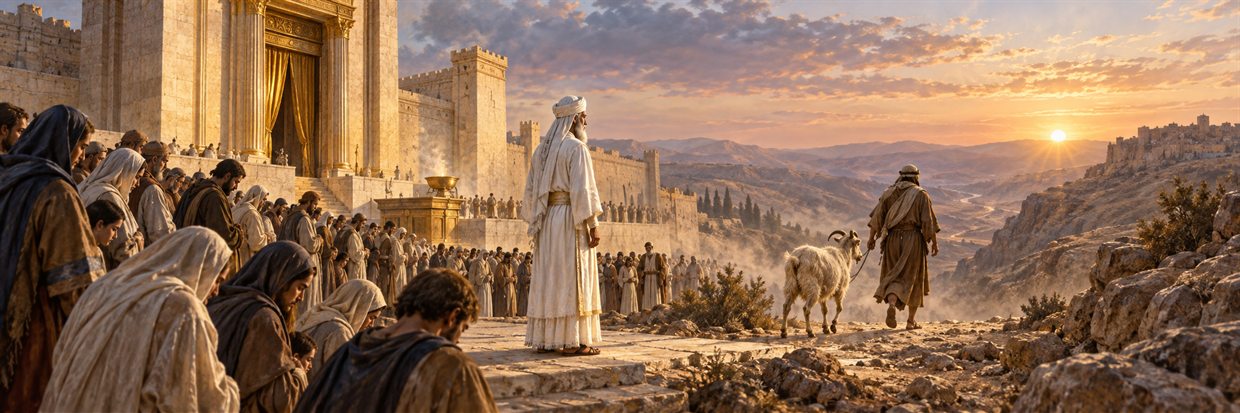
Yom Kippur, the Day of Atonement, is a Jewish day of repentance, prayer and fasting. It concludes the ten Days of Repentance that begin with Rosh Hashanah. Fasting practices include exemptions, including for children and people whose health would be endangered 3.
The Torah gives the day in one sentence: for on this day shall atonement be made for you, to cleanse you; from all your sins shall ye be clean before the LORD (Leviticus 16:30). It comes on the tenth of Tishrei, ten days after Rosh Hashanah, and closes the Ten Days of Repentance that begin with the new year; in the Jewish picture of those days, the Book of Life opened on Rosh Hashanah is sealed at the end of Yom Kippur 1,2.
The Mishnah draws the line that the day is known for: Yom Kippur atones for sins between a person and God, but for sins between a person and another it does not atone until the wrong has been put right with that person (Mishnah Yoma 8:9). That is why the days before are spent asking forgiveness of people, and the day itself asking it of God. The same passage ends with Rabbi Akiva's words: happy are you, Israel, before whom are you made clean, and who makes you clean? Your Father in heaven 3.
Leviticus describes the Day of Atonement and its Temple service. Rabbinic teaching and later liturgy shape the fasting and prayer associated with Yom Kippur today.
Leviticus 16 is the chapter of the day. It tells how Aaron, the first High Priest, was to enter the Holy of Holies once a year, on this day alone, with incense and the blood of a bull and a goat, and how two goats were brought and lots drawn: one for the LORD, offered as a sin offering, and one for Azazel, on whose head the priest confessed all the sins of Israel before it was sent away into the wilderness, the scapegoat (16:7-10, 16:21-22). The chapter ends by making the day a statute for ever: in the seventh month, on the tenth day, ye shall afflict your souls and do no work (16:29-34) 4.
Leviticus 23 repeats the command in the calendar of festivals, calls the day a sabbath of solemn rest, and fixes its hours from evening to evening; Numbers 29 gives its offerings. Leviticus 25:9 adds that the shofar announcing the jubilee year was sounded on this day, which is why a single blast of the shofar ends the fast today 4,1. Jewish tradition holds that the first Yom Kippur was the day Moses came down from Sinai with the second tablets after the golden calf, and that God's forgiveness that day is what the day remembers.
The service of the two goats was performed in the Temple until its destruction in 70 CE; the Mishnah's tractate Yoma preserves it in detail, and the Musaf prayer of Yom Kippur, the Avodah, retells it step by step, with the congregation bowing to the ground where the priest once did 3,1. Rabbinic teaching explains the Torah's instruction to afflict oneself: the Mishnah spells them out as five prohibitions, eating and drinking, washing, anointing, wearing leather shoes and marital relations (Mishnah Yoma 8:1) 3. The confession of sins, said aloud ten times through the day, the white clothing, and the five services are rabbinic and medieval; Kol Nidre is the declaration concerning vows that opens the evening service. Its precise origins remain uncertain. Accounts connecting it with forced conversion are interpretations of its history, rather than an established explanation of its composition 5. 10
| Passage | What it is | Edition |
|---|---|---|
| Leviticus 16 | Institutes the day | JPS TaNaKH 1917 |
| Leviticus 23:26-32 | Institutes the day | JPS TaNaKH 1917 |
| Numbers 29:7-11 | Institutes the day | JPS TaNaKH 1917 |
| Leviticus 25:9 (the jubilee shofar on Yom Kippur) | Names the holiday | JPS TaNaKH 1917 |
| Acts 27:9 (the Fast) | Names the holiday | Berean Standard Bible |
| Isaiah 57:14-21 | Read on the day | JPS TaNaKH 1917 |
| Isaiah 58 | Read on the day | JPS TaNaKH 1917 |
| the Book of Jonah | Read on the day | JPS TaNaKH 1917 |
| Micah 7:18-20 | Read on the day | JPS TaNaKH 1917 |
| Hebrews 9:1-14 | A Christian reading | Berean Standard Bible |
| Hebrews 9:24-28 | A Christian reading | Berean Standard Bible |
Who keeps it Many Rabbinic Jewish communities, with a twenty-five hour fast, five prayer services, the Kol Nidre and Ne'ilah, and white clothing; the most widely observed day of the Jewish year.
The fast begins before sunset with Kol Nidre and ends after nightfall the next day with a single blast of the shofar; in between are five services, white clothes, and no food, drink, washing, leather or perfume.
The day before, families eat a festive meal, ask forgiveness of one another, and light a memorial candle. Just before sunset the fast begins, and the congregation, many in white and wearing canvas shoes instead of leather, hears Kol Nidre sung three times before the open ark. The morning service reads Leviticus 16 and Isaiah 58; Yizkor, the memorial prayer for the dead, follows; the Musaf service retells the Temple's Avodah; the afternoon reads Leviticus 18 and the whole Book of Jonah; and Ne'ilah, the closing of the gates, ends the day as the sun sets, with the congregation standing, the ark open, the Shema said aloud, and one long blast of the shofar 1,2. Then the fast is broken with a meal, and five days later Sukkot begins 2.
Orthodox and Conservative communities keep the whole of this. Conservative synagogues often shorten the Avodah; Reform synagogues keep the fast and the services in a shorter form, read Deuteronomy 29 and 30, the renewal of the covenant, in place of Leviticus 16 in the morning, and see their largest congregations of the year on this day and Rosh Hashanah 1,6. Karaite Jews keep the fast from the Torah's text alone, and the Samaritans keep the Day of Atonement as well 1.
In Israel the day stops the country. There are no broadcasts, no flights, no public transport and no open shops; the roads empty and children cycle down the middle of the highways; about six in ten Israeli Jews say they fast, many of them people who keep little else 1. In 1973 the afternoon of Yom Kippur was broken by air-raid sirens when Egypt and Syria attacked, and the war that followed carries the day's name 1.
These passages offer a starting point for study. Service readings and verse numbering can differ by tradition, Bible edition and year; use the relevant community's calendar for a particular service.
The morning reads the chapter of the two goats and the prophet who asks whether a fast is only bowing the head; the afternoon reads the Book of Jonah, because God forgave a city that repented.
Morning: Leviticus 16, the service of the day, with Numbers 29:7-11 as the maftir; haftarah Isaiah 57:14 to 58:14, in which the prophet says the fast God chooses is to loose the fetters of wickedness and share bread with the hungry. Afternoon: Leviticus 18; haftarah the whole Book of Jonah, ending with Micah 7:18-20, who is a God like unto Thee that pardoneth iniquity 7,8.
Jonah is read as the sun goes down because it is the story of a whole city, Nineveh, and a reluctant prophet, both forgiven when they turned; a Jewish source says that as Jonah is answered from the belly of the fish, the congregation is reminded that it too can be answered, even as the day wanes 8. Reform congregations read Deuteronomy 29 and 30 in the morning, the covenant made with those standing there and those not there that day, and begin the haftarah at Isaiah 58 6.
In brief Morning: Leviticus 16 and Numbers 29:7-11, haftarah Isaiah 57:14 to 58:14. Afternoon: Leviticus 18, haftarah the Book of Jonah and Micah 7:18-20.
The Letter to the Hebrews interprets the Day of Atonement's Temple service in relation to Jesus. Yom Kippur remains a Jewish observance with its own continuing meaning.
Hebrews 9 describes the Holy of Holies which only the High Priest entered, once a year, with blood, and then says that Christ entered the greater sanctuary of heaven once for all with his own blood; 9:24-28 and 10:1-14 contrast the yearly sacrifices with one sacrifice for sins for all time. A Protestant commentator of the seventeenth century, Matthew Henry, states the reading in its classic form: the high priest entered but once a year into the holiest, and in this the antitype excels the type, for he has entered once for all 9. That is the Christian reading of the chapter, held by Catholic, Orthodox and Protestant churches alike, ; Judaism reads Leviticus 16 as the service of its own Temple and keeps the day the chapter commands.
The goat sent away in Leviticus 16 is the origin of the English word scapegoat, and it has entered Christian speech and art as a figure for Christ bearing sins away 1. Some Christians, among them the Seventh-day Adventists, give the Day of Atonement a place in their own teaching about judgment; Messianic Jewish congregations and the churches of the Armstrong tradition keep the fast on the tenth of Tishrei as a commanded day 4.
Acts 27:9 refers to 'the Fast,' generally understood as Yom Kippur, when describing the dangers of Paul's autumn voyage. This reference helps locate the narrative in the Jewish calendar; it does not institute a Christian observance 4.
Yom Kippur is the tenth of Tishrei, nine days after Rosh Hashanah, and falls in September or October.
The Torah fixes the date, the tenth day of the seventh month, and the hours, from evening to evening (Leviticus 23:27-32); the fast runs about twenty-five hours, from a few minutes before sunset on the ninth to nightfall on the tenth 2. Because the day depends on Rosh Hashanah, and the fixed calendar keeps Rosh Hashanah off Sunday, Wednesday and Friday, Yom Kippur never falls on Friday or Sunday, so the fast is never beside the Sabbath 4.
Yom Kippur is a single day everywhere, in Israel and outside it and in every movement; it is the one festival the diaspora never doubled, since two days of a full fast were judged too much to ask. Five days after it comes Sukkot.
| Rule | 2026 | 2027 |
|---|---|---|
| 10 Tishrei | Evening of 20 September to nightfall 21 September | Evening of 10 October to nightfall 11 October |
Yes. Leviticus 16 gives the Temple service of the day, the High Priest's one entry into the Holy of Holies and the two goats; Leviticus 23:26-32 and Numbers 29:7-11 command the date, the fast and the rest as a statute for ever. The five prohibitions, the confession, the five services and Kol Nidre were shaped by the rabbis and the Middle Ages 4,3.
The Torah says afflict yourselves and do no work; the Mishnah spells the affliction out as five things: no eating or drinking, no washing, no anointing with oil or perfume, no leather shoes, and no marital relations. The sick and children are exempt from the fast, and saving a life overrides it 3,1.
Kol Nidre is a declaration concerning vows recited at the opening of Yom Kippur. It does not cancel obligations to other people. Its precise origins are uncertain; the association with forced conversion should not be presented as a settled historical explanation 5,10.
It is read in the afternoon because it is the story of a city and a prophet both forgiven when they turned back to God. As Jonah is answered from inside the fish, the congregation is reminded near the day's end that it too can be answered 8.
Yom Kippur is not generally part of Catholic, Eastern Orthodox or Protestant liturgical calendars. Christians often read Leviticus 16 alongside Hebrews, which interprets the Day of Atonement in relation to Christ. Some Messianic Jewish congregations and other groups observe the day on the tenth of Tishrei. 9,4
Quoted from the JPS TaNaKH 1917; each links to its chapter and carries a Memorize button that starts the five-step path. Switch the edition to read them in another Bible here.
For on this day shall atonement be made for you, to cleanse you; from all your sins shall ye be clean before the LORD.
The one sentence the whole day rests on, read in the morning and returned to at the close: on this day atonement is made for you, to cleanse you.
Is not this the fast that I have chosen? to loose the fetters of wickedness, to undo the bands of the yoke, and to let the oppressed go free, and that ye break every yoke?
From the morning haftarah: the fast God chooses is to loose the fetters of wickedness. Read while the congregation is fasting.
Who is a God like unto Thee, that pardoneth the iniquity, and passeth by the transgression of the remnant of His heritage? He retaineth not His anger for ever, because He delighteth in mercy. He will again have compassion upon us; He will subdue our iniquities; and Thou wilt cast all their sins into the depths of the sea.
The close of the afternoon haftarah, after Jonah: a God who pardons iniquity and casts sins into the depths of the sea.
and should not I have pity on Nineveh, that great city, wherein are more than sixscore thousand persons that cannot discern between their right hand and their left hand, and also much cattle?'
The last verse of Jonah and the last word of the afternoon reading: God's question about pitying a city of people who cannot tell their right hand from their left.
Make it part of your day
Optional further reading: you can explore the text without sharing its beliefs or taking part in the observance.
The verse the day is built on, to carry from one Yom Kippur to the next.
For on this day shall atonement be made for you, to cleanse you; from all your sins shall ye be clean before the LORD.
The numbers match the references in the article. Links include religious texts, community explanations and historical studies. Read more about how this guide was researched.
BibleVerse Editorial, "Yom Kippur: What It Marks, Where It Comes From, and How It Is Kept", BibleVerse, published 2026-09-11, updated 2026-09-12, https://bibleverse.site/holidays/yom-kippur/
Version 1.1. Awaiting review by a member of the community it describes. Dates in the table are for 2026 and 2027 and are refreshed yearly. Corrections are welcome through the contact page.
See which Jewish, Christian and Islamic holidays the Bible commands, tells or names, and where the rest come from.
Rosh Hashanah is the Jewish New Year and the beginning of the High Holy Days. Prayer, the sound of the shofar and festive meals mark a time of reflection and hope for the year ahead.
Explore shared roots, distinct scriptures and differences in belief.