Holidays in the Bible
See which Jewish, Christian and Islamic holidays the Bible commands, tells or names, and where the rest come from.
Holidays in the Bible · Jewish
the Jewish New Year · Yom Teruah, the day of the shofar blast
Rosh Hashanah is the Jewish New Year and the beginning of the High Holy Days. Prayer, the sound of the shofar and festive meals mark a time of reflection and hope for the year ahead.
When 1 and 2 Tishrei. 2026 Evening of 11 September to 13 September; the Hebrew year 5787 begins.
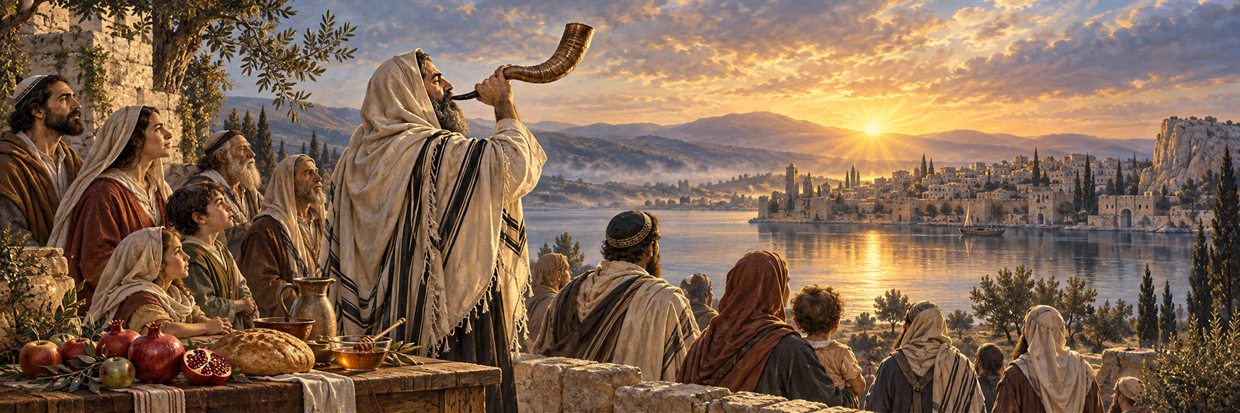
Rosh Hashanah is the Jewish New Year and the beginning of the High Holy Days. Prayer, the sound of the shofar and festive meals mark a time of reflection and hope for the year ahead.
The Torah calls the day something else: a day of the blowing of the horn, Yom Teruah, a holy convocation on the first day of the seventh month (Leviticus 23:23-25, Numbers 29:1-6). It does not call it a new year, and the phrase rosh hashanah, the head of the year, appears once in the whole Tanakh, in Ezekiel 40:1, where it means something else 1. The name and the meaning that Jews keep today come from the Mishnah, which lists four new years and makes the first of Tishrei the new year for counting years, for sabbatical and jubilee years, and for planting; the same chapter says that on this day all who come into the world pass before God like sheep, one by one, and the day of judgment was born (Mishnah Rosh Hashanah 1:1-2) 2.
So the day carries two moods at once. It is the coronation of God as King, sung in the prayers with trumpet blasts, and the birthday of the world, which Jewish tradition places on this day as the anniversary of the creation of Adam and Eve 3; and it is Yom HaDin, the day of judgment, when in the prayer book's picture the Book of Life is opened, to be sealed ten days later at the close of Yom Kippur 4. The greeting is shanah tovah, a good year, and the wish that the hearer be written and sealed for a good year.
The Torah prescribes a sacred day on the first of the seventh month. Rabbinic teaching develops its themes of the new year, judgment and repentance, along with the observances familiar today.
Leviticus 23:24 commands a solemn rest, a memorial proclaimed with the blast of horns, and a holy convocation on the first day of the seventh month; Numbers 29:1 calls it a day of blowing the horn and gives its offerings. That is all the Torah says. The horn itself is older in the text: Numbers 10:10 commands trumpets over the offerings at the new moons and the festivals, and Psalm 81:3-4, sung on the day, says blow the horn at the new moon, for it is a statute for Israel 1.
The Bible shows the day being kept once. In Nehemiah 8, on the first day of the seventh month, Ezra reads the Torah to the whole people from morning until midday, they weep, and Nehemiah tells them the day is holy to the LORD and they are not to mourn but to eat the fat and drink the sweet and send portions to those who have nothing, for the joy of the LORD is your strength. The apples and honey of every Jewish table on this day have that verse behind them 1.
The Mishnah gave the day its name and its weight, and the Talmud gave the shofar its reason: Rabbi Abbahu says that God tells Israel to blow before him with a ram's horn so that he will remember for them the binding of Isaac, in whose place a ram was offered, and count it as if they had bound themselves before him (Talmud Rosh Hashanah 16a) 5. That is why the horn is a ram's, and why the second day reads Genesis 22. The Musaf prayer of the day has three sections found nowhere else in the year, Kingship, Remembrance and Shofar, each of ten verses from the Torah, the Prophets and the Writings, each closed with the horn 1,4.
The two days are rabbinic too, and two-day observance is traditional both in Israel and in the diaspora. Because Rosh Hashanah falls on the first of the month, in Temple times even Jerusalem could not know until the witnesses came whether the day had begun, so two days were kept everywhere, and this remains traditional practice in Israel and in Orthodox and Conservative communities abroad; Reform practice varies, the movement having kept the second day of this festival alone while many of its North American congregations keep one 6,1. Karaite Jews keep the day as the Torah names it, one day of blowing and rejoicing, without the rabbinic additions 1.
| Passage | What it is | Edition |
|---|---|---|
| Leviticus 23:23-25 | Institutes the day | JPS TaNaKH 1917 |
| Numbers 29:1-6 | Institutes the day | JPS TaNaKH 1917 |
| Nehemiah 8:1-12 | Tells the event | JPS TaNaKH 1917 |
| Ezekiel 40:1 (the only biblical use of the phrase rosh hashanah) | Names the holiday | JPS TaNaKH 1917 |
| Psalm 81 | Read on the day | JPS TaNaKH 1917 |
| Genesis 21 | Read on the day | JPS TaNaKH 1917 |
| Genesis 22 | Read on the day | JPS TaNaKH 1917 |
| 1 Samuel 1 | Read on the day | JPS TaNaKH 1917 |
| Jeremiah 31 | Read on the day | JPS TaNaKH 1917 |
Who keeps it Many Rabbinic Jewish communities; two days in Orthodox and Conservative practice everywhere, and in Israel; many Reform congregations keep one. The shofar is sounded, apples are dipped in honey, and tashlich is said by water.
Two days of festival: the shofar blown in the synagogue, a long service with prayers for the year, festive meals with apples and honey and round bread, and on the first afternoon a walk to water to cast off the past year's sins.
The evening service opens the year; at home candles are lit, kiddush is said, the round challah, shaped for the cycle of the year, is dipped in honey, apples are dipped in honey with a wish for a good and sweet year, and many tables add a pomegranate for merits as many as its seeds, a new fruit, and the head of a fish or a lamb with the wish to be a head and not a tail 3,4. The greeting through the two days is shanah tovah.
The morning service is the longest of the year after Yom Kippur. The Torah reading tells of Isaac's birth on the first day and his binding on the second, with Hannah's prayer and Jeremiah's promise to Rachel as the haftarot. Then the shofar: the blessing, and the three sounds, tekiah, a long blast, shevarim, three broken notes, and teruah, nine short ones, in sets, a hundred blasts in all through the service; the sages heard in them a call to wake, and the Musaf prayer sets its three sections of Kingship, Remembrance and Shofar around them 7,4. When the first day falls on the Sabbath the shofar is not blown, a rabbinic rule, and the second day carries it 4.
On the afternoon of the first day, or the second when the first is the Sabbath in Ashkenazi practice, congregations walk to a river, a lake or the sea for tashlich, saying Micah 7:18-20, thou wilt cast all their sins into the depths of the sea, and many empty their pockets or throw crumbs into the water; the custom is medieval, from about the thirteenth century, and some rabbis objected that people might trust the water rather than repentance 8. The ten days that follow, the Days of Awe, are for teshuvah, turning back, and for asking forgiveness of people before asking it of God on Yom Kippur 4.
Orthodox and Conservative Jews keep both days with the full liturgy; Reform synagogues keep the shofar, the readings and the Musaf themes in their own prayer book, and see their largest congregations of the year on these days and Yom Kippur 1. In Israel the two days are public holidays, and the shofar can be heard from the beaches of Tel Aviv to the Western Wall.
These passages offer a starting point for study. Service readings and verse numbering can differ by tradition, Bible edition and year; use the relevant community's calendar for a particular service.
The first day reads Isaac's birth and Hannah's prayer; the second reads the binding of Isaac and Jeremiah's promise to Rachel, who weeps for her children.
First day: Genesis 21, the birth of Isaac and the sending away of Hagar and Ishmael, the child God remembered, with Numbers 29:1-6 as the maftir; haftarah 1 Samuel 1:1 to 2:10, Hannah praying for a child and her song when he comes. Both were chosen because the Talmud says Sarah and Hannah were remembered on Rosh Hashanah, the day of remembrance 1.
Second day: Genesis 22, the Akedah, the binding of Isaac and the ram caught in the thicket, the reason for the ram's horn; haftarah Jeremiah 31:1-19, Rachel weeping for her children and God's answer, Is Ephraim a darling son unto me? 1. Psalm 81, blow the horn at the new moon, is the psalm of the day, and Psalm 47, God is gone up amidst the sound of the horn, is said seven times before the shofar is blown.
In brief First day: Genesis 21 (the birth of Isaac), haftarah 1 Samuel 1:1 to 2:10 (Hannah). Second day: Genesis 22 (the binding of Isaac), haftarah Jeremiah 31. Maftir Numbers 29:1-6 both days.
Some biblical passages read at Rosh Hashanah also have important roles in Christian teaching. A few Christian groups observe a Feast of Trumpets.
The binding of Isaac, the second day's reading, is one of the Bible's chapters that Christians read most: Hebrews 11:17-19 counts Abraham's obedience as faith that God could raise the dead, the Easter Vigil reads Genesis 22 among its lessons, and Christian tradition since the church fathers has read Isaac carrying the wood up the mountain as a figure of Christ carrying the cross. Those are Christian readings of a chapter the synagogue reads for the ram, and the page reports them as such. Muslims read the same test of Abraham at Eid al-Adha, which has its own card on the overview.
The trumpet of the last day is a New Testament image: Paul writes that the dead will be raised at the last trumpet (1 Corinthians 15:52) and that the Lord will come down with the trumpet of God (1 Thessalonians 4:16), and Revelation counts seven. Some Christian readers connect those verses with the Torah's day of blowing the horn; the churches of the Armstrong tradition, such as the United Church of God, keep Leviticus 23:24 as the Feast of Trumpets and hold, in their own words, that the day pictures the return of Christ to establish the Kingdom of God 9. Messianic Jewish congregations keep Yom Teruah with the shofar. Rosh Hashanah is not part of most Christian liturgical calendars. Many Western churches begin their liturgical year with Advent; the Eastern Orthodox Church New Year is September 1, a distinct observance 10.
Christians who read Nehemiah 8:10, the joy of the LORD is your strength, as a favourite verse are reading a sentence spoken on Rosh Hashanah, to a people told to stop weeping and eat the sweet; a passage that can be studied in its original narrative setting.
Rosh Hashanah is the first and second of Tishrei, in September or early October, and begins the Hebrew year.
The Torah fixes the first day of the seventh month (Leviticus 23:24); the month is the seventh counting from Nisan in the spring, as the Torah counts, and the first counting years, as the Mishnah does, which is why the Hebrew year number changes on this day and not at Pesach. The fixed calendar attributed to Hillel II keeps the first of Tishrei off Sunday, Wednesday and Friday, so that Yom Kippur never falls beside the Sabbath and Hoshana Rabbah never on it, and the whole year's festivals are placed by where this day falls 1.
Jewish days begin at sunset, so the festival begins on the evening before the first date in the table, and the year number in the table is the one that begins that evening. The two days are kept as one long day, yoma arichta, in Jewish law, which is why the second day has a different status from the extra diaspora day of other festivals; not every community observes both days.
| Rule | 2026 | 2027 |
|---|---|---|
| 1 and 2 Tishrei | Evening of 11 September to 13 September; the Hebrew year 5787 begins | Evening of 1 October to 3 October; the Hebrew year 5788 begins |
The day is, under another name. Leviticus 23:24 and Numbers 29:1 command a holy day of rest and horn-blowing on the first day of the seventh month, and Nehemiah 8 shows it being kept. The Torah does not call it a new year; the Mishnah made the first of Tishrei the new year for counting years and the day of judgment, and the name Rosh Hashanah comes from there 1,2.
Because it falls on the first day of the month. In Temple times the new month was declared when witnesses had seen the new moon, and even Jerusalem could not be sure in advance which day was the first, so two were kept everywhere. It is the one festival Israel and Reform Judaism kept at two days, though many Reform congregations in North America now keep one 6,1.
The Talmud gives the reason: God says to blow before him with a ram's horn so that he will remember the binding of Isaac, in whose place a ram was offered. That is also why Genesis 22 is read on the second day. Any kosher animal's horn but a cow's may be used; a ram's is the custom 5,7.
For a sweet year: the wish said over the apple is that the year be good and sweet. Round challah is dipped in honey too, for the cycle of the year, and a pomegranate, a new fruit and the head of a fish carry their own wishes. Nehemiah 8:10, spoken on this day, told the people to eat the fat and drink the sweet 3,4.
Rosh Hashanah is not generally part of Christian liturgical calendars. The Eastern Orthodox Church New Year on September 1 is a different observance 10. Christians read the day's chapters, Genesis 22 above all, and the trumpet of the last day in Paul and Revelation is a Christian image that some connect with the Torah's day of blowing. The churches of the Armstrong tradition and Messianic Jewish congregations keep the day as the Feast of Trumpets or Yom Teruah 9.
Quoted from the JPS TaNaKH 1917; each links to its chapter and carries a Memorize button that starts the five-step path. Switch the edition to read them in another Bible here.
Speak unto the children of Israel, saying: In the seventh month, in the first day of the month, shall be a solemn rest unto you, a memorial proclaimed with the blast of horns, a holy convocation.
The whole of the Torah's command: a solemn rest, a memorial proclaimed with the blast of horns, a holy convocation.
(81-4) Blow the horn at the new moon, at the full moon for our feast-day. (81-5) For it is a statute for Israel, an ordinance of the God of Jacob.
The psalm of the day: blow the horn at the new moon, for it is a statute for Israel.
Then he said unto them: 'Go your way, eat the fat, and drink the sweet, and send portions unto him for whom nothing is prepared; for this day is holy unto our Lord; neither be ye grieved; for the joy of the LORD is your strength.'
Spoken on the first of Tishrei to a people in tears: eat the fat and drink the sweet, for the joy of the LORD is your strength.
He will again have compassion upon us; He will subdue our iniquities; and Thou wilt cast all their sins into the depths of the sea.
The verse of tashlich, said by the water on the first afternoon: cast all their sins into the depths of the sea.
Make it part of your day
Optional further reading: you can explore the text without sharing its beliefs or taking part in the observance.
The sentence spoken on the first Rosh Hashanah the Bible records, to carry into the new year.
Then he said unto them: 'Go your way, eat the fat, and drink the sweet, and send portions unto him for whom nothing is prepared; for this day is holy unto our Lord; neither be ye grieved; for the joy of the LORD is your strength.'
The numbers match the references in the article. Links include religious texts, community explanations and historical studies. Read more about how this guide was researched.
BibleVerse Editorial, "Rosh Hashanah: What It Marks, Where It Comes From, and How It Is Kept", BibleVerse, published 2026-09-11, updated 2026-09-12, https://bibleverse.site/holidays/rosh-hashanah/
Version 1.1. Awaiting review by a member of the community it describes. Dates in the table are for 2026 and 2027 and are refreshed yearly. Corrections are welcome through the contact page.
See which Jewish, Christian and Islamic holidays the Bible commands, tells or names, and where the rest come from.
Yom Kippur, the Day of Atonement, is a Jewish day of repentance, prayer and fasting. It concludes the ten Days of Repentance that begin with Rosh Hashanah.
Explore shared roots, distinct scriptures and differences in belief.