Holidays in the Bible
See which Jewish, Christian and Islamic holidays the Bible commands, tells or names, and where the rest come from.

Holidays in the Bible · Christian
The Transfiguration commemorates the Gospel account of Jesus appearing in glory before Peter, James and John, with Moses and Elijah beside him.
When 6 August; or the Sunday before Lent. 2026 6 August (Julian-calendar observance: 19 August Gregorian); nominal date, local liturgical transfers may apply; the Sunday before Lent in Lutheran and many Protestant churches.
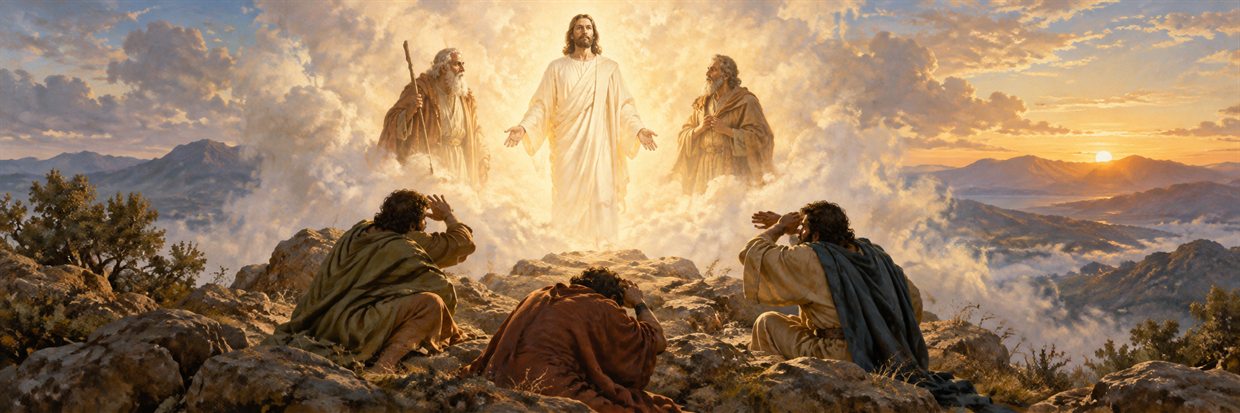
The Transfiguration commemorates the Gospel account of Jesus appearing in glory before Peter, James and John, with Moses and Elijah beside him.
Three Gospels tell the story (Matthew 17:1-9, Mark 9:2-8, Luke 9:28-36), each placing it just after Peter has confessed Jesus to be the Christ and Jesus has first foretold his death, with Matthew and Mark recording Jesus' instruction to keep the vision private until the resurrection; Luke instead says that the disciples kept silent at that time 4. The second letter of Peter recalls it as something seen and heard: "we were eyewitnesses of his majesty... we ourselves heard this voice from heaven when we were with him on the holy mountain" (2 Peter 1:16-18). No Gospel names the mountain; since the third century Christians have identified it with Mount Tabor in Galilee, and Origen and Jerome already did, though Hermon and other peaks have been proposed 1,4.
The feast is kept on 6 August in Catholic, Anglican and Byzantine Orthodox calendars; for churches using the Julian calendar, that date currently corresponds to 19 August Gregorian. Other Eastern Christian calendars have their own reckoning; Lutheran, Presbyterian and other churches that follow the Revised Common Lectionary keep Transfiguration Sunday on the last Sunday before Lent, and the Armenian church keeps it on the fourteenth Sunday after Easter 3. In the East it is one of the twelve Great Feasts; in the West it was a local feast until Pope Callixtus III made it universal in 1457 3.
The feast commemorates a Gospel event. Its early history is less certain than its place in later church calendars, and traditions differ in when they observe it.
The Gospels tell the event in the shape of the Hebrew Bible's own mountain scenes, and the churches read it so. Moses came down from Sinai with a face so radiant that the people were afraid (Exodus 34:29-35); Elijah met God at Horeb in a still small voice (1 Kings 19:9-13); Daniel saw the Ancient of Days in clothing white as snow and one like a son of man coming with the clouds (Daniel 7:9-14); and Malachi promised Elijah's return before the day of the LORD (Malachi 4:5), which the disciples ask about on the way down (Matthew 17:10-13). Since Origen, Christian readers have taken Moses and Elijah to stand for the Law and the Prophets, so that the voice saying "listen to him" sets Jesus above both; Luther read them the same way 4. These interpretations belong to Christian tradition.
The origins of the annual feast are uncertain. Historical accounts connect it with Eastern Christian devotion to the Transfiguration and to Mount Tabor, the traditional site of the event. Those associations do not establish a precise founding date 3,5. Orthodox teaching gives particular attention to the light of Christ and the transformation of human life through participation in God's glory 2.
The feast spread through different local calendars rather than beginning everywhere at once. Catholic historical accounts associate its wider Western adoption with Pope Callixtus III in the fifteenth century; the precise chronology is not needed to understand the observance today 3. The Roman calendar places the feast on 6 August, while a number of Protestant lectionaries also feature the Transfiguration before Lent. 9
| Passage | What it is | Edition |
|---|---|---|
| Matthew 17:1-9 | Tells the event | Berean Standard Bible |
| Mark 9:2-8 | Tells the event | Berean Standard Bible |
| Luke 9:28-36 | Tells the event | Berean Standard Bible |
| 2 Peter 1:16-18 | Tells the event | Berean Standard Bible |
| Daniel 7:9-14 | Read on the day | Berean Standard Bible |
| Exodus 34:29-35 | A Christian reading | Berean Standard Bible |
| 1 Kings 19:9-13 | A Christian reading | Berean Standard Bible |
Who keeps it Catholic and Orthodox churches on 6 August (19 August on the Julian calendar), with the blessing of grapes in the East; Lutheran and many other Protestant churches keep it on the last Sunday before Lent.
The Orthodox keep the feast with an all-night vigil and the blessing of grapes and other first fruits after the Liturgy; Catholics keep 6 August as a feast of the Lord; Lutherans and Reformed churches keep Transfiguration Sunday as the last Sunday after Epiphany, the hinge into Lent.
In the Orthodox churches the Transfiguration is one of the twelve Great Feasts, with a one-day forefeast, an all-night vigil on the eve, and an afterfeast of eight days that ends the day before the forefeast of the Dormition 3. It falls inside the Dormition Fast of the first fourteen days of August, and the fast is relaxed for it, with fish, wine and oil allowed 3. After the Divine Liturgy grapes are brought to the church and blessed, or apples and other fruit where grapes do not grow; this begins the blessing of the year's first fruits, and the Orthodox Church calls the blessing of grapes "the most beautiful and adequate sign of the final transfiguration of all things" 2,3. The hymn of the day sings "Thou wast transfigured on the mount, O Christ God, revealing thy glory to thy disciples as they could bear it," and the Orthodox Church says the feast shows Christians their own destiny, to be transformed and glorified by the splendour of God 2. It is the second of the three feasts of the Saviour in August, between the Procession of the Cross on the first and the icon not made by hands on the sixteenth 3.
The Coptic church keeps the feast on 6 August of its own calendar, which is 19 August, inside the fast of Saint Mary, and counts it among the seven minor feasts of the Lord; the Armenian church keeps it on the fourteenth Sunday after Easter as one of its five major feasts, under the name Vardavar, the rose festival, whose older customs Armenians still keep on the day 3.
In the Catholic Church 6 August is a feast of the Lord, kept with Mass and its own readings; the Gospel of the Transfiguration is also read on the second Sunday of Lent every year, so that Catholics hear the story twice, once in Lent as a promise before the Passion and once in August in its own right 3. Anglicans keep 6 August as a festival 3. Lutheran churches in North America, and Presbyterian and other Reformed churches following the Revised Common Lectionary, keep Transfiguration Sunday on the last Sunday after Epiphany, the Sunday before Ash Wednesday, so that the season of light ends on the mountain and Lent begins on the way down; some Lutheran churches before the 1970s kept 6 August as well, and the Church of Sweden and the Church of Finland read the story on a summer Sunday 3. Whether the Sunday is kept liturgically or in name only is left, in Presbyterian practice, to the minister and session 3.
These passages offer a starting point for study. Service readings and verse numbering can differ by tradition, Bible edition and year; use the relevant community's calendar for a particular service.
Readings center on the Gospel account of the Transfiguration. Other passages and the selected Gospel vary by church and year.
For the Roman feast on 6 August, the 2027 calendar (Year B) lists Daniel 7:9–10, 13–14; 2 Peter 1:16–19; and Mark 9:2–10. This is a specific annual selection, not the complete list for every tradition or cycle. 9
The Orthodox vespers of the feast reads Moses going up into the cloud on Sinai (Exodus 24:12-18), Moses asking to see God's glory and seeing his back (Exodus 33:11 to 34:8), and Elijah at Horeb (1 Kings 19:3-16); the Liturgy reads 2 Peter 1:10-19 and Matthew 17:1-9 2. John's Gospel has no transfiguration, and some scholars hear its echo in "we have seen his glory" (John 1:14) 4.
In brief Daniel 7:9-10, 13-14; 2 Peter 1:16-19; the Transfiguration Gospel of the year.
The Gospel scene draws on Jewish Scripture: the mountain, cloud, Moses and Elijah recall earlier biblical accounts.
Exodus 34:29–35 describes Moses' radiant face after speaking with God, and 1 Kings 19 describes Elijah at Horeb. Christian interpretation connects these accounts with the Transfiguration. In Jewish tradition, the passages have their own significance in the lives of Moses and Elijah 4,7.
Moses and Elijah are also honored in Islam. Qur'an 7:143 recounts Moses asking to see God at a mountain; it is a different account from the Transfiguration 8.
The shared imagery offers a point of comparison, while the religious teachings differ. Christian interpretation centers on Jesus' divine glory. Islamic teaching honors Jesus as a prophet and Messiah without identifying him as God 6,8.
The Transfiguration is 6 August in the Catholic, Orthodox and Anglican calendars, 19 August for churches on the Julian calendar, and the Sunday before Ash Wednesday in Lutheran and Reformed churches.
The 6 August date is fixed; the Orthodox churches of Russia, Serbia, Georgia and Jerusalem keep it on their own 6 August, which is 19 August on the civil calendar, while the Greek, Romanian and American Orthodox keep the civil date 3. In the East the feast lies inside the two-week Dormition Fast, six days after the Procession of the Cross and nine before the Dormition itself, which has its own card on the overview 3.
Transfiguration Sunday moves with Easter, since it is the Sunday before Ash Wednesday: in 2026 it is 15 February and in 2027 it is 7 February. The Armenian feast, the fourteenth Sunday after Easter, falls in July 3. The dates table gives 6 August with the Sunday noted.
| Rule | 2026 | 2027 |
|---|---|---|
| 6 August; or the Sunday before Lent | 6 August (Julian-calendar observance: 19 August Gregorian); nominal date, local liturgical transfers may apply; the Sunday before Lent in Lutheran and many Protestant churches | 6 August (Julian-calendar observance: 19 August Gregorian); nominal date, local liturgical transfers may apply; the Sunday before Lent in Lutheran and many Protestant churches |
Matthew 17, Mark 9 and Luke 9 describe the Transfiguration, and 2 Peter 1:16–18 recalls the heavenly voice. The annual feast and its calendar dates developed through church tradition 3,4.
No Gospel names the mountain. Since the third century Christians, Origen among them, have identified it with Mount Tabor in Galilee, where a Byzantine church of the fifth or sixth century lies under the Franciscan Church of the Transfiguration built in 1924, and the Greek Orthodox have a monastery beside it; Mount Hermon and others have been proposed 4,5.
Because the Revised Common Lectionary, followed by North American Lutheran, Presbyterian and other churches, sets Transfiguration Sunday on the last Sunday after Epiphany, so that the season of light ends on the mountain and Lent begins on the way down. Some Lutheran churches kept 6 August as well before the 1970s 3.
The August date became established in Eastern and Western church calendars over time. Historical accounts associate its wider Western adoption with Callixtus III in the fifteenth century, but the feast's early origins are uncertain 3.
In the Orthodox churches grapes, or other fruit where grapes do not grow, are brought to be blessed after the Liturgy, beginning the blessing of the year's first fruits; the Orthodox Church calls it a sign of the final transfiguration of all creation. Lammas on 1 August is another first-fruits custom in parts of the Western Christian tradition 2,3.
Quoted from the Berean Standard Bible; each links to its chapter and carries a Memorize button that starts the five-step path. Switch the edition to read them in another Bible here.
There He was transfigured before them. His face shone like the sun, and His clothes became as white as the light.
His face shone like the sun, and his clothes became as white as the light. The feast in one verse.
While Peter was still speaking, a bright cloud enveloped them, and a voice from the cloud said, “This is My beloved Son, in whom I am well pleased. Listen to Him!”
The bright cloud and the voice: this is my beloved Son, listen to him. The sentence the churches hear as the point of the day.
For we did not follow cleverly devised fables when we made known to you the power and coming of our Lord Jesus Christ, but we were eyewitnesses of His majesty. For He received honor and glory from God the Father when the voice came to Him from the Majestic Glory, saying, “This is My beloved Son, in whom I am well pleased.” And we ourselves heard this voice from heaven when we were with Him on the holy mountain.
We were eyewitnesses of his majesty; we heard this voice when we were with him on the holy mountain. The one New Testament letter that remembers the scene.
And when Moses came down from Mount Sinai with the two tablets of the Testimony in his hands, he was unaware that his face had become radiant from speaking with the LORD.
Moses coming down from Sinai, unaware that his face had become radiant. The Hebrew Bible's shining face, which the feast reads beside Jesus'.
Make it part of your day
Optional further reading: you can explore the text without sharing its beliefs or taking part in the observance.
The voice from the cloud, which the churches read as the reason for the day.
While Peter was still speaking, a bright cloud enveloped them, and a voice from the cloud said, “This is My beloved Son, in whom I am well pleased. Listen to Him!”
The numbers match the references in the article. Links include religious texts, community explanations and historical studies. Read more about how this guide was researched.
BibleVerse Editorial, "The Transfiguration: What It Marks, Where It Comes From, and How It Is Kept", BibleVerse, published 2026-09-12, updated 2026-09-12, https://bibleverse.site/holidays/transfiguration/
Version 1.1. Awaiting review by a member of the community it describes. Dates in the table are for 2026 and 2027 and are refreshed yearly. Corrections are welcome through the contact page.
See which Jewish, Christian and Islamic holidays the Bible commands, tells or names, and where the rest come from.
Epiphany celebrates Jesus being revealed to the world. Western traditions often focus on the visit of the magi; Eastern Orthodox Theophany celebrates his baptism.
Explore shared roots, distinct scriptures and differences in belief.