Holidays in the Bible
See which Jewish, Christian and Islamic holidays the Bible commands, tells or names, and where the rest come from.
Holidays in the Bible · Christian
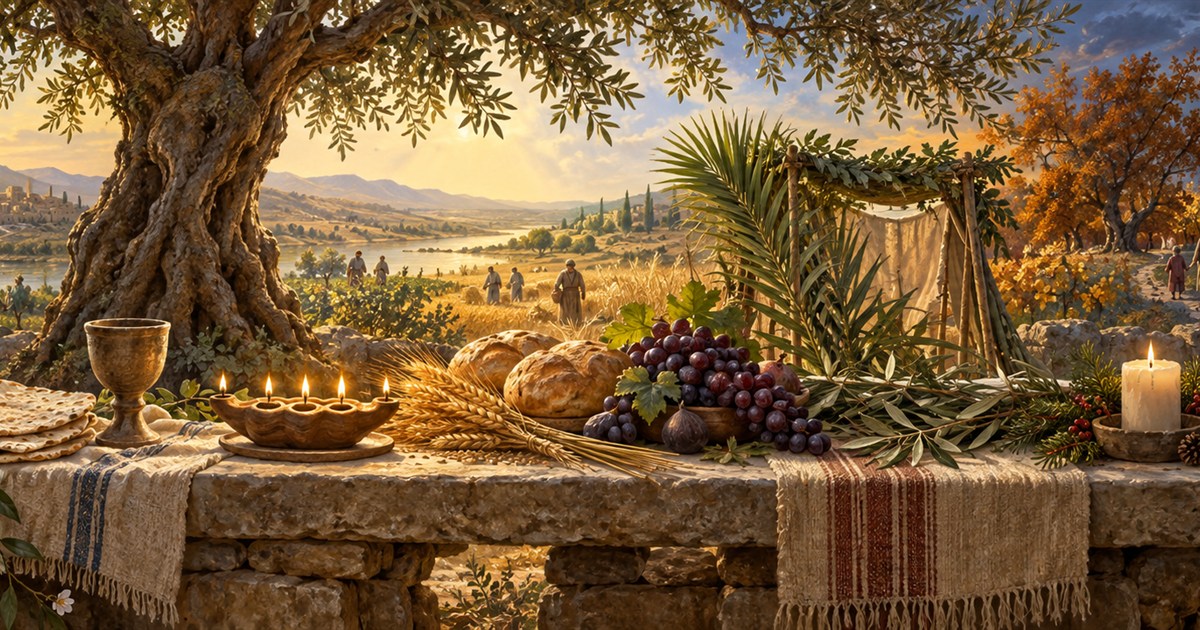
Thanksgiving is a national holiday in the United States and Canada, observed on different dates. People mark it in religious and secular ways. This guide explores its history and the biblical passages about gratitude used in Christian observance.
When Fourth Thursday of November (United States); second Monday of October (Canada). 2026 26 November; nominal date, local liturgical transfers may apply; United States; Canada keeps the second Monday of October.
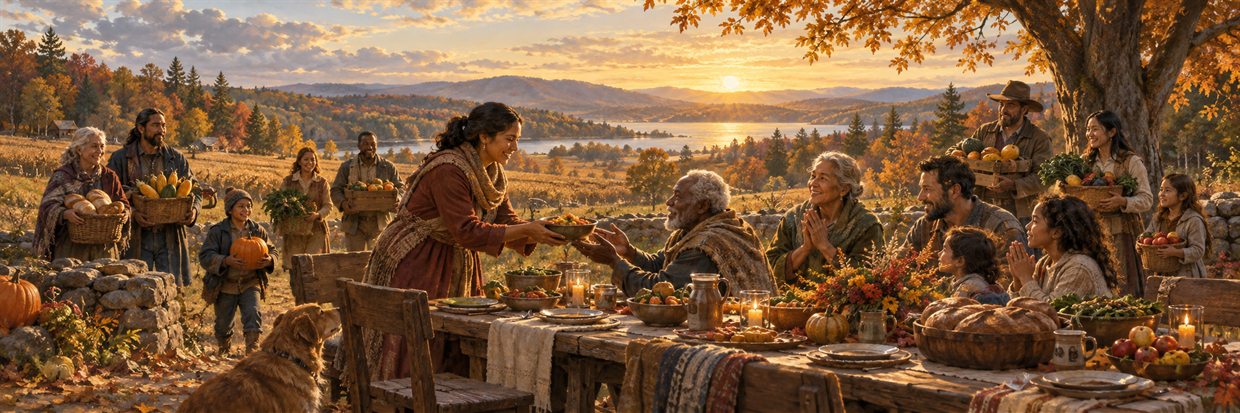
Thanksgiving brings together traditions of gratitude, harvest celebration and family gatherings. The United States observes it on the fourth Thursday of November and Canada on the second Monday of October. The national holidays developed through civic decisions, alongside religious observances 4,6.
Biblical passages about gratitude provide a religious connection to the later holiday: the Torah's thanksgiving offering, the todah of Leviticus 7:12-15, brought in gratitude and eaten the same day; the command to bless God for the good land after eating and being satisfied (Deuteronomy 8:10); the psalm whose Hebrew title names it a psalm of thanksgiving (Psalm 100, JPS 1917), which the churches read as Psalm 100; and, in the New Testament, the man who returned to give thanks after Jesus healed ten people with leprosy (Luke 17:11-19) and Paul's instruction to give thanks in every circumstance (1 Thessalonians 5:18). These passages help explain Christian thanksgiving, but do not establish the modern national holiday.
The holiday has carried different meanings at different times. Lincoln's 1863 proclamation combined gratitude for the harvest with concern for those bereaved by the Civil War 5. At Plymouth in 1621, Edward Winslow described a three-day harvest celebration attended by Massasoit and approximately ninety Wampanoag men 2. Today, religious services, family gatherings and secular celebrations are among its observances 1.
The modern holiday developed from earlier harvest celebrations and religious days of thanksgiving. In the United States, presidential proclamations and later federal legislation established the national observance 3,4,5. Canada follows a separate calendar 6.
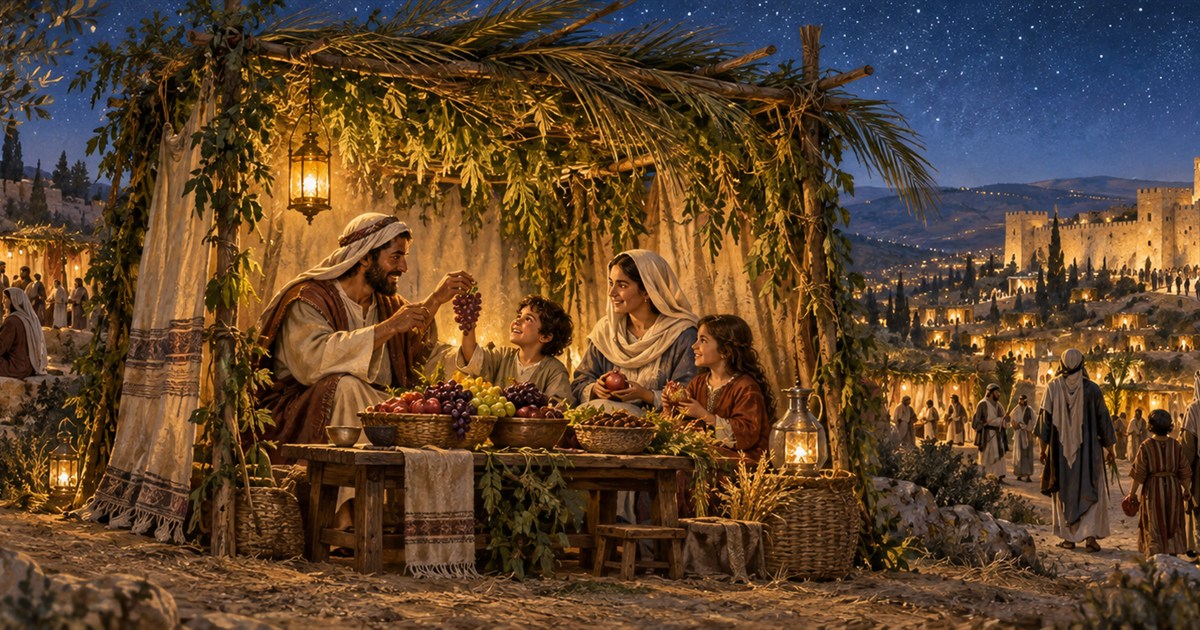
The Bible describes thanksgiving and several harvest observances. Exodus 23:16 names both the Feast of Harvest and the Feast of Ingathering. Israel was to keep the Feast of Tabernacles for seven days after gathering the produce of the threshing floor and the winepress, rejoicing before God because he had blessed the harvest (Deuteronomy 16:13-15); that feast is Sukkot, which Jews still keep in the autumn. The psalms call the congregation to enter God's gates with thanksgiving (Psalm 100:4-5) and praise him for crowning the year with bounty (Psalm 65:9-13). Paul tells the churches to be thankful (Colossians 3:15-17) and to present their requests with thanksgiving (Philippians 4:6). These passages concern worship and gratitude rather than the date of the later civic holiday.
The English Puritans kept days of thanksgiving and days of fasting as religious observances called for particular mercies, and in New England the autumn thanksgivings, kept from early November to mid-December, functioned for some almost as a Calvinist alternative to Christmas 1. The first known civil day of thanksgiving in that tradition was declared at Plymouth Colony in 1623, two years after the harvest feast of 1621 1. The feast itself is known from two surviving accounts: Edward Winslow wrote that after the harvest was gathered the governor sent four men fowling "that so we might after a speciall manner rejoyce together", and that "many of the Indians coming amongst us, and amongst the rest their greatest king Massasoyt, with some ninetie men" were entertained and feasted for three days; William Bradford recorded the small harvest, the store of fowl and the wild turkeys 2. Virginia has an earlier claim: instructions dated 4 September 1619 required the settlers of Berkeley Hundred to keep the day of their arrival each year as a day of thanksgiving to God 3,1.
The national day came by proclamation. On 3 October 1789, at the request of both houses of the first Congress, George Washington assigned Thursday 26 November 1789 as a day of public thanksgiving and prayer, the first under the new Constitution 3,4. Later presidents proclaimed such days irregularly. Sarah Josepha Hale, the editor of Godey's Lady's Book, campaigned for a fixed national day and wrote to several presidents 1, and on 3 October 1863 Lincoln, in a proclamation drafted by his Secretary of State William Seward, invited the country to keep the last Thursday of November as a day of thanksgiving and praise; the day has been kept every year since 5,4.
The date was fixed by law after a quarrel. In 1939 the last Thursday of November fell on the last day of the month, and Franklin Roosevelt moved the holiday a week earlier to lengthen the Christmas shopping season; thirty-two states followed him, sixteen refused, and for two years the country kept two Thanksgivings 4. Congress ended it: the House passed a resolution for the last Thursday on 6 October 1941, the Senate amended it to the fourth Thursday, and Roosevelt signed it on 26 December 1941 4. Canada's history includes a period from 1921 to 1931 when Thanksgiving and Armistice Day shared a date 18. Its present observance falls on the second Monday of October 6.
| Passage | What it is | Edition |
|---|---|---|
| Deuteronomy 8:7-18 | Read on the day | Berean Standard Bible |
| Psalm 100 | Read on the day | Berean Standard Bible |
| Luke 17:11-19 | Read on the day | Berean Standard Bible |
| 1 Thessalonians 5:18 | Read on the day | Berean Standard Bible |
| Philippians 4:4-9 | Read on the day | Berean Standard Bible |
| Sirach 50:22-24 | Read on the day | World English Bible (Catholic) |
Who keeps it A civil holiday in the United States and Canada, also marked by some churches with thanksgiving services. The displayed date is for the United States; Canada observes the second Monday of October.
A shared meal is a familiar part of Thanksgiving. Some families say grace, and some churches hold services on the day or the evening before. Others observe it without a religious service 1.
In the United States the Catholic Church lists Thanksgiving Day in the proper calendar for the country's dioceses, and its liturgical calendar directs that on the day any readings may be taken from the Mass "In Thanksgiving to God" 7. A Thanksgiving Day selection includes the blessing of the God of all in Sirach 50:22-24, Paul's thanks for the church at Corinth in 1 Corinthians 1:3-9, and the ten lepers in Luke 17:11-19 19. Sirach is in Catholic and Orthodox Bibles; Anglican editions that include the Apocrypha place it there, and most Protestant Bibles and the Jewish Tanakh do not carry it, so the link here is to the World English Bible's Catholic edition. The same three verses are the source of the hymn "Now thank we all our God", written in German by the Lutheran pastor Martin Rinkart about 1636 and used as a Christian hymn of thanksgiving 13.
The Episcopal Church's Book of Common Prayer gives Thanksgiving Day its own collect, giving thanks "for the fruits of the earth in their season and for the labors of those who harvest them" and asking that the church be a faithful steward of that bounty "for the relief of all who are in need" 8. Episcopal, Lutheran, Methodist, Presbyterian, United Church of Christ and other congregations that follow the Revised Common Lectionary have a set of readings for the day in each year of its cycle: in 2026, Deuteronomy 8:7-18, Psalm 65, 2 Corinthians 9:6-15 and Luke 17:11-19; in 2027, Joel 2:21-27, Psalm 126, 1 Timothy 2:1-7 and Matthew 6:25-33 9,10. The lectionary lists a Canadian Thanksgiving Day in October with the same readings 9.
Churches need not follow a shared lectionary to hold a Thanksgiving service. Local observances can include prayer, hymns and a meal. The form of observance depends on the congregation; a denomination's name alone does not establish whether it keeps the day 1.
Other countries keep a church harvest thanksgiving rather than a national day. In Germany, Austria and Switzerland Erntedankfest is kept by Catholic and Protestant congregations with the church decorated with produce and a harvest crown; the German Catholic bishops' conference set the first Sunday of October as its date in 1972 without making it obligatory, and the Protestant churches kept it earlier on the Sunday after Michaelmas 12. The English harvest festival began when the Rev. Robert Hawker invited his parishioners at Morwenstow in Cornwall to a special thanksgiving service in 1843; the Victorian hymns "We plough the fields and scatter" and "Come, ye thankful people, come" spread the idea, and churches are still decorated with baskets of fruit and food in September or October 11.
Since 1970, Indigenous people and their allies have gathered on Cole's Hill in Plymouth for the National Day of Mourning on US Thanksgiving. Its organizers, United American Indians of New England, describe it as a time to remember Indigenous ancestors, honour Native resilience, and protest land dispossession, racism and continuing oppression 16. This observance is an important part of Thanksgiving's contemporary history; it does not represent a single view held by every Indigenous person.
These passages offer a starting point for study. Service readings and verse numbering can differ by tradition, Bible edition and year; use the relevant community's calendar for a particular service.
Thanksgiving readings often focus on gratitude, the harvest and generosity. The selections below show how particular churches and lectionaries connect those themes with the holiday.
The Revised Common Lectionary's Thanksgiving Day set for 2026, Year A, is Deuteronomy 8:7-18, the good land and the warning not to forget who gave it; Psalm 65, which crowns the year with bounty; 2 Corinthians 9:6-15, on generous giving that overflows in thanksgiving to God; and Luke 17:11-19, the ten lepers healed and the one, a Samaritan, who returned 9. For 2027, Year B, the set is Joel 2:21-27, Psalm 126, 1 Timothy 2:1-7 and Matthew 6:25-33, on not worrying about food and clothing 10.
The Catholic Mass in Thanksgiving to God offers a choice of readings, and one Thanksgiving Day selection includes Sirach 50:22-24, 1 Corinthians 1:3-9 and Luke 17:11-19 7,19. The Book of Common Prayer's own table pairs its collect with Deuteronomy 8, Psalm 65, James 1:17-27 and Matthew 6:25-33, the same passages the lectionaries draw on 17. The links here are for study; a church's own lectionary is the authority for its service.
In brief Mass for Thanksgiving Day: Sirach 50:22-24 or Deuteronomy 8:7-18; 1 Corinthians 1:3-9; Luke 17:11-19.
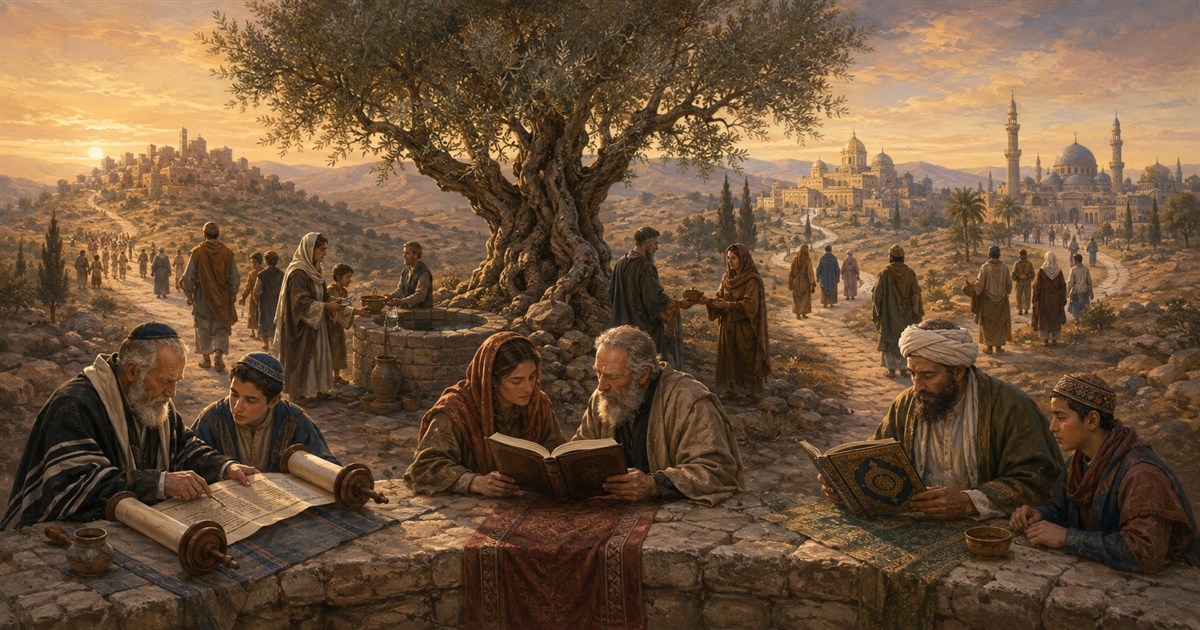
Jewish communities have their own traditions of gratitude, including Sukkot and prayers of thanksgiving. Some American Jews also celebrate the national holiday, while others do not; religious views about participation differ 14,15.
The Torah's harvest feast is Deuteronomy 16:13-15: seven days of rejoicing after the produce of the threshing floor and the winepress is gathered, because God has blessed the harvest. Jews keep it as Sukkot, eating in a temporary hut in the weeks before or after the Canadian Thanksgiving and a month or more before the American one. The thanksgiving offering of Leviticus 7:12-15, JPS 1917, the todah, and the psalm titled for it, Psalm 100, are part of Jewish scripture and worship, as well as texts read by Christians.
My Jewish Learning describes Thanksgiving as an opportunity for some American Jews to gather with family and express both Jewish and American identities. It also discusses objections to adopting a non-Jewish holiday. These are varied experiences, not a universal Jewish practice 14.
Rabbinic discussion asks whether Thanksgiving is a civic occasion or a religious custom Jews should not adopt. Rabbi Jack Abramowitz's overview for the Orthodox Union contrasts authorities who permitted commemoration, including Rabbis Moshe Feinstein and Joseph Soloveitchik, with Rabbi Yitzchak Hutner's opposition 15. This summarizes a disagreement; it is not a religious ruling for individual readers.
In the United States Thanksgiving is the fourth Thursday of November: 26 November in 2026 and 25 November in 2027. In Canada it is the second Monday of October: 12 October in 2026 and 11 October in 2027.
The American rule is the joint resolution Roosevelt signed on 26 December 1941, which chose the fourth Thursday rather than the last so that a November with five Thursdays would not push the day to the 30th 4. Before that the day followed the president's annual proclamation, on the last Thursday of November from Lincoln's proclamation of 1863 onward 5,4.
Canada observes Thanksgiving on the second Monday of October 6. Church harvest thanksgivings elsewhere have their own local calendars, including autumn observances in Germany and England 12,11. The table below gives the US and Canadian dates.
| Rule | 2026 | 2027 |
|---|---|---|
| Fourth Thursday of November (United States); second Monday of October (Canada) | 26 November; nominal date, local liturgical transfers may apply; United States; Canada keeps the second Monday of October | 25 November; nominal date, local liturgical transfers may apply; United States; Canada keeps the second Monday of October |
The Bible does not establish the modern national holiday. It does contain passages about gratitude and harvest celebrations, including Leviticus 7, Deuteronomy 16 and Psalm 100. Christians also draw on Luke 17 and 1 Thessalonians 5:18. The US national observance developed through proclamations and legislation; Canada has its own history and date. 3,4,5,6
Thursday 26 November 2026 in the United States, the fourth Thursday of November, and Monday 12 October 2026 in Canada, the second Monday of October. In 2027 the dates are 25 November and 11 October. 4,6
The Revised Common Lectionary reads Deuteronomy 8:7-18, Psalm 65, 2 Corinthians 9:6-15 and Luke 17:11-19 in 2026, and Joel 2:21-27, Psalm 126, 1 Timothy 2:1-7 and Matthew 6:25-33 in 2027. A Catholic Thanksgiving Day selection includes Sirach 50:22-24, 1 Corinthians 1:3-9 and Luke 17:11-19. The Book of Common Prayer pairs its Thanksgiving Day collect with Deuteronomy 8, Psalm 65, James 1 and Matthew 6. 7,8,9,10,17 19
Edward Winslow describes a three-day harvest feast attended by Massasoit and approximately ninety Wampanoag men. William Bradford describes the harvest and available food, including wild turkeys, but does not supply those details of the gathering. Neither calls the event Thanksgiving in these accounts. The celebration should be distinguished from separately proclaimed Puritan days of thanksgiving. 2
Some American Jews celebrate it as a civic or family occasion; others do not. Rabbinic authorities have differed over whether participation is appropriate. Jewish traditions of gratitude, including Sukkot and prayers of thanksgiving, are distinct from the national holiday. 14,15
Quoted from the Berean Standard Bible; each links to its chapter and carries a Memorize button that starts the five-step path. Switch the edition to read them in another Bible here.
Enter His gates with thanksgiving and His courts with praise; give thanks to Him and bless His name.
A psalm of thanksgiving in its Hebrew title, and a passage for exploring gratitude in worship.
When you eat and are satisfied, you are to bless the LORD your God for the good land that He has given you.
Moses tells Israel to bless God after eating and being satisfied. This passage appears in the Revised Common Lectionary's Year A Thanksgiving selection.
When one of them saw that he was healed, he came back, praising God in a loud voice. He fell facedown at Jesus’ feet in thanksgiving to Him—and he was a Samaritan.
One of ten people healed by Jesus returns to give thanks. This passage appears in the Catholic Thanksgiving selection and the Revised Common Lectionary's Year A selection.
Be anxious for nothing, but in everything, by prayer and petition, with thanksgiving, present your requests to God.
Paul connects prayer with thanksgiving in his letter to the Philippians.
Make it part of your day
Optional further reading: you can explore the text without sharing its beliefs or taking part in the observance.
Paul's whole instruction for the day, in nine words worth carrying past it.
Give thanks in every circumstance, for this is God’s will for you in Christ Jesus.
The numbers match the references in the article. Links include religious texts, community explanations and historical studies. Read more about how this guide was researched.
BibleVerse Editorial, "Thanksgiving Day: What It Marks, Where It Comes From, and How It Is Kept", BibleVerse, published 2026-09-18, updated 2026-09-19, https://bibleverse.site/holidays/thanksgiving/
Version 1.1. Awaiting review by a member of the community it describes. Dates in the table are for 2026 and 2027 and are refreshed yearly. Corrections are welcome through the contact page.
See which Jewish, Christian and Islamic holidays the Bible commands, tells or names, and where the rest come from.
Sukkot is a seven-day Jewish festival of harvest and remembrance. Its temporary shelters, called sukkot, recall the Israelites' life in the wilderness.
Explore shared roots, distinct scriptures and differences in belief.