Holidays in the Bible
See which Jewish, Christian and Islamic holidays the Bible commands, tells or names, and where the rest come from.
Holidays in the Bible · Jewish
the Feast of Tabernacles · the Feast of Booths
Sukkot is a seven-day Jewish festival of harvest and remembrance. Its temporary shelters, called sukkot, recall the Israelites' life in the wilderness.
When 15 to 21 Tishrei. 2026 Evening of 25 September to 2 October; the first two days are Yom Tov outside Israel.
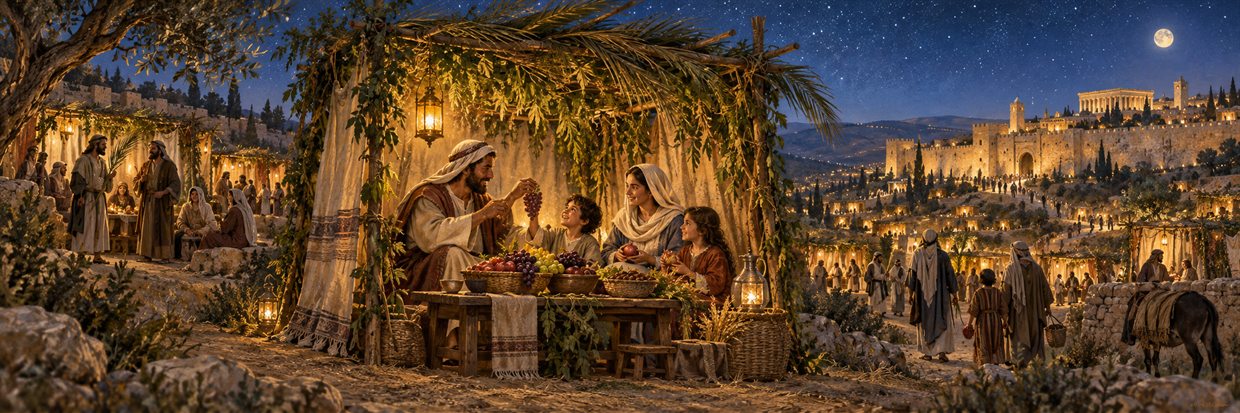
Sukkot is a seven-day Jewish festival of harvest and remembrance. Its temporary shelters, called sukkot, recall the Israelites' life in the wilderness.
The Torah gives the festival two meanings and keeps them together. It is the Feast of Ingathering, when the fruit and the grapes are in and the year's work is done (Exodus 23:16, Deuteronomy 16:13), and it is the Feast of Booths, when Israel is to live in huts for seven days so that every generation may know that God made the people dwell in booths when he brought them out of Egypt (Leviticus 23:42-43) 1,2. Deuteronomy adds a third thing, and it is the one the rabbis named the festival for: thou shalt rejoice in thy feast, thou and thy son and thy daughter and the stranger and the fatherless and the widow (Deuteronomy 16:14). The prayer book calls Sukkot the season of our joy 1.
It comes five days after Yom Kippur, so the Jewish autumn moves from judgment to joy in less than a week, and it closes with two more days, Shemini Atzeret and Simchat Torah, that have their own cards on the overview.
The Torah commands dwelling in booths and taking the four species in Leviticus 23, and prescribes the seventy bulls across seven days in Numbers 29:12–34. Later Temple ceremonies and rabbinic customs developed around the festival.
Leviticus 23:33-43 gives the festival in full: the fifteenth day of the seventh month, seven days of offerings with a holy convocation on the first and an eighth day of assembly after, the taking of the fruit of goodly trees, branches of palm, boughs of thick trees and willows of the brook on the first day, and the seven days in booths. Numbers 29:12-34 lists the offerings, which fall from thirteen bulls on the first day to seven on the seventh, seventy in all; the Talmud says the seventy bulls are for the seventy nations of the world, and the single bull of the eighth day for Israel (Talmud Sukkah 55b) 3. Deuteronomy 16 makes it one of the three pilgrimages, and Deuteronomy 31:10-13 commands that every seventh year the whole Torah be read aloud to all Israel, men, women and children and the stranger, at this festival 2.
The Bible keeps returning to Sukkot at its turning points. Solomon dedicated the first Temple at the feast of the seventh month, and the people went home on the eighth day (1 Kings 8:2, 8:65-66). The returned exiles kept it at the rebuilt altar before the second Temple had walls (Ezra 3:4), and under Ezra and Nehemiah the people went out for branches of olive, myrtle and palm and built booths on their roofs and in the courts of the Temple, and the writer says that from the days of Joshua until that day the children of Israel had not done so, and there was very great gladness (Nehemiah 8:13-18) 2.
Two things the Torah does not describe grew up in the second Temple. Water was drawn from the pool of Siloam and poured on the altar each morning of the festival, and the night before, in the Court of the Women, there was a celebration with golden lampstands that lit every courtyard in Jerusalem, pious men dancing with torches, and the Levites on the fifteen steps with harps and trumpets; the Mishnah says that whoever has not seen the rejoicing at the place of the water-drawing has never seen rejoicing in his life (Mishnah Sukkah 5:1-4) 4. And the rabbis defined the booth itself: a sukkah higher than twenty cubits is unfit, and so is one less than ten handbreadths high, or without three walls, or with more sun than shade (Mishnah Sukkah 1:1); the roof must be of cut plants, schach, and the Mishnah's tractate on the festival is where rabbinic requirements for the sukkah are discussed 5.
| Passage | What it is | Edition |
|---|---|---|
| Leviticus 23:33-43 | Institutes the day | JPS TaNaKH 1917 |
| Numbers 29:12-34 | Institutes the day | JPS TaNaKH 1917 |
| Deuteronomy 16:13-15 | Institutes the day | JPS TaNaKH 1917 |
| Exodus 23:16 (the Feast of Ingathering) | Institutes the day | JPS TaNaKH 1917 |
| Deuteronomy 31:10-13 | Institutes the day | JPS TaNaKH 1917 |
| 1 Kings 8:2 | Tells the event | JPS TaNaKH 1917 |
| Nehemiah 8:13-18 | Tells the event | JPS TaNaKH 1917 |
| John 7:2 | Names the holiday | Berean Standard Bible |
| Zechariah 14 | Read on the day | JPS TaNaKH 1917 |
| Ezekiel 38:18-23 | Read on the day | JPS TaNaKH 1917 |
| the Book of Ecclesiastes | Read on the day | JPS TaNaKH 1917 |
| John 7:37-39 | A Christian reading | Berean Standard Bible |
Who keeps it Many Rabbinic Jewish communities, eating (and in many homes sleeping) in a sukkah for seven days and waving the lulav and etrog; the first day (two outside Israel) is a full festival day.
For seven days families eat in the sukkah, and many sleep in it; each morning the four species are held together and waved, and on the seventh day the synagogue circles seven times with willows.
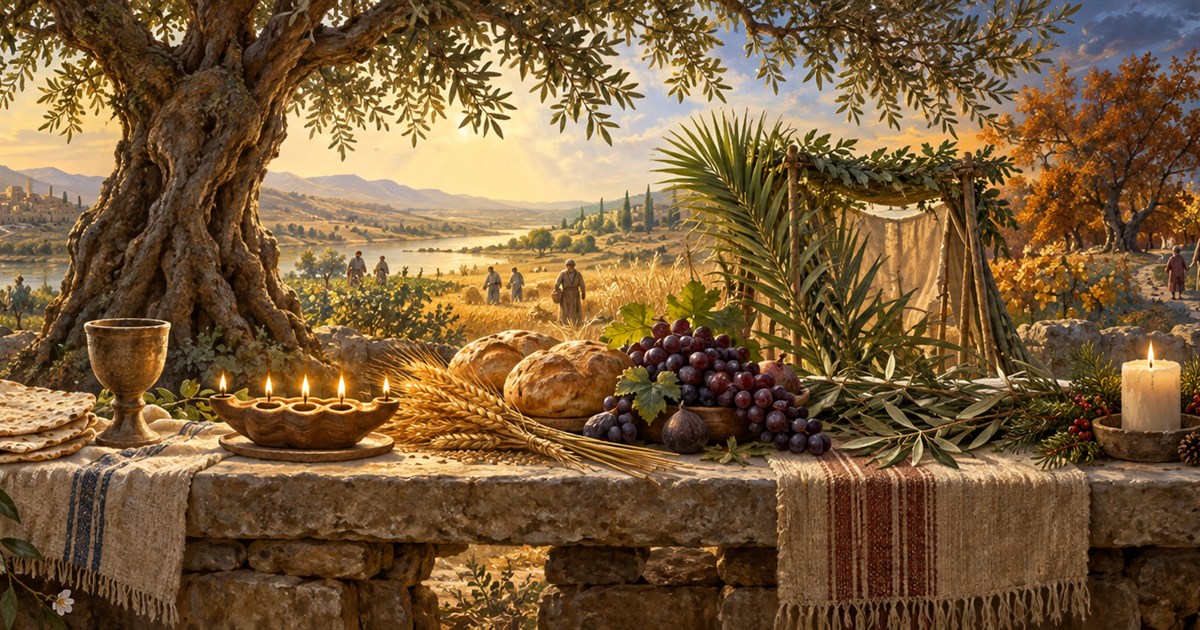
The sukkah goes up in the days after Yom Kippur, in a garden, on a balcony or on a roof: at least three walls and a roof of branches, bamboo or palm fronds laid loosely enough to see the stars, and decorated with fruit, paper chains and the children's drawings. Meals are eaten in it, with the blessing to dwell in the sukkah, and in warm climates people sleep in it; in Israel restaurants build them for customers. A custom invites seven guests of the Bible, the ushpizin, one to each night: Abraham, Isaac, Jacob, Moses, Aaron, Joseph and David 1.
The four species, arba minim, are a palm frond, the lulav, bound with three myrtle and two willow branches, and a citron, the etrog, held in the other hand; each morning of the festival except the Sabbath they are held together, blessed and waved in six directions, and the congregation circles the synagogue once with them saying Hoshana, save now. On the seventh day, Hoshana Rabbah, the circling is seven times and a bundle of willows is beaten on the ground 1,2. The first day is Yom Tov, a day of rest like the Sabbath (two days outside Israel in Orthodox and Conservative practice); the middle days are chol ha-moed, when most work is allowed.
Orthodox, Conservative, Reform and Reconstructionist Jews all keep the sukkah and the four species; Reform practice keeps one day of Yom Tov, as Israel does, and reads only the Sukkot section of Leviticus 23 on the first morning 7. The Samaritans keep the festival too, in their own way, and Karaite Jews keep it from the Torah's text 2. In Jerusalem the Western Wall fills with lulavim, and since 1980 thousands of Christian pilgrims have come each Sukkot too, for a reason the neighbours section gives.
Karaite interpretations differ from the rabbinic use of the four species. The Karaite Jews of America describes both majority and minority views among Karaite sages about the plants in Leviticus 23, including their use in building the sukkah. 12
These passages offer a starting point for study. Service readings and verse numbering can differ by tradition, Bible edition and year; use the relevant community's calendar for a particular service.
The first day reads the Torah's calendar of festivals and the prophet who says all nations will one day come up to Jerusalem for Sukkot; the Sabbath of the festival reads Ecclesiastes.
First day: Leviticus 22:26 to 23:44, the whole calendar of the appointed seasons with Sukkot at its end, and Numbers 29:12-16 as the maftir; haftarah Zechariah 14, which the Talmud ordains for the day because it is written in it to keep the feast of Sukkot, and which ends with all the nations going up to Jerusalem year by year to keep it (Talmud Megillah 31a) 7,8. Second day outside Israel: the same Torah reading; haftarah 1 Kings 8:2-21, Solomon's dedication at the feast. Each middle day reads its own day's offerings from Numbers 29.
On the Sabbath of the festival: Exodus 33:12 to 34:26, Moses asking to see God's glory, with haftarah Ezekiel 38:18 to 39:16, the war of Gog, which the rabbis paired with Zechariah's; and the Book of Ecclesiastes, read at the festival of joy as a reminder that the harvest and the hut are passing things, vanity of vanities, and that the whole matter is to fear God and keep his commandments 1. Hoshana Rabbah reads the day's offerings and adds the seven circuits with their litanies.
In brief First day: Leviticus 22:26 to 23:44 and Numbers 29:12-16, haftarah Zechariah 14. Sabbath of the festival: Exodus 33:12 to 34:26, haftarah Ezekiel 38:18 to 39:16, and the Book of Ecclesiastes.
John 7 places Jesus at the Feast of Tabernacles. Sukkot also has a place in the observance of some Christian groups.
John 7 opens with the Jewish Feast of Tabernacles near and Jesus going up to Jerusalem quietly; he teaches in the Temple through the festival, and on the last and greatest day of the feast he stands and calls out that whoever is thirsty should come to him and drink, and rivers of living water will flow from within (John 7:37-39). Christian readers, since the church fathers, have heard in that saying the water poured on the altar each morning of Sukkot and the prayers for rain that close the festival; the Gospel itself says he spoke of the Spirit. This interpretation belongs to Christian tradition 2. The Orthodox Church reads John 7:37–52 and 8:12 at the liturgy of Pentecost, its own feast of the Spirit.
Zechariah 14:16-19, the haftarah of the first day, says that everyone left of all the nations shall go up year by year to worship the King and to keep the feast of Sukkot. Some Christians take the verse as a summons to them now: the International Christian Embassy Jerusalem organizes a Christian Feast of Tabernacles celebration, and says in its own words that it does so because of Zechariah's verse 9,10. Jewish interpretations also understand the verse as a promise for the end of days, when the nations will come to the God of Israel, and the Talmud's seventy bulls for the seventy nations sit behind both readings 3,8.
The United Church of God observes the Feast of Tabernacles and the following sacred assembly within its annual calendar 11. Its interpretation is one example of Christian festival observance; it should not be applied to every Christian or Messianic congregation.
Sukkot begins on the fifteenth of Tishrei, five days after Yom Kippur, at the full moon, and falls in late September or October.
The Torah fixes the date, the fifteenth day of the seventh month (Leviticus 23:34), so the festival begins at the same full moon that Pesach begins at in the spring, half a year on. Jewish days begin at sunset, so the first meal in the sukkah is on the evening before the date in the table. The first day is Yom Tov everywhere, and the second as well outside Israel in Orthodox and Conservative practice; Hoshana Rabbah is the seventh day, and Shemini Atzeret and Simchat Torah follow on the eighth and, outside Israel, the ninth 1.
Because the fixed calendar keeps Rosh Hashanah off Sunday, Wednesday and Friday, the first day of Sukkot, two weeks later, never falls on those days either, and Hoshana Rabbah never falls on the Sabbath, so the willows can always be beaten.
| Rule | 2026 | 2027 |
|---|---|---|
| 15 to 21 Tishrei | Evening of 25 September to 2 October; the first two days are Yom Tov outside Israel | Evening of 15 October to 22 October; the first two days are Yom Tov outside Israel |
Yes, in more places than most festivals. Leviticus 23:33-43 commands the seven days, the booths and the four species; Exodus 23 and 34 name it the Feast of Ingathering; Deuteronomy 16 makes it a pilgrimage and commands joy; Numbers 29 lists its seventy bulls; and Solomon, Ezra and Nehemiah are all recorded keeping it. John 7 sets a chapter of the Gospel at it 2.
Because Leviticus 23:42-43 commands Israel to dwell in booths for seven days so that every generation will know that God made the people dwell in booths when he brought them out of Egypt. The rabbis fixed the measurements: at least three walls, a roof of cut branches with more shade than sun, no taller than twenty cubits 5,1.
The four plants Leviticus 23:40 commands Israel to take on the first day: the fruit of goodly trees, understood as the citron or etrog; branches of palm, the lulav; boughs of thick trees, the myrtle; and willows of the brook. They are held together, blessed and waved each morning of the festival except the Sabbath 1,6.
Sukkot. John 7 opens with the Jewish Feast of Tabernacles near, Jesus goes up to Jerusalem for it, and on its last and greatest day he calls out that whoever is thirsty should come to him and drink. Christian readers connect the saying with the water poured on the altar each day of the festival; the Gospel says he spoke of the Spirit 2.
Because of Zechariah 14:16, which says every nation left shall go up year by year to keep the feast of Sukkot. The International Christian Embassy Jerusalem has held a Christian Feast of Tabernacles celebration in the city every Sukkot since 1980 on the strength of that verse, drawing several thousand pilgrims. Jews read the same verse as a promise for the end of days 9,10.
Quoted from the JPS TaNaKH 1917; each links to its chapter and carries a Memorize button that starts the five-step path. Switch the edition to read them in another Bible here.
Ye shall dwell in booths seven days; all that are home-born in Israel shall dwell in booths; that your generations may know that I made the children of Israel to dwell in booths, when I brought them out of the land of Egypt: I am the LORD your God.
The command and its reason in two verses: dwell in booths seven days, so that your generations may know that God made Israel dwell in booths when he brought them out of Egypt.
And thou shalt rejoice in thy feast, thou, and thy son, and thy daughter, and thy man-servant, and thy maid-servant, and the Levite, and the stranger, and the fatherless, and the widow, that are within thy gates.
The commandment to rejoice, with everyone included down to the stranger and the widow; the reason the prayer book calls Sukkot the season of our joy.
And it shall come to pass, that every one that is left of all the nations that came against Jerusalem shall go up from year to year to worship the King, the LORD of hosts, and to keep the feast of tabernacles.
The close of the first day's haftarah: every nation left shall go up year by year to keep the feast of Sukkot.
And all the congregation of them that were come back out of the captivity made booths, and dwelt in the booths; for since the days of Joshua the son of Nun unto that day had not the children of Israel done so. And there was very great gladness.
The whole congregation of the returned exiles in booths on their roofs, with gladness the writer says had not been seen since Joshua.
Make it part of your day
Optional further reading: you can explore the text without sharing its beliefs or taking part in the observance.
The two verses every sukkah is built on, to carry from one autumn to the next.
Ye shall dwell in booths seven days; all that are home-born in Israel shall dwell in booths; that your generations may know that I made the children of Israel to dwell in booths, when I brought them out of the land of Egypt: I am the LORD your God.
The numbers match the references in the article. Links include religious texts, community explanations and historical studies. Read more about how this guide was researched.
BibleVerse Editorial, "Sukkot: What It Marks, Where It Comes From, and How It Is Kept", BibleVerse, published 2026-09-11, updated 2026-09-12, https://bibleverse.site/holidays/sukkot/
Version 1.1. Awaiting review by a member of the community it describes. Dates in the table are for 2026 and 2027 and are refreshed yearly. Corrections are welcome through the contact page.
See which Jewish, Christian and Islamic holidays the Bible commands, tells or names, and where the rest come from.
The Torah's eighth day of solemn assembly after Sukkot, a festival of its own, on which the prayer for rain begins.
Explore the books and their place in four scriptural traditions.