Holidays in the Bible
See which Jewish, Christian and Islamic holidays the Bible commands, tells or names, and where the rest come from.
Holidays in the Bible · Islamic
the Feast of the Sacrifice · Eid al-Kabir, the Greater Eid · Kurban Bayramı
Eid al-Adha, the Muslim Feast of the Sacrifice, remembers Abraham's willingness to obey God. It takes place during the final days of Hajj, the pilgrimage to Mecca.
When 10 Dhu al-Hijjah, the last month of the Islamic year, for three to four days. 2026 27 May to 30 May (Umm al-Qura; a day earlier or later by local sighting).
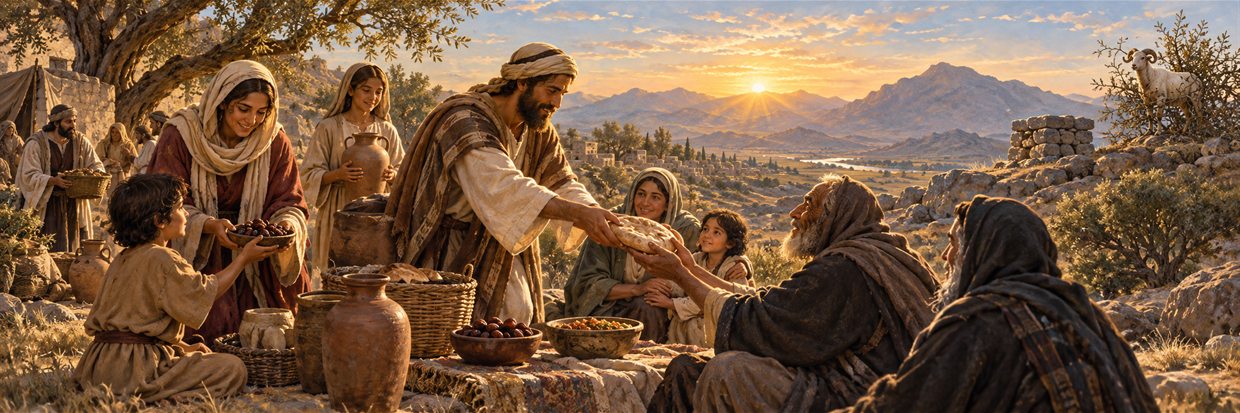
Eid al-Adha, the Muslim Feast of the Sacrifice, remembers Abraham's willingness to obey God. It takes place during the final days of Hajj, the pilgrimage to Mecca.
The story is the Qur'an's. In the thirty-seventh surah Abraham prays for a righteous son and is given one; when the boy is old enough to work beside him, Abraham says he has seen in a dream that he must sacrifice him, and the son answers that his father should do as he is commanded and will find him patient; Abraham lays him face down, and God calls out that he has fulfilled the vision, and ransoms the boy with a great sacrifice (Qur'an 37:99-111) 1,2. The feast is called al-Adha, the sacrifice, and Eid al-Kabir, the greater Eid; in Turkish it is Kurban Bayramı and in South Asia Bakrid 2.
Eid al-Adha begins on 10 Dhu al-Hijjah, the last month of the Islamic year. It coincides with the sacrifice day during Hajj, after the pilgrims' day at Arafat. Further pilgrimage rites take place during the following days of Tashreeq, 11–13 Dhu al-Hijjah 6. Communities share the Hijri date, but local calendar decisions can produce different Gregorian dates 2,3. The Qur'an and Genesis describe related accounts of Abraham's test, with differences explored below.
The Qur'an recounts Abraham's willingness to sacrifice his son. Genesis 22 describes a related account, naming Isaac. The texts and their interpretations have distinct details.
The Qur'an's account (Qur'an 37:99-113) does not name the son in the verses that tell the sacrifice; after the ransom it gives Abraham the good news of Isaac, a prophet among the righteous. Muslim tradition has generally understood the son of the sacrifice to be Ishmael, Abraham's first son, partly because Isaac's birth is announced after it; some early Muslim scholars held that it was Isaac, and the classical commentators record both views with Ishmael becoming the predominant identification 4,2. The hajj itself is built around Hagar and Ishmael: the running between Safa and Marwa remembers Hagar's search for water, and the well of Zamzam the water God gave her son 4.
The Bible tells the test in Genesis 22. God tells Abraham to take his son, his only son Isaac, whom he loves, to the land of Moriah and offer him; Abraham rises early, carries the fire and the knife while Isaac carries the wood, and answers Isaac's question by saying that God himself will provide the lamb; on the mountain the angel stops his hand, a ram is caught in a thicket, and God swears to bless him and all nations through his offspring because he did not withhold his son. Genesis names Isaac, and tells Ishmael's story in the chapters around it: his birth to Hagar (Genesis 16), God's promise to make him a great nation (Genesis 17:20), and the wilderness where God heard the boy's voice and opened Hagar's eyes to a well (Genesis 21:8-21), and the two brothers burying their father together (Genesis 25:9).
Genesis explicitly names Isaac; the Qur'anic sacrifice passage does not name the son. Muslim interpretations have included both Isaac and Ishmael, with Ishmael the predominant identification today 2,4. These distinctions matter even where the accounts share themes of trust and obedience.
| Passage | What it is | Edition |
|---|---|---|
| Genesis 22:1-19 | Tells the event | Berean Standard Bible |
| Genesis 21:8-21 (Hagar and Ishmael in the wilderness) | Tells the event | Berean Standard Bible |
| Genesis 16 | Tells the event | Berean Standard Bible |
| Hebrews 11:17-19 | A Christian reading | Berean Standard Bible |
| James 2:21-23 | A Christian reading | Berean Standard Bible |
| Qur'an 37:99-113, the sacrifice of Abraham's son | the tradition's own scripture | Qur'an and hadith |
| Qur'an 2:124-129, Abraham and Ishmael raise the foundations of the House | the tradition's own scripture | Qur'an and hadith |
| Qur'an 22:34-37, the sacrifice and the pilgrimage | the tradition's own scripture | Qur'an and hadith |
Who keeps it Muslims everywhere, Sunni and Shia, at the close of the hajj: the Eid prayer, the sacrifice of an animal with a third given to the poor, new clothes and visits over three or four days.
Eid prayer, visits and sharing food are central features of the festival. Those who undertake the sacrifice may arrange it locally or support its distribution elsewhere; circumstances and religious guidance differ.
The day begins with the takbir, the call God is greatest, said aloud on the way to prayer, and the Eid prayer itself, two units of prayer in a mosque or an open field after sunrise, followed by a sermon that retells Abraham's sacrifice 2. Then the udhiyah or qurbani, the sacrifice, by those who can afford it: the animal is slaughtered in God's name, and a customary way to share the meat is to give portions to the household, relatives or friends, and people in need 2. Many Muslims in cities now pay for a sacrifice performed elsewhere and given to the poor, and pilgrims at Mecca buy a voucher for an animal slaughtered in their name on the tenth 3.
The feast lasts three or four days, the days of Tashreeq, with visits, new clothes, gifts to children and the greeting Eid mubarak, a blessed feast 2. Both Sunni and Shia communities celebrate Eid al-Adha, with differences in religious guidance and local custom. The day before, the Day of Arafah, when the pilgrims stand on the plain of Arafat, is a recommended fast for Muslims who are not on the hajj 3.
Hajj continues after the sacrifice day. The Ministry of Hajj and Umrah describes further stoning rites during the days of Tashreeq and departure on the twelfth or thirteenth of Dhu al-Hijjah 6. Eid connects Muslims on pilgrimage with communities celebrating elsewhere; it does not mean that all pilgrimage rites end on the tenth.
These passages offer a starting point for study. Service readings and verse numbering can differ by tradition, Bible edition and year; use the relevant community's calendar for a particular service.
The Eid sermon retells Abraham's sacrifice from the Qur'an's thirty-seventh surah; the same story is read in the synagogue on Rosh Hashanah and in the church at the Easter Vigil.
The Qur'an's account is Surah As-Saffat, those ranged in ranks, verses 99 to 113, read in the Eid sermon and in homes; Surah al-Hajj 22:34-37, which says that neither the meat nor the blood of the sacrifice reaches God but the devotion of those who offer it, is the verse most often set beside the sacrifice; and Surah al-Baqarah 2:124-129, Abraham and Ishmael raising the foundations of the House at Mecca, ties the feast to the hajj 1,2. The Qur'an is read in Arabic; the links on this page go to an English rendering at Quran.com, which is not part of this site's Bible editions.
In the Bible the test is Genesis 22:1-19, which Jews read on the second day of Rosh Hashanah and Christians at the Easter Vigil and on the second Sunday of Lent in some lectionaries. The Bible's Ishmael is in Genesis 16, Genesis 17, Genesis 21 and Genesis 25.
In brief The Eid prayer and sermon; the Qur'an's account in Surah 37 (As-Saffat). Muslim tradition generally identifies the son as Ishmael; Genesis names Isaac.
Jews read the same test of Abraham as the Akedah, the binding of Isaac, and read it aloud on Rosh Hashanah.
In Jewish tradition Genesis 22 is the last and greatest of the ten trials of Abraham, and it is read on the second day of Rosh Hashanah; the shofar blown on that day is a ram's horn so that God will remember the ram that was offered in Isaac's place, and the merit of the binding is invoked in the prayers of the Days of Awe 5. Eid al-Adha is not a Jewish liturgical festival, and the Qur'an is not Jewish scripture. Jewish interpretations of the Akedah concern Isaac, whom Genesis names. The Rosh Hashanah page explains that day.
Genesis also records promises to Ishmael and describes Isaac and Ishmael burying Abraham together (Genesis 17:20; 25:9). These passages offer further subjects for comparison without making Jewish and Muslim interpretations identical.
Christians read Genesis 22 as one of the chapters that most clearly points, in their reading, to the death of Jesus.
The New Testament reads the chapter twice: Hebrews 11:17-19 counts Abraham's obedience as faith that God could raise Isaac from the dead, and James 2:21-23 holds it up as faith made complete by works. Christian tradition since the church fathers has read Isaac carrying the wood up the mountain as a figure of Christ carrying the cross, God providing the lamb as a promise kept at Calvary, and Abraham not withholding his son as an image of the Father; the Easter Vigil reads the chapter among its lessons for that reason. These are Christian interpretations of the passage.
Eid al-Adha is not part of mainstream Christian liturgical calendars. Christian readings of Genesis and Islamic interpretations of Abraham's sacrifice can be studied alongside one another without treating either as the other's account.
Eid al-Adha is the tenth of Dhu al-Hijjah, the last month of the Islamic year, and moves through the seasons, coming about eleven days earlier each year.
The Islamic calendar is purely lunar, twelve months of the moon with no added month, so its year is about eleven days shorter than the solar year and the feast falls in every season over a lifetime; in 2026 it is in late May, and by the 2030s it will be in the spring and then the winter. The date depends on local calendar decisions concerning Dhu al-Hijjah. This site uses Saudi Arabia's precomputed Umm al-Qura calendar as a planning reference, not as confirmation of the official Hajj dates, and many countries begin the month a day earlier or later on a local sighting, so the feast can fall on two or three different days around the world 2,3.
The feast lasts three or four days, from the tenth through the days of Tashreeq, the eleventh to the thirteenth. Islamic days begin at sunset, so the eve of the feast is the evening of the Day of Arafah. Ashura, the other Islamic day connected to the Bible, falls at the start of the following month, Muharram, and has its own card on the overview.
| Rule | 2026 | 2027 |
|---|---|---|
| 10 Dhu al-Hijjah, the last month of the Islamic year, for three to four days | 27 May to 30 May (Umm al-Qura; a day earlier or later by local sighting) | 16 May to 19 May (Umm al-Qura; a day earlier or later by local sighting) |
The event is. Eid al-Adha remembers Abraham's willingness to sacrifice his son at God's command, which the Qur'an tells in Surah 37 and Genesis 22 tells of Isaac. The feast itself, with its prayer and sacrifice during the final days of Hajj, comes from the Qur'an and Islamic practice, not from the Bible 1,2.
Genesis 22 names Isaac. The Qur'an's account does not name the son, and Muslim tradition has generally understood him to be Ishmael, partly because the Qur'an announces Isaac's birth after the sacrifice; some early Muslim scholars held that it was Isaac. Interpretations have differed 2,4.
Common observances include Eid prayer, visits and sharing food. Those undertaking the sacrifice share its meat, including with people in need; participation and distribution follow differing circumstances and religious guidance 2.
Because the Islamic calendar is lunar, with twelve months of the moon and no added month, so its year is about eleven days shorter than the solar year and every Islamic date moves earlier through the seasons. The day is the tenth of Dhu al-Hijjah; its Gregorian date depends on the sighting of the new moon, and can differ by a day between countries 2,3.
Quoted from the Berean Standard Bible; each links to its chapter and carries a Memorize button that starts the five-step path. Switch the edition to read them in another Bible here.
Abraham answered, “God Himself will provide the lamb for the burnt offering, my son.” And the two walked on together.
Abraham's answer to Isaac on the way up the mountain, in the account of Genesis.
“Do not lay a hand on the boy or do anything to him,” said the angel, “for now I know that you fear God, since you have not withheld your only son from me. ”
The angel stops Abraham's hand: now I know that you fear God. The Qur'an's account ends the test the same way, with God saying the vision is fulfilled.
Then Abraham looked up and saw behind him a ram in a thicket, caught by its horns. So he went and took the ram and offered it as a burnt offering in place of his son.
Genesis describes a ram offered in Isaac's place. Compare the Islamic sacrifice tradition described above, while distinguishing the biblical account from later observance.
Then God heard the voice of the boy, and the angel of God called to Hagar from heaven, “What is wrong, Hagar? Do not be afraid, for God has heard the voice of the boy where he lies. Get up, lift up the boy, and take him by the hand, for I will make him into a great nation.”
God hears the voice of the boy Ishmael in the wilderness and promises to make him a great nation; the Bible's own account of the son Muslim tradition names.
Make it part of your day
Optional further reading: you can explore the text without sharing its beliefs or taking part in the observance.
A verse from Genesis to explore alongside the accounts discussed here.
Abraham answered, “God Himself will provide the lamb for the burnt offering, my son.” And the two walked on together.
The numbers match the references in the article. Links include religious texts, community explanations and historical studies. Read more about how this guide was researched.
BibleVerse Editorial, "Eid al-Adha: What It Marks, Where It Comes From, and How It Is Kept", BibleVerse, published 2026-09-11, updated 2026-09-12, https://bibleverse.site/holidays/eid-al-adha/
Version 1.1. Awaiting review by a member of the community it describes. Dates in the table are for 2026 and 2027 and are refreshed yearly. Corrections are welcome through the contact page.
See which Jewish, Christian and Islamic holidays the Bible commands, tells or names, and where the rest come from.
Rosh Hashanah is the Jewish New Year and the beginning of the High Holy Days. Prayer, the sound of the shofar and festive meals mark a time of reflection and hope for the year ahead.
Explore shared roots, distinct scriptures and differences in belief.