Holidays in the Bible
See which Jewish, Christian and Islamic holidays the Bible commands, tells or names, and where the rest come from.
Holidays in the Bible · Christian
the Falling Asleep of the Theotokos · the Assumption of Mary
The Dormition and the Assumption commemorate the end of Mary's earthly life. Orthodox and Catholic Christians celebrate related teachings about Mary, with differences explained below.
When 15 August (28 August on the Julian calendar). 2026 15 August (Julian-calendar observance: 28 August Gregorian); nominal date, local liturgical transfers may apply.
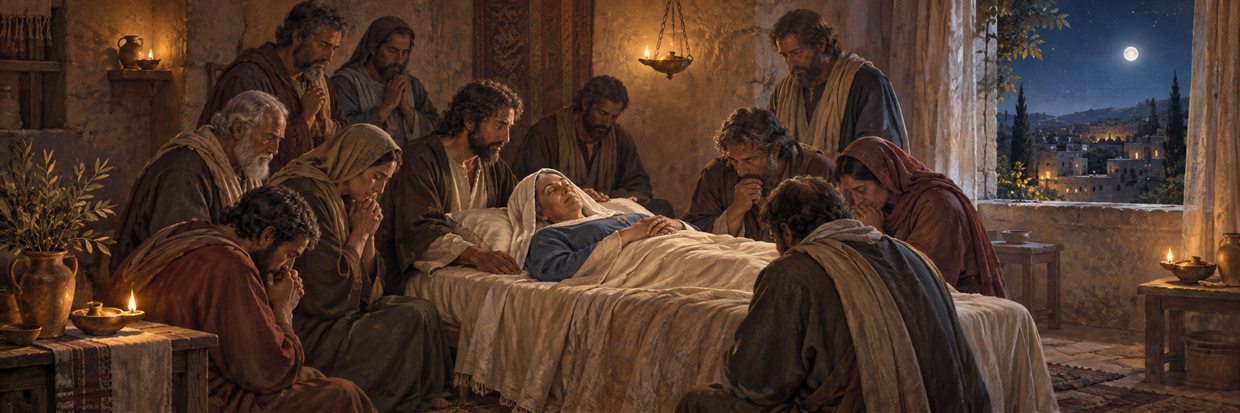
The Dormition and the Assumption commemorate the end of Mary's earthly life. Orthodox and Catholic Christians celebrate related teachings about Mary, with differences explained below.
The Bible does not tell it. The last the New Testament says of Mary is that she stood at the cross and was given into John's care (John 19:25-27) and that she prayed with the apostles in the upper room before Pentecost (Acts 1:14); nothing in scripture narrates her death, burial or assumption, and in the late fourth century Epiphanius of Salamis wrote that he could find no authorised tradition about how her life ended 3. The churches know this and say so. The Catholic definition rests the teaching on the faith of the whole church, the liturgy, the fathers, and passages of scripture read in that light; the Orthodox keep the feast from tradition and the liturgy without a definition 1,2,3.
The day is a holy day of obligation for Catholics and one of the twelve Great Feasts of the Orthodox year, preceded in the East by a two-week fast; Lutheran calendars keep 15 August as the feast of Saint Mary, Mother of our Lord, and the Church of England and other Anglican provinces keep a feast of the Blessed Virgin Mary on the day, some under the name of her falling asleep; most other Protestant churches do not keep it and do not hold the teaching 3.
The feast developed from Christian traditions about the end of Mary's life. The surviving narratives vary, and their early history is not reducible to one founding date.
Stephen Shoemaker's study describes diverse Dormition and Assumption narratives becoming clearly visible in fifth- and sixth-century evidence, while arguing that some traditions have earlier origins. The dates of surviving evidence and the dates proposed for a tradition's composition are different questions. 6
Over time, these traditions took their place in Eastern and Western worship. The Orthodox account centers on Mary's death and her reception into heavenly life; the Catholic doctrine affirms her bodily assumption. The two traditions share much, but their formulations are not identical 1,2.
The Catholic Church made the teaching a dogma on 1 November 1950. After a century of petitions, Pius XII asked every bishop in the world in 1946 whether the bodily Assumption could be defined, and on their answer issued the apostolic constitution Munificentissimus Deus, which in its paragraph 44 pronounces, declares and defines "as a divinely revealed dogma that the Immaculate Mother of God, the ever Virgin Mary, having completed the course of her earthly life, was assumed body and soul into heavenly glory" 1,3. The document sets out what it rests on: the belief of the faithful and their bishops, the liturgy of East and West "since ancient times," the fathers and doctors from John of Damascus to Thomas Aquinas, and scripture read in that light, above all Genesis 3:15, Psalm 132:8, Revelation 12 and 1 Corinthians 15 1,3. It does not say whether Mary died; Catholics may hold either that she died and was raised or that she was taken up without dying, and Eastern Catholics keep the feast as the Dormition 3. The Orthodox teach plainly that she died and was raised on the third day, and hold it, as theologians of both churches note, less as a defined dogma than as something the liturgy sings and the faithful keep 2,3.
| Passage | What it is | Edition |
|---|---|---|
| Revelation 11:19 | Read on the day | Berean Standard Bible |
| Revelation 12:1-6 | Read on the day | Berean Standard Bible |
| 1 Corinthians 15:20-27 | Read on the day | Berean Standard Bible |
| Luke 1:39-56 | Read on the day | Berean Standard Bible |
| John 19:25-27 | Read on the day | Berean Standard Bible |
| Psalm 132:8 | A Christian reading | Berean Standard Bible |
| Genesis 3:15 | A Christian reading | Berean Standard Bible |
Who keeps it The Orthodox as the Dormition, after a two-week fast, on 15 August (28 August on the Julian calendar); Catholics as the Assumption on 15 August, a holy day of obligation; some Anglicans keep 15 August as a feast of Mary. Most Protestant churches do not keep it.
The Orthodox fast for fourteen days, sing the Paraklesis every evening, and in many places bury an icon of Mary in a procession like Holy Saturday's; Catholics celebrate the Assumption at Mass; whether attendance is obligatory depends on local church rules, and in Italy the day is the August holiday, Ferragosto.
The Orthodox Dormition Fast runs from 1 to 14 August, stricter than Advent, without meat, dairy, fish, wine or oil on weekdays and only wine and oil on weekends, relaxed for the Transfiguration on the sixth; it opens with the Procession of the Cross and the lesser blessing of water, and in the Greek tradition the Paraklesis, the supplicatory canon to the Theotokos, is sung every evening 4. The feast itself has a forefeast, an all-night vigil, and an afterfeast of eight days, and in many churches a rite of burial of the Theotokos, in which an icon or embroidered image of Mary lying in death is carried in procession and lamented, as the epitaphios of Christ is on Holy Friday 4. The hymn of the day sings "in giving birth you preserved your virginity, in falling asleep you did not forsake the world, O Theotokos," and the Orthodox Church explains the feast as the promise to everyone: Mary "died as all people die" and was "translated to life," and her glorification is "the sign, the guarantee" of what Christ will do for all 2. Fragrant herbs and flowers are blessed on the day in some places 4.
In the Catholic Church the Assumption is a solemnity and a holy day of obligation, kept with Mass; in Italy the day is Ferragosto, whose name may come from the holidays of the emperor Augustus in the month that bears his name 3. The feast is, for Catholics and Orthodox alike, Mary's heavenly birthday, and many Christians read it as a promise of their own resurrection 3.
Lutheran churches kept the feast after the Reformation as a day of Mary, and their present books call 15 August "Mary, Mother of Our Lord" or "St. Mary, Mother of our Lord," a lesser festival, without the teaching of the Assumption 3. In the Church of England the doctrine disappeared from worship in 1549 and returned in Anglo-Catholic practice in the twentieth century under other names; the Church of England keeps a feast of the Blessed Virgin Mary on 15 August, the Anglican Church of Canada calls the day her falling asleep, and Anglicans accept, reject, or count the teaching a thing indifferent 3. The Anglican and Roman Catholic commission's Seattle Statement of 2004, offered for study rather than as authority, held that the Assumption, understood within the biblical pattern of grace, need not divide the two churches 3. Reformed, Baptist, Pentecostal and most other Protestant churches keep no feast of Mary and hold that what the Bible does not teach the church may not require; this reflects their understanding of scriptural authority 3.
These passages offer a starting point for study. Service readings and verse numbering can differ by tradition, Bible edition and year; use the relevant community's calendar for a particular service.
The Catholic Mass reads the woman clothed with the sun, Paul on Christ the firstfruits, and Mary's Magnificat; the Orthodox Liturgy reads Christ's self-emptying and Jesus' word that the blessed are those who hear the word of God and keep it.
The Roman lectionary for the Mass of the day reads Revelation 11:19 and 12:1-6, the ark of the covenant seen in heaven and the woman clothed with the sun; 1 Corinthians 15:20-27, "Christ the firstfruits, then those who belong to him"; and Luke 1:39-56, the visitation and the Magnificat, "from now on all generations will call me blessed." The Byzantine Liturgy reads Philippians 2:5-11, Christ who emptied himself and was highly exalted, and Luke 10:38-42 with Luke 11:27-28, where a woman cries "blessed is the womb that bore you" and Jesus answers "blessed rather are those who hear the word of God and obey it"; the Orthodox Church says the feast is kept in that light, Mary blessed above all because she heard and kept the word 2.
The passages the Catholic definition reads in the light of the teaching are the Hebrew Bible's: the promise that the woman's seed will crush the serpent (Genesis 3:15), read of Mary as the new Eve; the psalm's "arise, O LORD, to your resting place, you and the ark of your strength" (Psalm 132:8), read with Mary as the ark; and the takings-up of Enoch (Genesis 5:24) and Elijah (2 Kings 2:11) as precedents 1,3. The page names these as the Catholic Church's readings, which is how the definition itself presents them; none of them mentions Mary.
In brief Revelation 11:19, 12:1-6, 10; 1 Corinthians 15:20-27; Luke 1:39-56. Byzantine: Philippians 2:5-11; Luke 10:38-42, 11:27-28.
Christian interpretations of Mary's assumption draw on passages from the Hebrew Bible, including imagery of the ark. These are Christian theological readings, rather than accounts of Mary in the Tanakh 1.
Genesis 5:24 describes God taking Enoch, and 2 Kings 2:11 describes Elijah being taken up in a whirlwind. Christian writers have used these passages in discussing Mary's assumption, while Jewish tradition understands them within its own accounts of Enoch and Elijah 3.
Muslims do not keep the day, but Mary, Maryam, holds a singular place in the Qur'an, which gives her a surah of her own, and which says nothing of her death.
The Qur'an honors Mary as chosen and purified (3:42), and Surah Maryam includes the account of Jesus' birth. It does not describe Mary's assumption. Islamic reverence for Mary should therefore be distinguished from the specific Christian teaching commemorated by this feast 5.
The Dormition and the Assumption are 15 August, a fixed date; churches on the Julian calendar keep it on 28 August, and the Orthodox fast for the fourteen days before.
The date has stood since the emperor Maurice fixed it around 600 3. Catholic, Anglican and Lutheran churches and the Orthodox on the Revised Julian calendar keep 15 August on the civil calendar; the Russian, Serbian, Georgian and Jerusalem churches keep their 15 August, which is civil 28 August, with their fast from 14 to 27 August 4. The Coptic church keeps its own fast of Saint Mary before the day 4.
In the East the feast sits at the end of the Dormition Fast that opens with the Procession of the Cross on 1 August and is broken by the Transfiguration on the sixth, which has its own page; the afterfeast runs eight days 4. The dates table gives the civil date and the Julian one.
| Rule | 2026 | 2027 |
|---|---|---|
| 15 August (28 August on the Julian calendar) | 15 August (Julian-calendar observance: 28 August Gregorian); nominal date, local liturgical transfers may apply | 15 August (Julian-calendar observance: 28 August Gregorian); nominal date, local liturgical transfers may apply |
No. The New Testament last shows Mary at the cross and in the upper room, and says nothing of her death or assumption; Epiphanius in the fourth century could find no authorised tradition about it. The Catholic definition of 1950 says the teaching rests on the church's faith, its liturgy, the fathers, and scripture read in that light; the Orthodox keep the Dormition from tradition without defining it 1,2,3.
Dormition means 'falling asleep' and refers to the Orthodox commemoration of Mary's death and reception into heavenly life. The Catholic definition of the Assumption affirms that Mary was taken body and soul into heavenly glory at the end of her earthly life, without explicitly defining whether she died first 1,2.
Munificentissimus Deus of 1 November 1950 cites the belief of the faithful and their bishops, the liturgy of East and West since ancient times, the fathers and doctors from John of Damascus to Thomas Aquinas, the fact that the church never sought or venerated Mary's bodily relics, and scripture read in the light of the teaching, above all Genesis 3:15, Psalm 132:8, Revelation 12 and 1 Corinthians 15 1.
Some do, as a day of Mary without the teaching. Lutheran books keep it as the lesser festival of Mary, Mother of our Lord; the Church of England keeps a feast of the Blessed Virgin Mary and some Anglican provinces call it her falling asleep, and Anglicans differ on the doctrine. Reformed, Baptist, Pentecostal and most other Protestant churches keep no feast of Mary and hold that the Bible does not teach the Assumption 3.
The Dormition Fast, from 1 to 14 August, is one of the four fasting seasons of the Orthodox year, stricter than Advent, with the Transfiguration on 6 August as a feast within it; the Paraklesis to the Theotokos is sung every evening in the Greek tradition. It prepares for one of the twelve Great Feasts 4.
Quoted from the Berean Standard Bible; each links to its chapter and carries a Memorize button that starts the five-step path. Switch the edition to read them in another Bible here.
For He has looked with favor on the humble state of His servant. From now on all generations will call me blessed. For the Mighty One has done great things for me. Holy is His name.
From now on all generations will call me blessed. Mary's Magnificat, the Gospel of the Catholic Mass of the day, and the one thing the Bible says of her future.
As Jesus was saying these things, a woman in the crowd raised her voice and said, “Blessed is the womb that bore You, and blessed are the breasts that nursed You!” But He replied, “Blessed rather are those who hear the word of God and obey it.”
Blessed is the womb that bore you; blessed rather are those who hear the word of God and keep it. The Gospel of the Orthodox Liturgy, read of Mary as the one who heard and kept it.
For as in Adam all die, so in Christ all will be made alive. But each in his own turn: Christ the firstfruits; then at His coming, those who belong to Him.
As in Adam all die, so in Christ all will be made alive, each in turn. The Catholic reading that sets the Assumption inside the general resurrection.
When Jesus saw His mother and the disciple whom He loved standing nearby, He said to His mother, “Woman, here is your son.” Then He said to the disciple, “Here is your mother.” So from that hour, this disciple took her into his home.
Woman, here is your son; here is your mother. The last scene the Bible gives Mary before the upper room, and the last word it has on her life.
Make it part of your day
Optional further reading: you can explore the text without sharing its beliefs or taking part in the observance.
The one thing the Bible says of Mary's future, which every church that keeps the day sings.
The numbers match the references in the article. Links include religious texts, community explanations and historical studies. Read more about how this guide was researched.
BibleVerse Editorial, "The Dormition and the Assumption: What They Mark, Where They Come From, and How They Are Kept", BibleVerse, published 2026-09-12, updated 2026-09-12, https://bibleverse.site/holidays/dormition/
Version 1.1. Awaiting review by a member of the community it describes. Dates in the table are for 2026 and 2027 and are refreshed yearly. Corrections are welcome through the contact page.
See which Jewish, Christian and Islamic holidays the Bible commands, tells or names, and where the rest come from.
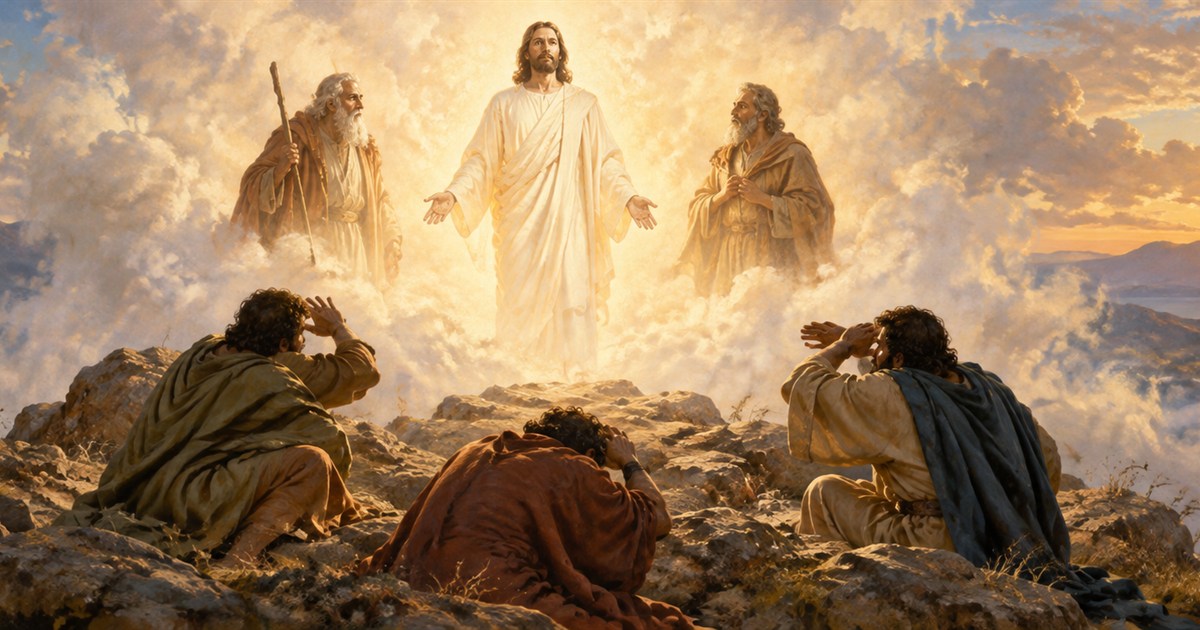
The Transfiguration commemorates the Gospel account of Jesus appearing in glory before Peter, James and John, with Moses and Elijah beside him.
Follow the branching histories of Christian and Jewish traditions.