Holidays in the Bible
See which Jewish, Christian and Islamic holidays the Bible commands, tells or names, and where the rest come from.
Holidays in the Bible · Christian
the Nativity of the Lord · the Nativity of Christ
Christmas celebrates the birth of Jesus. Many churches observe it on 25 December, while others use calendars or traditions that place the celebration in January.
When 25 December (7 January or 6 January in the churches named). 2026 25 December (Julian-calendar observance: 7 January Gregorian); nominal date, local liturgical transfers may apply; 6 January in the Armenian Church.
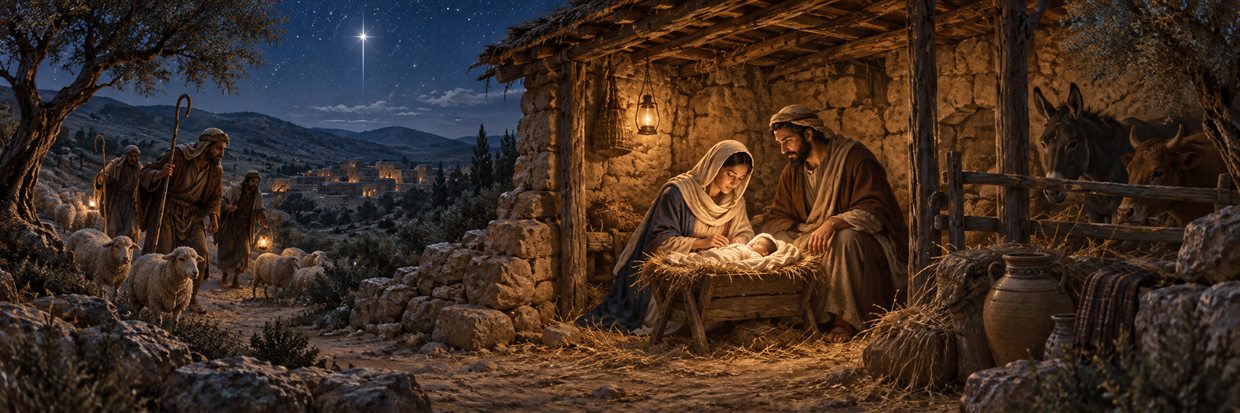
Christmas celebrates the birth of Jesus. Many churches observe it on 25 December, while others use calendars or traditions that place the celebration in January.
Two Gospels tell the birth. Luke has the census, the journey to Bethlehem, the manger, and the shepherds who hear the angels sing. Matthew has Joseph's dream, the naming of the child, and then the magi who follow a star from the east with gifts of gold, frankincense and myrrh. Neither Gospel has the other's visitors; the shepherds and the magi never meet in the Bible, and it was the church's crib scene that put them together 1.
Mark and John have no birth story. John instead opens with the Word who was with God and was God and became flesh (John 1:1-14), which is the Gospel read at the Christmas day Mass and at the Orthodox Paschal liturgy alike, and Paul says only that when the time had fully come God sent his Son, born of a woman (Galatians 4:4-5). For the churches Christmas is the feast of the incarnation, God becoming human, more than a birthday; the Orthodox liturgy sings that the eternal God is born as a little child 2.
Christmas developed in the early centuries of Christianity. A fourth-century Roman calendar records the celebration on 25 December, but the reasons this date became established remain debated.
The Gospels do not give a date for Jesus' birth. The Chronography of 354 records it on 25 December in material associated with the year 336. This is evidence for an early Roman observance, not a record of one decision that set the date for all Christians. 11,12
Historians have explored two main explanations for the December date: early Christian calculations linking Jesus' conception with the date of his death, and its relationship to Roman celebrations of the sun. Andrew McGowan explains the evidence and the difficulties with a simple borrowing theory. Neither explanation establishes Jesus' actual birthday. 11,12
Early Eastern celebrations could bring Jesus' birth and baptism together on 6 January. The Armenian Apostolic tradition continues this combined celebration. Several other churches observe Christmas on 25 December in the Julian calendar, currently 7 January in the Gregorian calendar. Armenian practice in Jerusalem has a further calendar difference, explained below 5.
Christmas has not always been kept everywhere. England's Puritan Parliament banned it in 1647, and the Massachusetts Bay Colony outlawed its observance in Boston in 1659 with a fine of five shillings, a ban lifted in 1681; Christmas did not become fashionable in New England until the middle of the nineteenth century, and Congress made it a federal holiday only in 1870 6.
| Passage | What it is | Edition |
|---|---|---|
| Luke 2:1-20 | Tells the event | Berean Standard Bible |
| Matthew 1:18-25 | Tells the event | Berean Standard Bible |
| Luke 1:26-38 | Tells the event | Berean Standard Bible |
| John 1:1-18 | Read on the day | Berean Standard Bible |
| Galatians 4:4-5 | Read on the day | Berean Standard Bible |
| Titus 2:11-14 | Read on the day | Berean Standard Bible |
| Isaiah 52:7-10 | Read on the day | Berean Standard Bible |
| Hebrews 1:1-6 | Read on the day | Berean Standard Bible |
| Isaiah 9:6 | A Christian reading | Berean Standard Bible |
| Micah 5:2 | A Christian reading | Berean Standard Bible |
Who keeps it Nearly every Christian church, on 25 December in the West and in most Orthodox churches; on 7 January (25 December on the Julian calendar) in the Russian, Serbian, Georgian, Ethiopian, Eritrean and Jerusalem churches and Ukrainian churches that keep the old calendar; on 6 January in the Armenian Apostolic Church. Jehovah's Witnesses do not keep it.
Christmas observances include church services, carols, family gatherings and acts of generosity. The surrounding seasons and customs vary by church and country.
In the Catholic Church the Roman Missal provides a Vigil Mass and Masses during the night, at dawn and during the day; the midnight Mass reads the shepherds, the dawn Mass their visit to the manger, and the day Mass the opening of John 13. Christmas is a holy day of obligation, opens an octave that ends on 1 January with the solemnity of Mary, Mother of God, and begins a Christmas season that runs to the Baptism of the Lord in January. Anglican and Lutheran churches keep the same shape with a midnight or late-night service, a Christmas morning service and the twelve days to Epiphany; Methodist, Presbyterian and Reformed churches keep Christmas Eve candlelight services and Christmas Day, and the lessons-and-carols service that King's College, Cambridge, made famous is now kept across the English-speaking churches.
In Eastern Orthodox worship, the Nativity Fast prepares for Christmas. Services include biblical readings, hymns and the liturgy of the feast, with details depending on the calendar and parish. 2 The Orthodox Church in America's fasting guide lists 25 December through 4 January as fast-free, followed by a fast on 5 January, the eve of Theophany. These are church-calendar dates; their civil-calendar equivalents differ for churches using the Julian calendar. 14
Baptist, Pentecostal and non-denominational churches keep Christmas Eve and Christmas Day services, often with a nativity play and a carol service, without a fixed Advent or octave. Jehovah's Witnesses do not keep Christmas, holding, in their own words, that Jesus asked to be remembered at his death and not his birth, that the apostles did not keep it, that there is no proof he was born on 25 December, and that the day's customs come from outside the Bible 7. Some Reformed and Presbyterian congregations in the Puritan tradition, and the Churches of Christ, keep no church calendar at all and treat the day as an ordinary Sunday or a civil holiday.
The customs around the day are later and vary by country: the crib, which Francis of Assisi is credited with staging at Greccio in 1223; carols from the Middle Ages; the tree, from Germany, which reached Britain and America in the nineteenth century; St Nicholas of Myra, a fourth-century bishop, who became Santa Claus by way of the Dutch Sinterklaas. None of these is in the Bible, and the churches keep them as customs, not as commandments 1.
These passages offer a starting point for study. Service readings and verse numbering can differ by tradition, Bible edition and year; use the relevant community's calendar for a particular service.
Christmas readings include the birth narratives in Matthew and Luke and John's account of the Word becoming flesh. The selection depends on the church and the service.
The Roman calendar lists different readings for the Vigil, Night, Dawn and Day Masses. For example, the Vigil uses Acts 13:16–17, 22–25, and the Night Mass uses Luke 2:1–14. The linked USCCB calendar gives the full selections and shorter options. Bible editions sometimes number the Isaiah passage differently; the reading links here are for study, not a substitute for a church's lectionary. 13
Byzantine rite: Galatians 4:4-7 and Matthew 2:1-12 at the liturgy of the feast, with Matthew 1:18-25 at the vigil and the prophecies of Micah 5 and Isaiah 7 at vespers 2. The Christian reading of Isaiah 7:14 and Micah 5:2 as prophecies of this birth is Matthew's own (Matthew 1:22-23, 2:5-6); Jewish readers read the same verses in their own context, as discussed below.
In brief Roman lectionary. Night: Isaiah 9:1-6; Titus 2:11-14; Luke 2:1-14. Day: Isaiah 52:7-10; Hebrews 1:1-6; John 1:1-18.
Hanukkah and Christmas have different histories and religious meanings. Their proximity on the calendar has also shaped the experiences of Jewish families living in Christian-majority societies 9,10.
Hanukkah commemorates the rededication of the Temple in Jerusalem. In some settings, especially in North America, the surrounding Christmas season has influenced its public celebration and gift-giving customs. These cultural connections do not make it a Jewish version of Christmas 9.
Matthew interprets Isaiah 7:14 and Micah 5:2 in relation to Jesus' birth. Jewish interpretation considers these passages within the Hebrew Bible and Jewish tradition, without accepting Matthew's identification of Jesus as their fulfillment.
There is hard history in the season, and a Jewish source records it: for centuries the Jews of Central and Eastern Europe feared Christmas-time, and wary of being attacked in the street they stayed home from the study house and played cards or chess with their families 10. In America, the same source says, 25 December has become for Jews a time to consider one's relationship to the wider society, and Jewish families answer the December question in every way from keeping clear of the season to sharing a neighbour's table 10.
Christmas is 25 December, or 7 January in churches that keep the Julian calendar, or 6 January in the Armenian Church.
The principal dates discussed here are 25 December, 7 January and 6 January. Churches that celebrate Julian-calendar 25 December currently do so on Gregorian 7 January. The Armenian Apostolic Church celebrates the Nativity and Theophany together on 6 January; in Jerusalem, its use of the Julian calendar places that celebration on Gregorian 19 January 1,5. Other Eastern church calendars have their own rules, so a local church calendar is the best guide to a particular service.
Advent begins on the fourth Sunday before Christmas, so its start moves between 27 November and 3 December; the twelve days run from Christmas to Epiphany on 6 January; and the Orthodox Nativity Fast begins on 15 November. The Presentation follows forty days after Christmas on 2 February.
| Rule | 2026 | 2027 |
|---|---|---|
| 25 December (7 January or 6 January in the churches named) | 25 December (Julian-calendar observance: 7 January Gregorian); nominal date, local liturgical transfers may apply; 6 January in the Armenian Church | 25 December (Julian-calendar observance: 7 January Gregorian); nominal date, local liturgical transfers may apply; 6 January in the Armenian Church |
Matthew and Luke describe Jesus' birth but do not give its calendar date. A fourth-century Roman calendar records a 25 December celebration associated with 336. Christmas observance developed through church tradition. 11,12
Scholars discuss early Christian date calculations and the relationship with Roman solar celebrations. The surviving evidence does not establish a single, universally accepted explanation. 11,12
Several churches celebrate 25 December according to the Julian calendar, which currently corresponds to 7 January in the Gregorian calendar. Armenian Nativity and Theophany celebrations follow a different tradition: 6 January, or Gregorian 19 January in Jerusalem 5.
Jehovah's Witnesses do not, holding in their own words that Jesus asked to be remembered at his death, that the apostles did not keep his birthday, and that the date and customs come from outside the Bible. Some churches in the Puritan tradition and the Churches of Christ keep no church calendar. England's Puritans banned the day in 1647 and Boston outlawed it from 1659 to 1681 7,6.
Hanukkah commemorates the rededication of the Temple in Jerusalem; Christmas celebrates Jesus' birth. Their dates can be close, and surrounding Christmas customs have influenced some modern Hanukkah celebrations, but they remain distinct holidays 9.
Quoted from the Berean Standard Bible; each links to its chapter and carries a Memorize button that starts the five-step path. Switch the edition to read them in another Bible here.
But the angel said to them, “Do not be afraid! For behold, I bring you good news of great joy that will be for all the people: Today in the city of David a Savior has been born to you. He is Christ the Lord!
The angel announces Jesus' birth to the shepherds. This passage is part of the Roman Christmas Night Mass reading.
The Word became flesh and made His dwelling among us. We have seen His glory, the glory of the one and only Son from the Father, full of grace and truth.
The Gospel of Christmas day: the Word became flesh. The churches call the feast the incarnation, and this is the verse they mean.
She will give birth to a Son, and you are to give Him the name Jesus, because He will save His people from their sins.”
Matthew describes the name given to Jesus in Joseph's dream. Luke 2:21 separately describes his naming and circumcision on the eighth day.
But when the time had fully come, God sent His Son, born of a woman, born under the law, to redeem those under the law, that we might receive our adoption as sons.
Paul's one sentence on the birth, read at the Orthodox liturgy of the feast: when the time had fully come.
Make it part of your day
Optional further reading: you can explore the text without sharing its beliefs or taking part in the observance.
Luke's account of the announcement to the shepherds.
But the angel said to them, “Do not be afraid! For behold, I bring you good news of great joy that will be for all the people: Today in the city of David a Savior has been born to you. He is Christ the Lord!
The numbers match the references in the article. Links include religious texts, community explanations and historical studies. Read more about how this guide was researched.
BibleVerse Editorial, "Christmas: What It Marks, Where It Comes From, and How It Is Kept", BibleVerse, published 2026-09-11, updated 2026-09-12, https://bibleverse.site/holidays/christmas/
Version 1.0. Awaiting review by a member of the community it describes. Dates in the table are for 2026 and 2027 and are refreshed yearly. Corrections are welcome through the contact page.
See which Jewish, Christian and Islamic holidays the Bible commands, tells or names, and where the rest come from.
Hanukkah is the eight-day Jewish Festival of Lights. It commemorates the rededication of the Temple in Jerusalem, and families mark it by lighting candles each evening.
Follow the branching histories of Christian and Jewish traditions.