Holidays in the Bible
See which Jewish, Christian and Islamic holidays the Bible commands, tells or names, and where the rest come from.
Holidays in the Bible · Jewish
Chanukah · the Feast of Dedication · the Festival of Lights
Hanukkah is the eight-day Jewish Festival of Lights. It commemorates the rededication of the Temple in Jerusalem, and families mark it by lighting candles each evening.
When 25 Kislev to 2 or 3 Tevet, eight days. 2026 First candle on the evening of 4 December; 5 December to 12 December.
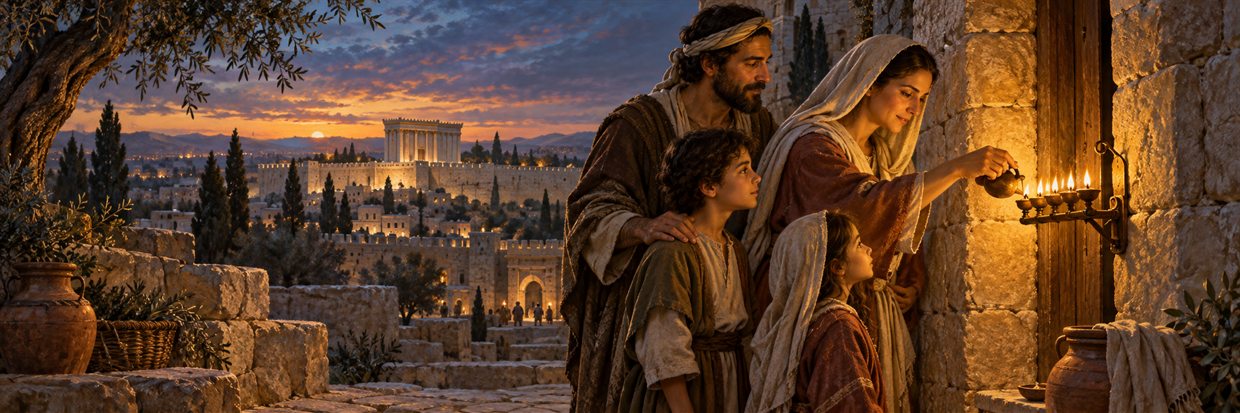
Hanukkah is the eight-day Jewish Festival of Lights. It commemorates the rededication of the Temple in Jerusalem, and families mark it by lighting candles each evening.
The story is set in the 160s BCE, when Judea was ruled by the Seleucid Greek king Antiochus IV. In 167 BCE he outlawed the Torah, the Sabbath and circumcision, set up an altar to Zeus in the Temple, and killed those who refused. A priest named Mattathias and his five sons rose against him; the third son, Judah, called the Maccabee, led the revolt, and in the winter of 164 BCE his forces retook Jerusalem, cleansed the Temple, built a new altar, and rededicated it on the twenty-fifth of Kislev with eight days of celebration. Hanukkah means dedication 1,2.
That is the story as the books of Maccabees tell it. Later Jewish tradition remembered a second thing about the same day: that when the Temple was lit again only one small jar of pure oil could be found, enough for one day, and it burned for eight. The two stories, the victory and the oil, are told together every Hanukkah, and this page says where each comes from 3,4.
Hanukkah commemorates the Temple's rededication. First and Second Maccabees describe that history, while the Talmud tells the account of the oil lasting eight days. These sources have different places in Jewish tradition 3,5.
The rededication is told twice, in 1 Maccabees 4:36-59 and 2 Maccabees 10:1-8, and a letter at the head of 2 Maccabees asks the Jews of Egypt to keep the days of the purification of the Temple in the month of Kislev (2 Maccabees 1:18). These Jewish writings were transmitted in Greek and received in Christian biblical collections. Catholic and many Orthodox Bibles include 1 and 2 Maccabees, but the contents and terminology of Orthodox collections vary. Their absence from the Tanakh should not be explained by assigning a single early closure date to all Hebrew Scripture. Rabbinic Judaism never received them into the Tanakh, and the Protestant Reformers set them apart as Apocrypha, printed between the Testaments in Luther's Bible and the first King James Bibles and read, in the Church of England's words, for example of life and instruction of manners but not to establish doctrine 5,1. On this site the Maccabees are read in the World English Bible Catholic Edition; the books of the Bible shelved four ways shows the canons side by side.
The New Testament explicitly names the festival in John 10:22. John 10:22 sets Jesus in the Temple in winter at the Feast of Dedication, walking in Solomon's Colonnade; the Gospel treats the feast as an ordinary fact of the Jerusalem year, and that single verse is the whole of Hanukkah in the New Testament 1.
Where the Tanakh is silent, the rabbis spoke. The Talmud asks What is Hanukkah? and answers with the oil: when the Greeks entered the Sanctuary they defiled all the oil, and when the Hasmoneans won they found one cruse still sealed by the High Priest, enough for one day, and a miracle let it burn eight days, and the next year the sages established the days as a festival with Hallel and thanksgiving (Talmud Shabbat 21b) 3. The Talmud also records the debate over how to light: the school of Shammai lit eight lights the first night and one fewer each night, the school of Hillel one and then one more, and Jewish law follows Hillel, because one goes up in holiness and not down 3. A Jewish source notes that the rabbis, who lived under Rome and had their own quarrels with the Hasmonean kings, preferred the oil to the battle, and chose for the Sabbath of Hanukkah the prophet's words: not by might, nor by power, but by my spirit (Zechariah 4:6) 6.
The Torah does have a dedication, and the synagogue reads it. Numbers 7 tells how the princes of the twelve tribes brought their offerings for the dedication of the Tabernacle's altar, one prince a day, and it is read through the eight days of Hanukkah; Numbers 8, the lighting of the lamps, closes it. Psalm 30, a song at the dedication of the House, is sung each morning. Christian readers sometimes find the persecution of Antiochus in Daniel 8 and Daniel 11:31, the abomination that makes desolate; that is a reading of Daniel and not a mention of the festival 1.
| Passage | What it is | Edition |
|---|---|---|
| 1 Maccabees 4:36-59 | Tells the event | World English Bible (Catholic) |
| 2 Maccabees 10:1-8 | Tells the event | World English Bible (Catholic) |
| 2 Maccabees 1:18 | Names the holiday | World English Bible (Catholic) |
| John 10:22-23 | Names the holiday | Berean Standard Bible |
| Numbers 7 (the dedication of the altar, read through the eight days) | Read on the day | JPS TaNaKH 1917 |
| Numbers 8:1-4 | Read on the day | JPS TaNaKH 1917 |
| Zechariah 4:1-7 | Read on the day | JPS TaNaKH 1917 |
| 1 Kings 7:40-50 | Read on the day | JPS TaNaKH 1917 |
| Haggai 2:18 (the twenty-fourth of the ninth month) | A text the day draws on | JPS TaNaKH 1917 |
Who keeps it Observed across Rabbinic Jewish communities, commonly with lights for eight nights and prayers of thanksgiving. Hanukkah itself does not prohibit work, but Shabbat restrictions still apply.
Each night for eight nights a candle is added to the Hanukkah lamp and lit in a window, with a blessing and a song; the days are ordinary working days, with fried food and games in the evenings.
The lamp is a hanukkiah, with eight branches and a ninth, the shamash, that lights the others; it is placed in a window or a doorway so that the miracle is made public, which the Talmud calls the point of the lights. One light is kindled the first night and one more each night after, with two blessings and, on the first night, a third for having reached the season; the hymn Ma'oz Tzur follows in Ashkenazi homes. Because the miracle was one of oil, the foods are fried: latkes, potato pancakes, in Ashkenazi kitchens, and sufganiyot, jam doughnuts, in Israel. Children play dreidel, a spinning top whose four letters stand for A great miracle happened there, and receive gelt, coins of chocolate or money 4,2.
Hanukkah is not a Yom Tov. Hanukkah itself does not prohibit work, but Shabbat restrictions still apply, and the Talmud's only prohibitions are of fasting and eulogy. In the synagogue Hallel is sung every morning, the paragraph Al HaNissim, for the miracles, is added to the daily prayers and to grace after meals, and the Torah reading from Numbers 7 is read each day; there is no haftarah on weekdays 7. The festival is observed across Orthodox, Conservative, Reform and Reconstructionist communities, with differences in custom and interpretation. Karaite Jews, who hold the Tanakh alone as Scripture, have historically not kept Hanukkah as a religious festival, since it is not in it; a Karaite writer records that some Karaite families now light candles as a custom rather than a commandment 10.
A Jewish source observes that Hanukkah was until modern times a fairly minor observance, and that its present size in America grew in the nineteenth and twentieth centuries as Jewish families answered the December season around them; the festival's own meaning, religious freedom won against a stronger power, is what its prayers have always said 8,2.
These passages offer a starting point for study. Service readings and verse numbering can differ by tradition, Bible edition and year; use the relevant community's calendar for a particular service.
The synagogue reads the dedication of the Tabernacle's altar, one tribe's gift each day, and sings the psalm for the dedication of the House.
Each morning: Numbers 7:1 to 8:4, divided over the eight days so that each day reads the offering of one prince and the last day reads the rest and the lighting of the lamps. Hallel, Psalms 113 to 118, is sung in full. Psalm 30, the song at the dedication of the House, is said 7.
On the Sabbath of Hanukkah the haftarah is Zechariah 2:10 to 4:7 (2:14 in the Hebrew numbering), the vision of the golden lampstand with the words not by might, nor by power; when the festival holds two Sabbaths the second reads 1 Kings 7:40-50, Solomon's lampstands for the Temple 6. The books of Maccabees themselves are not read in the synagogue, since they are not in the Tanakh; the Hanukkah story is told at home and in the prayer Al HaNissim, which names Mattathias and his sons, the few against the many, and the eight days of dedication 7.
In brief Numbers 7:1 to 8:4, the gifts of the tribal princes at the dedication of the altar, divided over the eight days. Sabbath of Hanukkah: haftarah Zechariah 2:14 to 4:7 (the lampstand vision); a second Sabbath, 1 Kings 7:40-50.
Christians meet Hanukkah in two places: in the books of Maccabees, if their Bible has them, and in one verse of John's Gospel.
First and Second Maccabees are Scripture in Catholic and many Orthodox biblical traditions; some Protestant editions include them in a separate Apocrypha section. They are not part of the Tanakh 5. The Orthodox Church in America also commemorates the Maccabean martyrs on 1 August, a separate observance from Hanukkah 9.
The one New Testament mention is John 10:22-23: the Feast of Dedication took place in Jerusalem, it was winter, and Jesus was in the Temple courts. Some Christian readers hear in the discourse that follows, on Jesus as the one whom the Father sanctified and sent (John 10:36), an echo of the dedication of the Temple; that is a Christian reading of a Jewish festival, and the Gospel itself makes nothing more of the day than its date 1.
Hanukkah is not a Jewish Christmas: the festivals have distinct histories and religious meanings. Hanukkah is not generally part of mainstream Christian liturgical calendars. The Christmas page explains that festival separately.
Hanukkah begins on 25 Kislev, with the first light kindled on the preceding civil evening, and continues for eight days into Tevet. Candle-lighting times depend on local custom and Shabbat.
The date comes from the books of Maccabees, which set the rededication on the twenty-fifth day of the ninth month, Kislev (1 Maccabees 4:52); the eight days come from the same books, which say the first celebration was kept for eight days in the manner of Sukkot, the festival the Maccabees had been unable to keep that autumn (2 Maccabees 10:6), and the Talmud gives the eight days of oil as the reason 1,3. Because the Hebrew months follow the moon, Hanukkah moves through late November and December on the Gregorian calendar; in some years, including the festival beginning in 2027, its eighth day falls in January.
Kislev has twenty-nine or thirty days in different years, so the last day of Hanukkah is the second or the third of Tevet. The new moon of Tevet, Rosh Chodesh, always falls inside the festival, with additional readings for the new month 4.
| Rule | 2026 | 2027 |
|---|---|---|
| 25 Kislev to 2 or 3 Tevet, eight days | First candle on the evening of 4 December; 5 December to 12 December | First candle on the evening of 24 December; 25 December to 1 January 2028 |
The rededication is described in 1 Maccabees 4 and 2 Maccabees 10. These books are Scripture in Catholic and many Orthodox collections, are absent from the Tanakh, and may appear as Apocrypha in Protestant editions. John 10:22 explicitly names the Feast of Dedication in the New Testament. The oil tradition and rules for the lights are discussed in the Talmud 5,1,3.
The books of Maccabees say the first celebration in 164 BCE was kept for eight days in the manner of Sukkot, the autumn festival the fighters had missed. The Talmud gives a second reason: one day's oil for the Temple lamp burned for eight days until new oil could be made. Both are told at Hanukkah 1,3.
Because the Torah has no Hanukkah, and Numbers 7 is the Torah's own dedication: the princes of the twelve tribes bringing their offerings for the dedication of the Tabernacle's altar. One prince's gift is read each day of the festival, and Numbers 8, the lighting of the lamps, closes it 7.
No. Christians whose Bibles carry the Maccabees read the story as Scripture, and the Orthodox and, until 1969, the Catholic Church have kept the Maccabean martyrs of 2 Maccabees 7 as saints on 1 August. John 10:22 places Jesus in the Temple at the festival. But the festival is Jewish, its observance is rabbinic, and the churches have never kept it 9,1.
No. A Jewish source says Hanukkah bears no relation to Christmas except that it also falls in midwinter. It is older than Christmas by more than a century, it was a minor festival until modern times, and its present size in America grew in the nineteenth and twentieth centuries 8,2.
Quoted from the JPS TaNaKH 1917; each links to its chapter and carries a Memorize button that starts the five-step path. Switch the edition to read them in another Bible here.
And the princes brought the dedication-offering of the altar in the day that it was anointed, even the princes brought their offering before the altar.
The Torah's own dedication, which the synagogue reads through the eight days: the princes bring their offerings on the day the altar was anointed.
'Speak unto Aaron, and say unto him: When thou lightest the lamps, the seven lamps shall give light in front of the candlestick.'
The lighting of the seven lamps, read on the last day; the Hanukkah lamp has eight branches and a ninth, and this is the verse behind the light.
Then he answered and spoke unto me, saying: 'This is the word of the LORD unto Zerubbabel, saying: Not by might, nor by power, but by My spirit, saith the LORD of hosts.
The haftarah of the Sabbath of Hanukkah, and the sentence the rabbis chose over the battle: not by might, nor by power, but by my spirit.
(30-13) So that my glory may sing praise to Thee, and not be silent; O LORD my God, I will give thanks unto Thee for ever.
A verse from the psalm for the dedication of the House, associated with Hanukkah.
Make it part of your day
Optional further reading: you can explore the text without sharing its beliefs or taking part in the observance.
The sentence the rabbis set at the heart of the festival, read on its Sabbath every year.
Then he answered and spoke unto me, saying: 'This is the word of the LORD unto Zerubbabel, saying: Not by might, nor by power, but by My spirit, saith the LORD of hosts.
The numbers match the references in the article. Links include religious texts, community explanations and historical studies. Read more about how this guide was researched.
BibleVerse Editorial, "Hanukkah: What It Marks, Where It Comes From, and Whose Bible Has It", BibleVerse, published 2026-09-11, updated 2026-09-12, https://bibleverse.site/holidays/hanukkah/
Version 1.1. Awaiting review by a member of the community it describes. Dates in the table are for 2026 and 2027 and are refreshed yearly. Corrections are welcome through the contact page.
See which Jewish, Christian and Islamic holidays the Bible commands, tells or names, and where the rest come from.
Christmas celebrates the birth of Jesus. Many churches observe it on 25 December, while others use calendars or traditions that place the celebration in January.
Explore the books and their place in four scriptural traditions.