Holidays in the Bible
See which Jewish, Christian and Islamic holidays the Bible commands, tells or names, and where the rest come from.

Holidays in the Bible · Islamic
the tenth of Muharram
Ashura falls on 10 Muharram in the Islamic calendar. Sunni observances often emphasize fasting and Moses' deliverance, while Shia observances center on mourning Husayn, the Prophet Muhammad's grandson.
When 10 Muharram, the first month of the Islamic year. 2026 25 June (Umm al-Qura; a day earlier or later by local sighting).
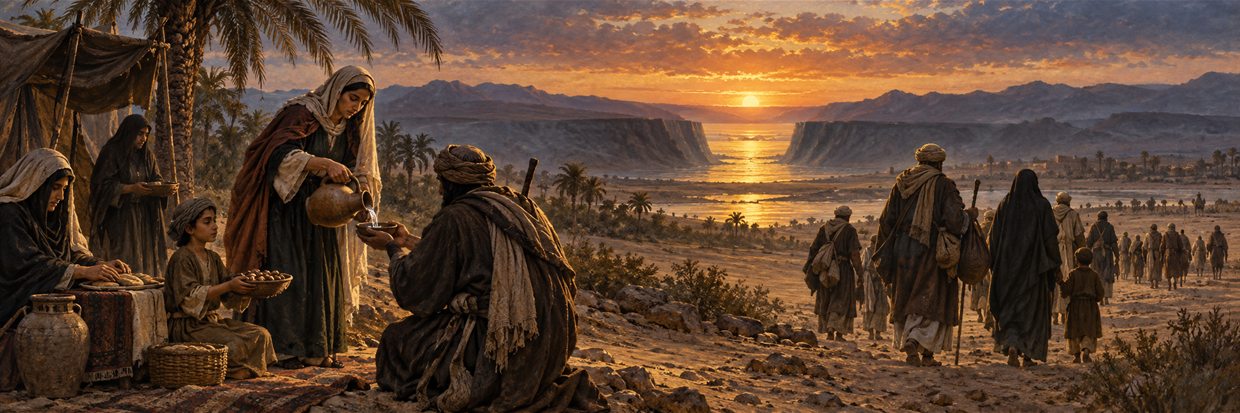
Ashura falls on 10 Muharram in the Islamic calendar. Sunni observances often emphasize fasting and Moses' deliverance, while Shia observances center on mourning Husayn, the Prophet Muhammad's grandson.
The name means the tenth, from the same root as the Hebrew word for ten, and the day is the tenth of Muharram, the first month of the Islamic calendar and one of its four sacred months in which fighting was forbidden even before Islam 1. The Sunni meaning connects to the Bible: the deliverance at the sea is told in Exodus 14, and the song Moses and Israel sang on the far shore in Exodus 15:1-21; the Qur'an tells the same crossing (Qur'an 26:52-68) 2. Shia mourning commemorates Karbala, an event in Islamic history, rather than a biblical narrative.
The Bible is a neighbour to one half of this day and a distinct from the other, and this site's readers should know which is which. What follows takes the Sunni fast first, because that is where the Bible comes in, and then Karbala, because that is a publicly visible form of remembrance when Ashura comes round.
The Sunni fast comes from a hadith in which the Prophet found the Jews of Medina fasting for the day Moses was saved and told the Muslims to fast too; the Shia mourning comes from the Battle of Karbala on 10 Muharram in the year 61 of the Hijra, 10 October 680 CE.
The Sunni tradition rests on reports in the two most trusted hadith collections. In Sahih al-Bukhari, Ibn Abbas relates that when the Prophet came to Medina he found the Jews fasting on the day of Ashura and asked them why; they said it was "a great day on which God saved Moses and drowned the folk of Pharaoh," and that Moses had fasted it in thanks; the Prophet said "I am closer to Moses than they," fasted the day, and ordered the Muslims to fast it 3,4. In Sahih Muslim the companions remark that the Jews and Christians hold the day in high esteem, and the Prophet says that next year, God willing, they will fast the ninth as well, but he died before the year came round; that is why Sunni practice fasts the ninth or eleventh with the tenth 5. The fast was obligatory for about a year, until the Qur'an made Ramadan the month of fasting (Qur'an 2:183-185), after which Ashura became a voluntary fast that Sunni jurists strongly encourage 1.
The account in the hadith recalls Moses' deliverance from Pharaoh, also narrated in Exodus 14. Connecting the hadith's Jewish fast with a particular observance in the Jewish calendar requires a separate historical argument. It should not be presented as an established identification with Yom Kippur 1,3.
The Shia mourning rests on the Battle of Karbala. When the Umayyad caliph Mu'awiya died in 680 CE and his son Yazid took the caliphate, making it hereditary, Husayn ibn Ali, the Prophet's grandson and the third imam of the Shia, refused to pledge allegiance to him; invited by the people of Kufa, he set out for Iraq with about seventy-two men and his household, was intercepted by the caliph's army, camped at Karbala on 2 October, was surrounded and cut off from the water of the Euphrates, and on 10 Muharram 61 AH, 10 October 680 CE, was killed with most of his male relatives and companions, the women and children taken captive to Damascus 6. Mourning began at once with the survivors, above all Husayn's sister Zaynab, and grew over the centuries into the rituals that define Shia identity: in Shia understanding Karbala is the struggle of good against evil, the height of self-sacrifice, and the wound at the heart of the Prophet's own family 1,7.
| Passage | What it is | Edition |
|---|---|---|
| Exodus 14 | Tells the event | Berean Standard Bible |
| Exodus 15:1-21 | Tells the event | Berean Standard Bible |
| Sahih al-Bukhari 2004, the Prophet found the Jews of Medina fasting on Ashura for the day Moses was saved from Pharaoh | the tradition's own scripture | Qur'an and hadith |
| Qur'an 26:52-68, the crossing of the sea | the tradition's own scripture | Qur'an and hadith |
Who keeps it Sunni Muslims with a recommended fast, on the tenth of Muharram and the day beside it; Shia Muslims as the day of mourning for Husayn ibn Ali, killed at Karbala in 680, with processions and passion plays. The two observances are different in meaning.
Sunni Muslims keep Ashura with a voluntary fast on the tenth and the ninth or eleventh, prayer and charity, and in some countries a festive meal; Shia Muslims keep it with ten days of mourning gatherings that end on the tenth in processions, the retelling of Karbala, and passion plays.
In Sunni Islam the ninth and tenth of Muharram are days of voluntary fasting from dawn to sunset, strongly encouraged by the jurists; the fast is understood as thanksgiving for God's deliverance of Moses, and many Sunnis treat the day as a happy one, with prayer, charity, visiting and special dishes 1. A questioner writing to the jurist Ibn Taymiyya around 1300 CE observed that people were joyful on Ashura, bathing, dressing up, shaking hands and cooking grains, so the festive keeping is old; in the Maghreb the day is kept with fasting, almsgiving, honouring the dead and special foods, and in Turkey and the Balkans with ashure, the grain and fruit pudding also called Noah's pudding, made in the month of Muharram 1,8. Not every Sunni scholar endorses the celebration, and some Sunni communities, especially in South Asia, have also remembered Karbala on the day in their own way, though that remembrance has faded 1,7.
In Shia Islam the whole first ten days of Muharram are days of mourning, and the tenth is their climax. The centre of the observance is the majlis, the gathering in a hall or husayniya where a reciter tells the story of Karbala and the mourners weep, beat their chests and sing elegies; in Iran, the Gulf and Lebanon the story is also acted as a passion play, the ta'ziyeh, and on Ashura itself always the martyrdom of Husayn; and processions of mourners march the streets of Shia cities chanting dirges, in Najaf toward the shrine of Ali and in Karbala past the shrine of Husayn, where the burning of his tents and the captivity of the women are re-enacted 1,7. Mourning practices vary by community. Some include rhythmic chest-beating; practices involving injury are contested within Shia communities 7. The mourning continues through Muharram and the following month, Safar, with pilgrimage to Husayn's shrine at Karbala 1,7.
The two observances sit on the same date and, in mixed communities, on the same streets, and Ashura has at times been an occasion for violence against Shia gatherings, including bombings of processions in Iraq and of a shrine in Iran 1. Attitudes toward particular mourning practices and reports about Ashura differ among scholars and communities 1,7.
Sistani's guidance describes mourning as a way of honoring Husayn and remembering his stand for religious and moral principles. This is one named Shia authority's account, not a statement that every community follows identical rituals 10.
These passages offer a starting point for study. Service readings and verse numbering can differ by tradition, Bible edition and year; use the relevant community's calendar for a particular service.
Sunni Muslims read the hadith of Moses and the fast; Shia Muslims recite the story of Karbala; and the Bible passage behind the Sunni day is Exodus 14 and 15.
The Sunni day has no fixed scripture reading; its texts are the hadith of Ibn Abbas in Bukhari and Muslim, read in the sermon of the week, and the Qur'an's telling of the crossing, in which God tells Moses to strike the sea with his staff and each part stands like a great mountain (Qur'an 26:52-68), 2. The Bible's own account is Exodus 14, the Song of the Sea in Exodus 15:1-21, and the psalm that remembers it, Psalm 106:9-11; the synagogue remembers the crossing on the seventh day of Passover and the church reads it at the Easter Vigil, so that all three traditions keep the same deliverance on their own days 9.
The Shia day's readings are the maqtal, the narrative of Husayn's death, recited in the majlis over the ten days and on Ashura, and the elegies and laments composed for it in Arabic, Persian, Urdu and other languages; the ziyara, the salutation addressed to Husayn at his shrine, is recited in Shia mourning observances 7. These readings belong to Ashura's own religious and cultural traditions.
In brief Sunni: the fast, with the hadith of Moses. Shia: the recitation of the events of Karbala (majlis) and elegies.
Ashura's Sunni traditions and Passover both recall Moses and the Israelites' deliverance. The observances have different calendars and religious settings.
The hadith's account of a fast in Medina is an Islamic report about Jewish practice. It does not by itself establish that this was Yom Kippur. In Jewish observance, Yom Kippur centers on atonement, while Passover commemorates the Exodus 1,3,4.
Exodus 14 is also important in Christian worship, including the Easter Vigil. This is a shared scriptural connection, rather than a shared observance of Ashura.
Shia mourning for Husayn concerns the history and religious meaning of Karbala. Comparisons with Christian mourning rituals may help readers notice similarities in expression, but the figures, events and teachings remain different 7.
Ashura is the tenth of Muharram, the first month of the Islamic year, and moves through the seasons, coming about eleven days earlier each year.
The Islamic calendar is purely lunar, so the day falls in every season over a lifetime; in 2026 it is in late June, and it will be in the spring by the 2030s. The date depends on the sighting of the new moon of Muharram: Saudi Arabia's Umm al-Qura calendar is computed in advance and is the one this site uses, and many countries begin the month a day earlier or later by local sighting, so the day can fall on two or three different dates around the world.
The Sunni fast is kept on the tenth with the ninth or the eleventh; the Shia observance runs from the first of Muharram to the tenth, and the mourning continues into Safar 1,7. Islamic days begin at sunset, so the eve of Ashura is the evening before. Eid al-Adha, the other Islamic day connected to the Bible on this site, falls in the month before, and has its own page.
| Rule | 2026 | 2027 |
|---|---|---|
| 10 Muharram, the first month of the Islamic year | 25 June (Umm al-Qura; a day earlier or later by local sighting) | 15 June (Umm al-Qura; a day earlier or later by local sighting) |
Ashura is an Islamic observance. Sunni accounts of its fast recall God's deliverance of Moses, a story also told in Exodus 14. For Shia Muslims, the day centers on remembering Husayn's death at Karbala, an event in Islamic history. 1,3,6
Ashura has different religious meanings across Muslim communities. Sunni accounts of the fast emphasize thanksgiving for God's deliverance of Moses. Shia mourning observances remember Husayn's death at Karbala and his stand against injustice. Customs and interpretations vary within both traditions. 1,3,7,10
On 10 Muharram 61 AH, 10 October 680 CE, Husayn ibn Ali, the Prophet's grandson, who had refused to pledge allegiance to the Umayyad caliph Yazid, was surrounded with about seventy-two men at Karbala in Iraq, cut off from the Euphrates, and killed with most of his male relatives and companions; the women and children were taken captive. Shia Muslims have mourned it every year since 6.
The hadith in Bukhari says he found the Jews of Medina fasting for the day Moses was saved, said 'I am closer to Moses than they,' and ordered the fast. Some Sunni reports say the Quraysh already fasted the day in Mecca. One historical interpretation identifies the Jewish fast in this report with Yom Kippur; this is an interpretation of the report, not a directly established identification. The sources describe these different accounts 1,3,4.
Because the Islamic calendar is lunar, twelve months of the moon with no added month, so every Islamic date moves about eleven days earlier each year. The day is the tenth of Muharram; its Gregorian date depends on the sighting of the new moon and can differ by a day between countries.
Quoted from the Berean Standard Bible; each links to its chapter and carries a Memorize button that starts the five-step path. Switch the edition to read them in another Bible here.
Then Moses stretched out his hand over the sea, and all that night the LORD drove back the sea with a strong east wind that turned it into dry land. So the waters were divided, and the Israelites went through the sea on dry ground, with walls of water on their right and on their left.
Moses stretches out his hand, the sea is driven back all night, and Israel crosses on dry ground with walls of water on either side. The deliverance the Sunni fast gives thanks for.
That day the LORD saved Israel from the hand of the Egyptians, and Israel saw the Egyptians dead on the shore.
That day the LORD saved Israel from the hand of the Egyptians. The sentence the Jews of Medina gave the Prophet as the reason for their fast.
The LORD is my strength and my song, and He has become my salvation. He is my God, and I will praise Him, my father’s God, and I will exalt Him.
The LORD is my strength and my song, and he has become my salvation. The Song of the Sea, sung by the synagogue on the seventh day of Passover and the church at the Easter Vigil.
This is to be a permanent statute for you: On the tenth day of the seventh month, you shall humble yourselves and not do any work—whether the native or the foreigner who resides among you—
The Torah's fast of the tenth day of the seventh month, Yom Kippur; historians think this is the Jewish fast the hadith describes.
Make it part of your day
Optional further reading: you can explore the text without sharing its beliefs or taking part in the observance.
The day the Jews of Medina named to the Prophet, and the day Sunni Muslims still fast for.
That day the LORD saved Israel from the hand of the Egyptians, and Israel saw the Egyptians dead on the shore.
The numbers match the references in the article. Links include religious texts, community explanations and historical studies. Read more about how this guide was researched.
BibleVerse Editorial, "Ashura: What It Marks, Where It Comes From, and How It Is Kept", BibleVerse, published 2026-09-12, updated 2026-09-12, https://bibleverse.site/holidays/ashura/
Version 1.1. Awaiting review by a member of the community it describes. Dates in the table are for 2026 and 2027 and are refreshed yearly. Corrections are welcome through the contact page.
See which Jewish, Christian and Islamic holidays the Bible commands, tells or names, and where the rest come from.
Eid al-Adha, the Muslim Feast of the Sacrifice, remembers Abraham's willingness to obey God. It takes place during the final days of Hajj, the pilgrimage to Mecca.
Explore shared roots, distinct scriptures and differences in belief.