Holidays in the Bible
See which Jewish, Christian and Islamic holidays the Bible commands, tells or names, and where the rest come from.
Holidays in the Bible · Christian
the Nativity Fast (Orthodox)
Advent is a season of preparation for Christmas. In many Western churches, it includes the four Sundays before Christmas and looks both to Jesus' birth and to the Christian hope of his return. Eastern Orthodox churches prepare through the Nativity Fast, with different dates and customs.
When Four Sundays before Christmas in many Western churches; the Eastern Orthodox Nativity Fast runs from 15 November to 24 December on the church's calendar. 2026 29 November to 24 December.
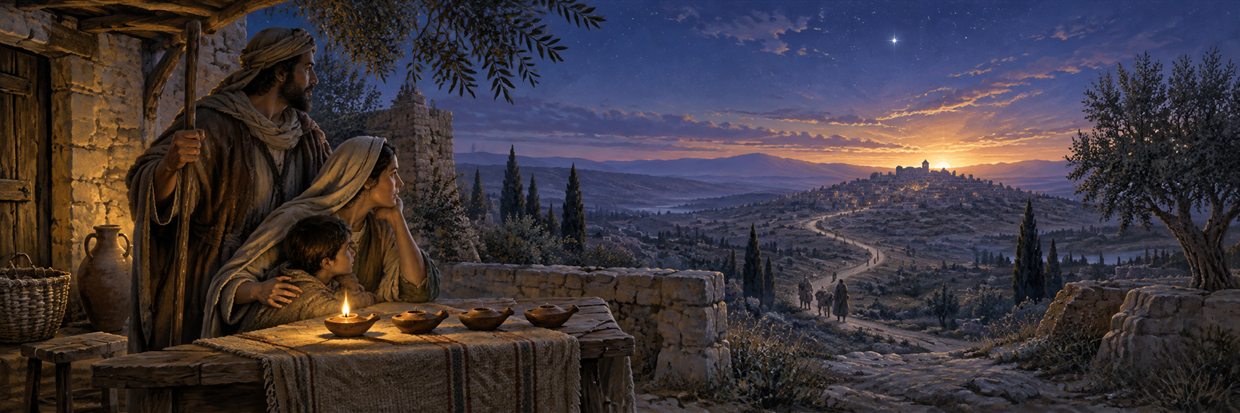
Advent is a season of preparation for Christmas, spanning four Sundays in many Western churches. Its name comes from the Latin adventus, meaning coming or arrival. Christians look back to Jesus' birth in Bethlehem and forward to his promised return 1,3.
The Church of England's service book puts the double meaning in one sentence: Advent is "a season of expectation and preparation, as the Church prepares to celebrate the coming (adventus) of Christ in his incarnation, and also looks ahead to his final advent as judge at the end of time" 5. The Catholic Church describes the same twofold character in its liturgical calendar, a season that directs hearts and minds both to Christ's second coming and to the anniversary of his birth 3. The Sunday readings follow that order: the first Sunday reads Jesus on the end of the age and the call to keep watch (Matthew 24:36-44, Mark 13:24-37), the second and third read John the Baptist in the wilderness (Mark 1:1-8, Matthew 3:1-12), and the fourth reads the days just before the birth, the annunciation to Mary or Joseph's dream (Luke 1:26-38, Matthew 1:18-25) 4,10.
The mood is expectation. The Church of England says that expectation rather than penitence is the season's "characteristic note", though it grants that "the character of the season is easily coloured by an analogy with Lent", and it records the old subjects of Advent meditation, the Four Last Things: death, judgement, heaven and hell 5. The season's one-word prayer is the Aramaic Maranatha, "Our Lord, come", which Paul writes at the close of 1 Corinthians 16:22 and which Common Worship calls "the fundamental Advent prayer" 5. Many Eastern Orthodox churches prepare through the Nativity Fast. English-language Orthodox resources also sometimes call it Advent, though its calendar and customs differ from those of Western churches 6,15.
Advent developed as a church season several centuries after the New Testament. Its readings draw on biblical themes of hope, preparation and watchfulness.
Isaiah speaks of a shoot that will spring from the stump of Jesse (Isaiah 11:1-10), of comfort for Jerusalem and a voice calling "prepare the way" (Isaiah 40:1-11), and of a great light for people walking in darkness (Isaiah 9:2-7). Malachi promises a messenger sent ahead to prepare the way (Malachi 3:1-4). All four Gospels connect John the Baptist's ministry with Isaiah 40 (Mark 1:1-8, Luke 3:1-6, John 1:19-28). Jesus tells his disciples that no one knows the day or the hour, so they must keep watch (Matthew 24:36-44), and Paul writes that "the night is nearly over; the day has drawn near" (Romans 13:11-14). The New Testament's Greek word for that coming is parousia, and adventus is its Latin translation 1.
The earliest traces of the season are Western, and they are about fasting and church attendance rather than a cycle of readings. A synod at Saragossa in 380 ordered that from 17 December to Epiphany no one should absent themselves from church; the Council of Tours in 567 ordered monks to fast every day in December until Christmas; and a synod at Macon in 581 ordered that from 11 November to the Nativity the Mass be offered in the Lenten manner on Mondays, Wednesdays and Fridays 1,2. The collection of homilies of Gregory the Great begins with a sermon for the second Sunday of Advent, and the Gelasian Sacramentary gives the season five Sundays 2.
The length took centuries to settle. Spain kept five Sundays in 650; some places began the fast on 11 November, St Martin's day, others on 15 November, and others at the autumn equinox; the 1907 Catholic Encyclopedia attributes the Roman four-Sunday arrangement to Gregory VII (1073-1085) 2. This is that reference work's account of a gradual development, not a single founding date for Advent. The Ambrosian rite of Milan still keeps six, beginning on the Sunday that falls between 13 and 19 November 1. In the Eastern Orthodox calendar described by the Orthodox Church in America, the Nativity Fast lasts forty days, from 15 November to 24 December 6.
Advent wreaths and calendars are much newer than the season. In 1839, Johann Hinrich Wichern used a candle-covered wooden wheel at the Rauhes Haus in Hamburg to help children count the days until Christmas. The four-candle wreath developed from this practice 8. Advent calendars also developed among German Protestants; their designs and ways of counting the days have changed over time 9. Violet is a traditional Western Advent colour, while some Lutheran and Anglican churches use blue 1,2.
| Passage | What it is | Edition |
|---|---|---|
| Isaiah 2:1-5 | Read on the day | Berean Standard Bible |
| Isaiah 7:14 | Read on the day | Berean Standard Bible |
| Isaiah 9:2-7 | Read on the day | Berean Standard Bible |
| Isaiah 11:1-10 | Read on the day | Berean Standard Bible |
| Isaiah 40:1-11 | Read on the day | Berean Standard Bible |
| Malachi 3:1-4 | Read on the day | Berean Standard Bible |
| Matthew 24:36-44 | Read on the day | Berean Standard Bible |
| Luke 3:1-6 | Read on the day | Berean Standard Bible |
| Romans 13:11-14 | Read on the day | Berean Standard Bible |
Who keeps it Many Western churches observe Advent over the four Sundays before Christmas. Wreaths are one common custom. Eastern Orthodox churches prepare through the Nativity Fast; dates and practices depend on the church and calendar.
In churches that observe Advent, familiar customs include a wreath, seasonal hymns such as "O come, O come, Emmanuel", and readings from Isaiah and about John the Baptist. Some families also use Advent calendars. These customs vary between churches and households.
In the Roman Rite of the Catholic Church, Advent begins with evening prayer on the Saturday before the first Sunday and runs to the afternoon of 24 December 3. At Advent Sunday Masses the Gloria is omitted. Violet is the usual colour for Advent Sundays and weekdays, but feasts and solemnities can have their own colours and include the Gloria. On the third Sunday, Gaudete Sunday, named from the first word of its entrance chant, "Rejoice" (Philippians 4:4-5), rose may be worn instead of violet 4,18. From 17 December the weekday readings turn from the second coming to the events before the birth, and at evening prayer the O Antiphons are sung, one each day from 17 to 23 December, each addressing Christ by a title drawn from the prophets: O Wisdom, O Adonai, O Root of Jesse, O Key of David, O Dayspring, O King of the nations, O Emmanuel 5. In the United States, 8 December, the Immaculate Conception, falls inside Advent as a holy day of obligation and the country's patronal feast 4.
In the Eastern Orthodox practice described by the Orthodox Church in America the season is the Nativity Fast, also called St Philip's Fast because it begins the day after his feast: forty days, from 15 November to 24 December, with fish allowed on some days and not on others, and no fish at all from 20 December 6. The Orthodox Church in America explains the fast as preparation of the same kind as Great Lent, through fasting, prayer and almsgiving; its guidance describes abstaining from certain foods as one part of that preparation, with allowances that vary by day and local practice. Individual observance may be adjusted with pastoral guidance 6,7. Churches that keep the Julian calendar begin the fast on 28 November by the civil calendar, because their Christmas is 7 January.
The Church of England begins its year on Advent Sunday and keeps the season with the Advent wreath, which it notes was "imported into Britain from northern Europe in the nineteenth century", with the Advent antiphons at evening prayer, with carol services, and with the Moravian Christingle for children 5. Its Book of Common Prayer calendar still marks 16 December as O Sapientia, a trace of the medieval Salisbury use that began the antiphons a day early and added an eighth 5. Lutheran churches keep the wreath that one of their own pastors devised, and the Lutheran Book of Worship lists blue as the preferred colour 1,8. Methodist, Presbyterian, Reformed and other churches that follow the Revised Common Lectionary read the same four Sundays 10.
Some congregations follow a formal Advent calendar; others prepare for Christmas through locally chosen services or sermon series, or do not observe Advent as a separate season. Wreath symbolism also varies. The USCCB describes the progressive lighting of four candles as a way to mark the weeks, with a rose candle often used on the third Sunday 3.
These passages offer a starting point for study. Service readings and verse numbering can differ by tradition, Bible edition and year; use the relevant community's calendar for a particular service.
The readings of Advent come from the prophets, above all Isaiah, from the story of John the Baptist, and from Jesus telling his followers to stay awake. Each Sunday has its own set, and the sets change with a three-year cycle.
In the Roman lectionary the four Sundays keep one shape in every year: the first reads Jesus on the end of the age and the call to watch, the second and third read John the Baptist, and the fourth reads the events just before the birth 3,4. Advent 2026 opens Year B. On the first Sunday the readings are Isaiah 63:16b-17, 19b; 64:2-7 in the Catholic lectionary's numbering (see the official reading), 1 Corinthians 1:3-9 and Mark 13:33-37; on the second, Isaiah 40:1-5, 9-11, 2 Peter 3:8-14 and Mark 1:1-8; on the third, Isaiah 61:1-2, 10-11, 1 Thessalonians 5:16-24 and John 1:6-8, 19-28; on the fourth, 2 Samuel 7:1-16 in selected verses, Romans 16:25-27 and Luke 1:26-38 4. The linked calendar gives the exact verses and the weekday readings. Verse numbering differs here between the Catholic lectionary and the BSB, so the official reading is linked rather than transferring its verse numbers to a different edition 17.
The Revised Common Lectionary, used by Anglican, Lutheran, Methodist, Presbyterian and many other churches, reads for the same Sundays in Year B: Isaiah 64:1-9, Psalm 80, 1 Corinthians 1:3-9 and Mark 13:24-37; Isaiah 40:1-11, 2 Peter 3:8-15 and Mark 1:1-8; Isaiah 61:1-4, 8-11, 1 Thessalonians 5:16-24 and John 1:6-8, 19-28; and 2 Samuel 7:1-11, 16, the Magnificat (Luke 1:46-55), Romans 16:25-27 and Luke 1:26-38 10. In Year A, the year that ends on 28 November 2026, the Gospel was Matthew: Matthew 24:36-44, 3:1-12, 11:2-11 and 1:18-25, with Isaiah 2:1-5, 11:1-10, 35:1-10 and 7:10-16 11. The reading links here are for study; a church's own lectionary is the authority for its service.
In brief Roman lectionary, first Sunday of Advent, year A: Isaiah 2:1-5; Romans 13:11-14; Matthew 24:37-44. The Sundays move from the second coming, through John the Baptist, to Mary.
The prophets that Advent reads are Jewish scripture first, and Jews read them too, on their own calendar and with their own meaning. Isaiah 40, which Christians hear on the second Sunday of Advent, is read in synagogues on the Sabbath after Tisha B'Av, and there it is about comfort for Jerusalem after the exile.
That Sabbath is Shabbat Nachamu, the Sabbath of comfort, named from the first words of its haftarah, Isaiah 40:1-26: "Comfort, comfort my people" 12. It falls on the Sabbath after Tisha B'Av, the fast for the destruction of the Temple, and opens the seven haftarot of consolation that lead to Rosh Hashanah 13. In the Jewish reading, as My Jewish Learning presents it, the prophet is told to speak tenderly to Jerusalem because her term of service is over and she has paid for her sins, and the voice in the wilderness announces God's return to a city that had been laid waste 12. The Gospels quote the same verses of John the Baptist (Mark 1:2-3). Both readings are of the same words, and the site carries them in the Jewish Publication Society translation as well as in a Christian one (Isaiah 40:1-11, JPS 1917).
Isaiah 11, the shoot from the stump of Jesse, is read on the second Sunday of Advent in Year A. In traditional Jewish messianic interpretation, the chapter describes the Messiah: a human descendant of David, not a divine figure, who will gather the dispersed of Israel, rebuild the Temple and bring peace, and Maimonides made those deeds the test of any claimant 14. Judaism holds that this has not happened and so that the Messiah has not yet come; Reform Judaism's Pittsburgh Platform of 1885 set aside the hope for an heir of David in favour of the hope for a messianic age 14. Christians read the same chapter of Jesus. These interpretations reflect different Jewish and Christian understandings of messianic hope.
The fourth Sunday of Advent in Year A reads Isaiah 7:10-16 beside Matthew 1:18-25, where Matthew quotes the verse as "the virgin will be with child" 11. The Hebrew word is almah, and the Jewish Publication Society translation on this site renders it "the young woman" (Isaiah 7:14, JPS 1917), a sign given to King Ahaz about his own day; Matthew's Greek quotation has parthenos, virgin, and he applies the verse to Mary (Matthew 1:22-23). The two translations sit side by side here, and a reader can see the difference for themselves.
In Western churches that observe the four-Sunday season Advent begins on the fourth Sunday before Christmas, which is always between 27 November and 3 December, and ends on Christmas Eve. In 2026 it begins on Sunday 29 November; in 2027, on Sunday 28 November.
The rule counts back from 25 December: Advent Sunday is the Sunday nearest to the feast of St Andrew on 30 November, when Christmas falls on a Monday the fourth Sunday is Christmas Eve itself 2. The Ambrosian rite of Milan begins six Sundays before Christmas, on the Sunday that falls between 13 and 19 November 1.
In the Eastern Orthodox practice described here the Nativity Fast runs from 15 November to 24 December on the church's own calendar 6. Churches that keep the Julian calendar begin on 28 November and end on 6 January by the civil calendar, since their Christmas falls on 7 January. The table below gives both years.
| Rule | 2026 | 2027 |
|---|---|---|
| Four Sundays before Christmas in many Western churches; the Eastern Orthodox Nativity Fast runs from 15 November to 24 December on the church's calendar | 29 November to 24 December | 28 November to 24 December |
Advent's themes and readings come from the Bible, but the Bible does not prescribe a season of four Sundays before Christmas. The season developed gradually in the churches, with early evidence of preparation through worship and fasting. Its length and customs have varied by region and tradition. 1,2,3
In churches that observe the four-Sunday Western season, Advent begins on Sunday 29 November 2026 and ends on Christmas Eve. The Eastern Orthodox Nativity Fast described here begins on 15 November in the church calendar, corresponding to 28 November in the current civil calendar for churches using the Julian calendar. 4,6
A four-candle wreath marks the four Sundays of Advent, with another candle lit each week. Some churches assign themes such as hope, peace, joy and love, but there is no single set used by all Christians. A rose candle is often used on the third Sunday, Gaudete Sunday. The modern wreath developed from Wichern's candle wheel in Hamburg in 1839. 1,3,8
Practices vary. The Eastern Orthodox Nativity Fast described here lasts forty days and includes dietary rules with local and pastoral variations. In Western Christianity, historical fasting practices, present church requirements and voluntary observance are not the same thing. The US Catholic bishops' pastoral statement encourages Advent preparation and voluntary self-denial; it does not prescribe a general forty-day Advent fast. 6,7,16
Quoted from the Berean Standard Bible; each links to its chapter and carries a Memorize button that starts the five-step path. Switch the edition to read them in another Bible here.
The people walking in darkness have seen a great light; on those living in the land of the shadow of death, a light has dawned.
Read at the Christmas night Mass and through Advent: the light that the season waits for.
Then a shoot will spring up from the stump of Jesse, and a Branch from his roots will bear fruit.
The shoot from the stump of Jesse, read on the second Sunday of Advent in Year A and named in the O Antiphon for 19 December.
And do this, understanding the occasion. The hour has come for you to wake up from your slumber, for our salvation is nearer now than when we first believed. The night is nearly over; the day has drawn near. So let us lay aside the deeds of darkness and put on the armor of light.
The epistle of the first Sunday of Advent in Year A: the night is nearly over, so wake up.
Therefore keep watch, because you do not know the day on which your Lord will come.
The Gospel of the first Sunday in Year A, and the season's instruction in four words: therefore keep watch.
Make it part of your day
Optional further reading: you can explore the text without sharing its beliefs or taking part in the observance.
Isaiah's call to prepare the way is taken up in the Gospel accounts of John the Baptist and in Christian Advent readings.
A voice of one calling: “Prepare the way for the LORD in the wilderness; make a straight highway for our God in the desert.
The numbers match the references in the article. Links include religious texts, community explanations and historical studies. Read more about how this guide was researched.
BibleVerse Editorial, "Advent: What It Marks, Where It Comes From, and How It Is Kept", BibleVerse, published 2026-09-18, updated 2026-09-19, https://bibleverse.site/holidays/advent/
Version 1.1. Awaiting review by a member of the community it describes. Dates in the table are for 2026 and 2027 and are refreshed yearly. Corrections are welcome through the contact page.
See which Jewish, Christian and Islamic holidays the Bible commands, tells or names, and where the rest come from.
Christmas celebrates the birth of Jesus. Many churches observe it on 25 December, while others use calendars or traditions that place the celebration in January.
Follow the branching histories of Christian and Jewish traditions.