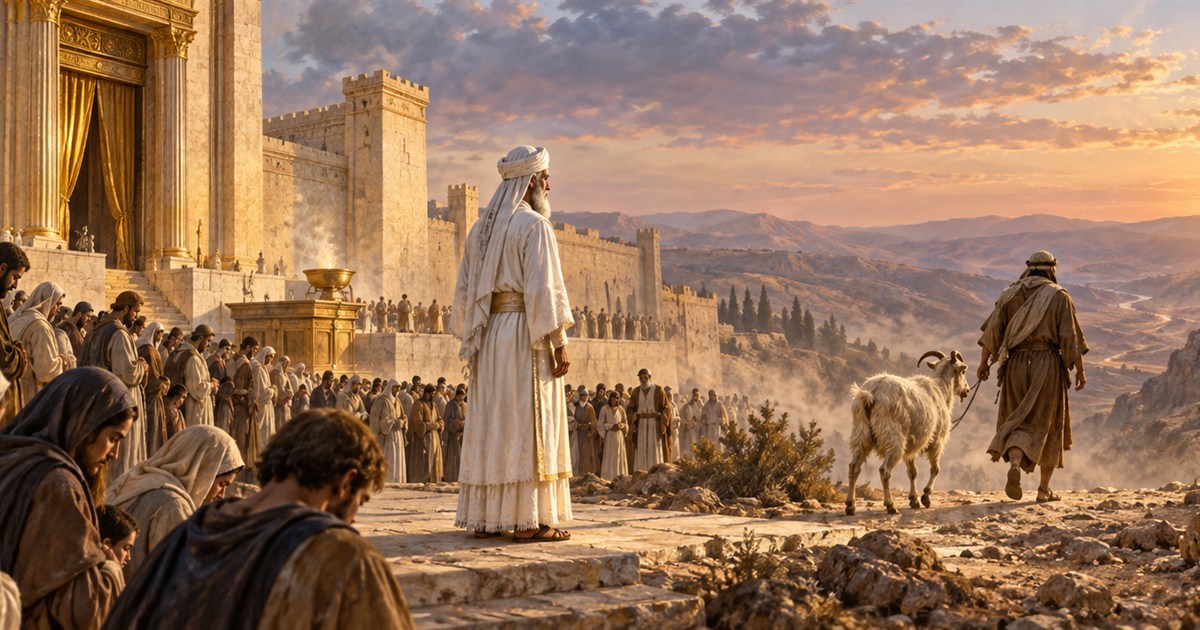
Holidays in the Bible
See which Jewish, Christian and Islamic holidays the Bible commands, tells or names, and where the rest come from.

Holidays in the Bible · Jewish
the Ninth of Av
Tisha B'Av is a Jewish day of mourning for the destruction of the First and Second Temples in Jerusalem and other tragedies in Jewish history. Observances include fasting and reading Lamentations.
When 9 Av (moved to 10 Av when it falls on Shabbat). 2026 Evening of 22 July to nightfall 23 July.
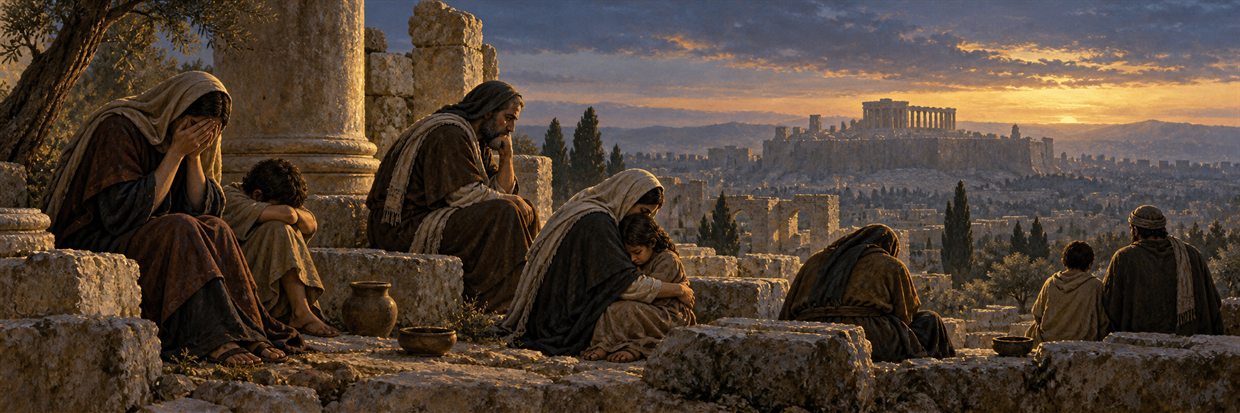
Tisha B'Av is a Jewish day of mourning for the destruction of the First and Second Temples in Jerusalem and other tragedies in Jewish history. Observances include fasting and reading Lamentations.
The First Temple's destruction is told in the Bible: in the fifth month Nebuzaradan, captain of Nebuchadnezzar's guard, came to Jerusalem and burnt the house of the LORD (2 Kings 25:8-9, Jeremiah 52:12-13), in 587 or 586 BCE. The fast for it is also in the Bible: the prophet Zechariah, speaking to Jews who had returned from Babylon, names "the fast of the fourth month, and the fast of the fifth, and the fast of the seventh, and the fast of the tenth" and promises they will one day become joy (Zechariah 8:19); the fast of the fifth month is Tisha B'Av 2. The Second Temple's destruction by Titus in 70 CE is not narrated as a completed historical event in the Tanakh; the Mishnah records it, and the Talmud sets both burnings on the ninth of Av 1,3.
Orthodox and Conservative Jews keep the fast in full; many Reform congregations do not keep it, and some hold a service of remembrance 4. It is the one fast besides Yom Kippur that lasts a full night and day, and the only one on which Jews mourn as if for a death: no leather shoes, no washing, no greeting, study traditionally restricted to texts about mourning and calamity 4.
The fast comes from the Bible's account of the Temple's burning and from Zechariah's fast of the fifth month; the Mishnah fixed the day at the ninth of Av and listed five calamities on it, and the Talmud explains why.
The Bible gives two dates for the burning: 2 Kings says Nebuzaradan came on the seventh of the fifth month, Jeremiah says the tenth (2 Kings 25:8, Jeremiah 52:12). The Talmud in Taanit 29a resolves them: the Babylonians entered the Sanctuary on the seventh, desecrated it on the seventh and eighth, set it alight toward nightfall on the ninth, and it burned through the tenth; Rabbi Yohanan said that had he lived then he would have set the fast on the tenth, when most of it burned, and the sages answered that it is better to mark the beginning of the tragedy 3. Zechariah's prophecy names four fasts by month, and the Talmud in Rosh Hashanah 18b, in the name of Rabbi Akiva, matches them to days: the fourth month is the seventeenth of Tammuz, when the city wall was breached; the fifth is the ninth of Av, when the Temple burned; the seventh is the third of Tishrei, when Gedaliah was killed; the tenth is the tenth of Tevet, when Nebuchadnezzar's siege began (Ezekiel 24:1-2) 2. The same passage explains Zechariah's promise: when there is peace the days will be joy, when there is persecution they are fasts, and in between the community may choose; but the Ninth of Av is obligatory always, because on it the calamities were multiplied 2.
The Mishnah in Taanit 4:6 lists five things that befell on the Ninth of Av: it was decreed that the generation of the wilderness would not enter the Land; the Temple was destroyed the first time, by Nebuchadnezzar, and the second, by the Romans; Betar was captured; and Jerusalem was ploughed over 1. The Talmud derives the first from the spies: they returned on the ninth of Av and the people wept that night (Numbers 14:1), and God said, you have wept for nothing, and I will fix for you a weeping for generations 3. Betar was the last fortress of Bar Kokhba's revolt, taken by Rome in 135 CE, and the ploughing was Rome's sign that the city would not be rebuilt 1,4. So the day carries the Bible's burning, the rabbis' reckoning of the spies, and two Roman catastrophes the Bible does not know, and the Mishnah is where the five are joined.
Later tradition kept adding. The expulsion of the Jews from England was dated 18 July 1290, the ninth of Av, and the Alhambra decree expelling them from Spain took effect on 31 July 1492, the seventh; Germany entered the First World War on the ninth and tenth of Av in 1914; and the deportations from the Warsaw ghetto to Treblinka began on 22 July 1942 12 4. Communities have written kinot, laments, for the Holocaust and, since 2023, for the seventh of October, and read them with the medieval ones 4. The day has become the one on which Jewish tradition mourns everything at once, which is what the Talmud meant by calamities multiplied.
| Passage | What it is | Edition |
|---|---|---|
| Zechariah 8:19 (the fast of the fifth month) | Institutes the day | JPS TaNaKH 1917 |
| 2 Kings 25:8-9 | Tells the event | JPS TaNaKH 1917 |
| Jeremiah 52:12-13 | Tells the event | JPS TaNaKH 1917 |
| the Book of Lamentations | Read on the day | JPS TaNaKH 1917 |
| Deuteronomy 4:25-40 | Read on the day | JPS TaNaKH 1917 |
| Jeremiah 8:13-22 | Read on the day | JPS TaNaKH 1917 |
| Jeremiah 9 | Read on the day | JPS TaNaKH 1917 |
| Isaiah 40:1-26 (Shabbat Nachamu, the Sabbath after) | Read on the day | JPS TaNaKH 1917 |
Who keeps it Orthodox and Conservative Jews with a twenty-five hour fast, Lamentations read by candlelight sitting on the floor, and no leather shoes; many Reform communities hold a service of remembrance.
Jews fast from sunset to nightfall, about twenty-five hours, sit on the floor or low stools, read Lamentations by candlelight, chant kinot through the morning, and keep the five prohibitions of a day of mourning; the three weeks before are a season of lessening joy.
The fast begins at sunset and ends at nightfall the next day, just over twenty-five hours, and carries five prohibitions like Yom Kippur's: no eating or drinking, no washing, no anointing, no leather shoes, and no marital relations 4,5. The last meal before it, the seudah hamafseket, is eaten alone, sitting on the floor, of a hard-boiled egg and bread dipped in ashes, the mourner's meal; the Mishnah already forbids two cooked dishes, meat and wine at that meal 1,4. In the synagogue that evening the lights are dimmed, the curtain is taken from the ark, and the Book of Lamentations, Eicha, is chanted in its own mournful tune while the congregation sits on the floor or on low stools, as mourners sit during shiva, and the custom holds until midday 4,5. Torah study, which is a joy, is forbidden except for Lamentations, Job, the sad parts of Jeremiah, and the Talmud's chapters on mourning and the destruction 4.
In the morning tallit and tefillin are not worn, since they are ornaments; they are put on at the afternoon service, when the mourning eases, and the prayer Nachem, console, is added to the Amidah for "the mourners of Zion and the mourners of Jerusalem and the city that is bereaved, destroyed, scorned and desolate" 4. Most of the morning is given to kinot, laments composed across the centuries by poets who lived through the events, among them Eleazar Kallir and Judah Halevi; kinot for the Holocaust have been added since 1945 4. Jews do not greet one another or send gifts, some sleep on the floor or without a pillow, and worn-out prayer books and Torah scrolls are often buried on the day 4. In Jerusalem, Jews have gone up the Mount of Olives and to the Western Wall to mourn since the Middle Ages 4.
The mourning starts three weeks earlier. The Seventeenth of Tammuz, the fast for the breach of the wall, opens the Three Weeks, in which traditional Jews hold no weddings and do not cut their hair; from the first of Av, the Nine Days, they also eat no meat and drink no wine, as the Mishnah says that when Av begins, joy is lessened 1,4. The week of the fast itself forbids haircuts and laundry 1. When the ninth falls on Shabbat the fast is put off to Sunday, and Havdalah is said on Sunday night, after it ends, because the wine could not be drunk 4. The Sabbath after is Shabbat Nachamu, named for its haftarah, Isaiah's "comfort ye, comfort ye my people" (Isaiah 40:1-26), the first of seven Sabbaths of consolation that run to Rosh Hashanah.
Reform Judaism's classical position discouraged the fast, since the movement did not pray for the Temple's return, and many Reform congregations still do not keep it, while some newer ones do, and Reform rabbis have described their stance as ambivalent; the Conservative movement rarely kept the day until its Camp Ramah made it central in the 1940s, and some Conservative and Modern Orthodox rabbis have proposed rewording Nachem now that Jerusalem is rebuilt and under Jewish rule 4. Karaite Jews fast on the seventh and tenth of Av, the Bible's two dates, rather than the rabbis' ninth 4. Since 1967 the national religious community has asked whether a day of mourning still fits a Jerusalem in Jewish hands, and answered that only a rebuilt Temple would end it 4.
These passages offer a starting point for study. Service readings and verse numbering can differ by tradition, Bible edition and year; use the relevant community's calendar for a particular service.
The night reads the whole Book of Lamentations; the morning reads Moses' warning of exile and Jeremiah's lament; the afternoon turns to the readings of every fast day.
On the night of the fast the Book of Lamentations is read entire, from "how doth the city sit solitary" (Lamentations 1:1) to "turn thou us unto thee, O LORD" (Lamentations 5:21), which the congregation repeats aloud so that the book does not end in despair. In the morning the Torah reading is Deuteronomy 4:25-40, Moses' warning that Israel will be scattered if it forgets, and the haftarah is Jeremiah 8:13 to 9:23, "for the hurt of the daughter of my people am I hurt." In the afternoon the readings are those of every fast day, Moses' plea after the golden calf (Exodus 32:11-14, Exodus 34:1-10) and the haftarah Isaiah 55:6 to 56:8, "seek ye the LORD while he may be found."
Psalm 137, "by the rivers of Babylon," with its oath "if I forget thee, O Jerusalem," is the day's psalm in the hearts of those who keep it; at Jewish weddings, when the groom breaks a glass, some recite its verses 5 and 6 so that even the joy remembers the ruin 10. The kinot are not scripture but poetry, and those of Kallir and of Judah Halevi are as fixed in the day as the readings 4.
In brief Evening: the Book of Lamentations. Morning: Deuteronomy 4:25-40, haftarah Jeremiah 8:13 to 9:23. Afternoon: Exodus 32:11-14 and 34:1-10, haftarah Isaiah 55:6 to 56:8. The Sabbath after: Isaiah 40:1-26.
Christians do not keep Tisha B'Av, but the Temple's fall in 70 CE is foretold in their Gospels, and the Book of Lamentations is sung in their Holy Week.
The New Testament remembers the Second Temple standing and Jesus foretelling its fall: "not one stone will be left upon another" (Mark 13:1-2, Luke 21:5-6), and Luke has him weep over the city and describe its siege (Luke 19:41-44) 7. Christians have read those words as fulfilled in 70 CE, and many scholars date Mark's Gospel around that year for the same reason 7. Interpretations of these passages must not be confused with collective blame against Jews. In Nostra Aetate §4 (1965), the Catholic Church rejects presenting Jews as rejected or accursed by God and condemns antisemitism. This is a named institutional position, not a claim that all Christians interpret the passages identically.
The Book of Lamentations is a Christian scripture too, and the Western church sings its verses at Tenebrae, the office of darkness in the last three days of Holy Week, where its "how doth the city sit solitary" is applied to the death of Jesus and the candles are put out one by one until the church is dark 6. A Christian reader who knows Tenebrae will recognise the sound of Tisha B'Av; the two traditions mourn different things with the same book. Josephus, whose account of the siege is the source Christians and Jews alike read, describes the Temple burning in the month of Av and Titus carrying the menorah to Rome in triumph 8.
Jerusalem's sacred sites are important in both Judaism and Islam. Jewish mourning for the Temples and Muslim reverence for al-Aqsa belong to distinct religious histories.
The compound known in Jewish usage as the Temple Mount is known in Islamic usage as al-Haram al-Sharif, the Noble Sanctuary. It includes al-Aqsa Mosque and the Dome of the Rock. Understanding its importance in both traditions provides context for this guide; present-day political and legal questions require separate treatment 9.
Tisha B'Av is the ninth of Av, in July or August; when it falls on Shabbat the fast is kept on Sunday, the tenth.
Av is the fifth month counting from Nisan and the eleventh of the Jewish civil year, so the fast falls in high summer, between mid-July and mid-August. When it falls on Shabbat the fast is deferred to Sunday, since only Yom Kippur may be kept on the Sabbath, and Havdalah is said when the fast ends 4. The fast runs from sunset to nightfall, about twenty-five hours.
The Seventeenth of Tammuz, three weeks before, opens the season and has its own card on the overview, as do the other two fasts Zechariah names, the Fast of Gedaliah after Rosh Hashanah and the Tenth of Tevet in midwinter. Six days after Tisha B'Av is Tu B'Av, the fifteenth of Av, of which Rabban Shimon ben Gamliel said in the Mishnah that there were no days as joyous for Israel as the fifteenth of Av and Yom Kippur; it is the turn from mourning to consolation 11.
| Rule | 2026 | 2027 |
|---|---|---|
| 9 Av (moved to 10 Av when it falls on Shabbat) | Evening of 22 July to nightfall 23 July | Evening of 11 August to nightfall 12 August |
The event is: 2 Kings 25 and Jeremiah 52 tell the burning of the First Temple in the fifth month, and Zechariah 8:19 names the fast of the fifth month among four fasts. The day itself, the ninth, was fixed by the rabbis, who reconciled the Bible's seventh and tenth; the Second Temple's fall in 70 CE is remembered in the Mishnah, rather than narrated in the Tanakh 1,2,3.
The Mishnah lists five things: the decree that the generation of the wilderness would die outside the Land, the burning of the First Temple by Babylon, the burning of the Second Temple by Rome in 70 CE, the fall of Betar in 135 CE, and the ploughing of Jerusalem. Later tradition added the expulsions from England in 1290 and Spain in 1492 and the start of the Warsaw deportations in 1942 1,4.
Both are full fasts of about twenty-five hours with the same five prohibitions, but Yom Kippur is a day of atonement commanded in the Torah and kept even on Shabbat, while Tisha B'Av is a day of mourning set by the prophets and rabbis, deferred to Sunday when it falls on Shabbat, and kept with Lamentations, sitting on the floor, and no tefillin in the morning 4,5.
Because the day is kept as a house of mourning: Jews sit on the floor or low stools as mourners do during shiva, the lights are dimmed and Lamentations and the kinot are read by candlelight, and greetings and gifts are avoided. The custom of sitting low holds until midday, when the mourning begins to ease 4.
No. Fasting is part of traditional observance, but participation varies across communities and individuals. Reform approaches include both non-observance and services of remembrance; Karaite practice follows different dates 4. Descriptions of fasting are educational, not instructions for every reader.
Quoted from the JPS TaNaKH 1917; each links to its chapter and carries a Memorize button that starts the five-step path. Switch the edition to read them in another Bible here.
HOW DOTH the city sit solitary, that was full of people! How is she become as a widow! She that was great among the nations, and princess among the provinces, how is she become tributary!
How doth the city sit solitary. The first word, Eicha, gives the book its Hebrew name and the night its sound.
'Thus saith the LORD of hosts: The fast of the fourth month, and the fast of the fifth, and the fast of the seventh, and the fast of the tenth, shall be to the house of Judah joy and gladness, and cheerful seasons; therefore love ye truth and peace.
The four fasts named by month, and the promise that they will become joy and gladness. The fast of the fifth month is Tisha B'Av.
Surely the LORD'S mercies are not consumed, surely His compassions fail not. They are new every morning; great is Thy faithfulness.
The LORD's mercies are not consumed, new every morning. The book's turn, in its middle chapter, from grief to trust.
If I forget thee, O Jerusalem, let my right hand forget her cunning. Let my tongue cleave to the roof of my mouth, if I remember thee not; if I set not Jerusalem above my chiefest joy.
If I forget thee, O Jerusalem. The oath of the exiles by the rivers of Babylon, which some recite at a Jewish wedding when the glass is broken.
Make it part of your day
Optional further reading: you can explore the text without sharing its beliefs or taking part in the observance.
The penultimate verse of Lamentations, traditionally repeated after the final verse so that the reading closes with a plea for renewal.
Turn Thou us unto Thee, O LORD, and we shall be turned; renew our days as of old.
The numbers match the references in the article. Links include religious texts, community explanations and historical studies. Read more about how this guide was researched.
BibleVerse Editorial, "Tisha B'Av: What It Marks, Where It Comes From, and How It Is Kept", BibleVerse, published 2026-09-12, updated 2026-09-12, https://bibleverse.site/holidays/tisha-bav/
Version 1.1. Awaiting review by a member of the community it describes. Dates in the table are for 2026 and 2027 and are refreshed yearly. Corrections are welcome through the contact page.
See which Jewish, Christian and Islamic holidays the Bible commands, tells or names, and where the rest come from.
Yom Kippur, the Day of Atonement, is a Jewish day of repentance, prayer and fasting. It concludes the ten Days of Repentance that begin with Rosh Hashanah.
Explore the books and their place in four scriptural traditions.