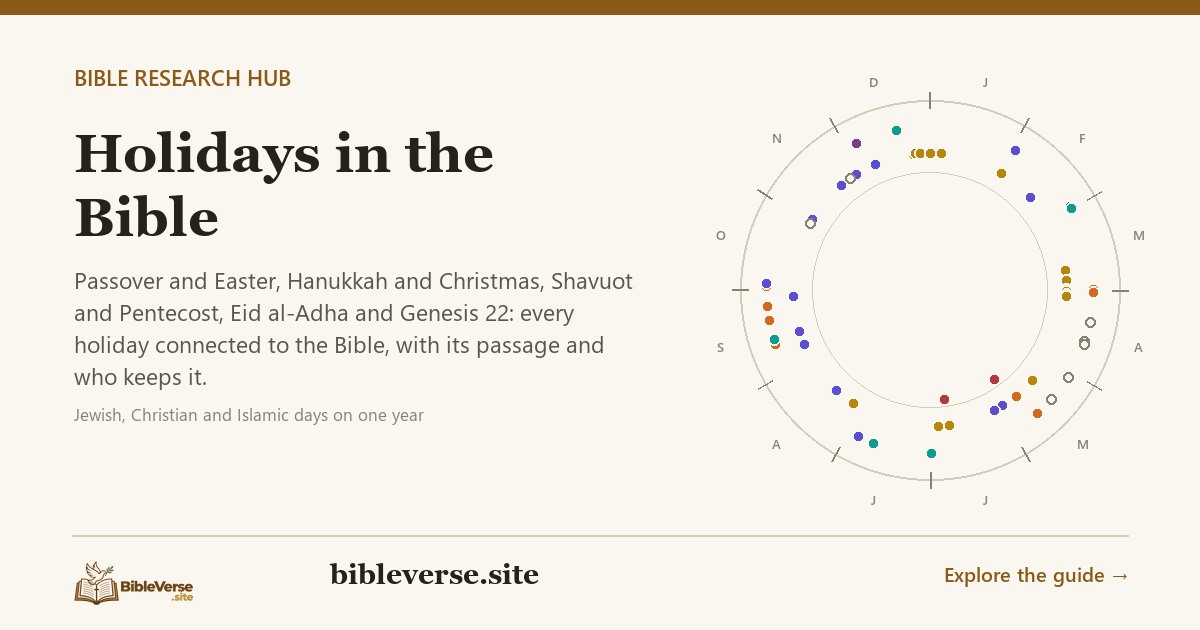
Holidays in the Bible
See which Jewish, Christian and Islamic holidays the Bible commands, tells or names, and where the rest come from.
Holidays in the Bible · Jewish
the Sabbath
Shabbat is the Jewish day of rest, from Friday sunset to Saturday nightfall. This guide also explores Sunday worship and the seventh-day Sabbath in Christian traditions.
When Every week, from sunset on Friday to nightfall on Saturday. 2026 Every week.
Shabbat is the Jewish day of rest, from Friday sunset to Saturday nightfall. This guide also explores Sunday worship and the seventh-day Sabbath in Christian traditions.
The Sabbath is the oldest holy day in the Bible and the only one in the Ten Commandments. It begins on the seventh day of creation, which God blessed and hallowed because on it he rested from all his work (Genesis 2:1-3), and it is commanded at Sinai in the fourth commandment, remember the sabbath day to keep it holy (Exodus 20:8-11). The commandment is given twice, with two reasons: in Exodus because God rested on the seventh day, in Deuteronomy because Israel had been slaves in Egypt and the LORD brought them out, so that the servant and the stranger may rest as you do (Deuteronomy 5:12-15) 1,2.
Christians keep the first day instead. The Gospels say the tomb was found empty early on the first day of the week (Matthew 28:1, John 20:1), the Acts of the Apostles shows the church at Troas meeting on the first day of the week to break bread (Acts 20:7), and Revelation calls it the Lord's day (Revelation 1:10). This page tells both days, each as its own people keep it, and says where they meet and where they part 3.
The Torah describes the seventh day as holy and commands rest. Rabbinic teaching explains how Shabbat is observed, while Christian traditions developed different understandings of Sabbath and Sunday worship.
The Sabbath appears repeatedly in the Torah. Besides Genesis 2 and the two Decalogues, the Torah gives the Sabbath as the day the manna did not fall (Exodus 16:22-30), as a sign between God and Israel for ever, holy to you (Exodus 31:12-17), as rest for the ox and the ass and the servant (Exodus 23:12), and as the first of the appointed seasons in Leviticus 23:3. The prophets return to it: Isaiah calls it a delight and the holy of the LORD (Isaiah 58:13-14), and Nehemiah shuts the gates of Jerusalem against the traders on it (Nehemiah 13:15-22) 2.
The Torah prohibits work and gives examples, including restrictions concerning fire (Exodus 35:3) and food preparation (Exodus 16:23). Rabbinic law develops a detailed account of prohibited labor; the Mishnah lists forty less one principal categories of labour, sowing, ploughing, reaping, grinding, kneading, baking, spinning, weaving, writing two letters, kindling a fire, carrying from one domain to another, and the rest, which the rabbis derived from the kinds of work done to build the Tabernacle (Mishnah Shabbat 7:2) 4. Much traditional rabbinic guidance about work on Shabbat, from not switching on a light to not carrying a key outside without an eruv, comes from that list and the centuries of law built on it; the candles, the kiddush over wine, the two loaves and the three meals are part of rabbinic tradition 1.
The New Testament nowhere commands a change of day. Jesus kept the Sabbath and argued about how, saying that the Sabbath was made for man and not man for the Sabbath (Mark 2:27-28); Paul instructed the Corinthians to set money aside on the first day (1 Corinthians 16:2) and he told the Colossians not to let anyone judge them over a Sabbath (Colossians 2:16-17). The Didache, about the year 100, says every Lord's day gather yourselves together and break bread; Justin Martyr describes the Sunday gathering at Rome about 155, with the memoirs of the apostles read, prayers, bread and wine, and gives the reason that it is the day on which God began the world and Jesus rose; in 321 the emperor Constantine made the day of the sun a day of rest across the empire 3,5. The churches hold that the first day was kept from the apostles' time because of the resurrection; the Catholic Church says in its Catechism that Sunday is expressly distinguished from the sabbath, that for Christians its ceremonial observance replaces that of the sabbath, and that it fulfils the spiritual truth of the Jewish sabbath 6. Seventh-day churches read the same history differently, and their reading is below.
| Passage | What it is | Edition |
|---|---|---|
| Genesis 2:1-3 | Institutes the day | JPS TaNaKH 1917 |
| Exodus 20:8-11 | Institutes the day | JPS TaNaKH 1917 |
| Deuteronomy 5:12-15 | Institutes the day | JPS TaNaKH 1917 |
| Exodus 31:12-17 | Institutes the day | JPS TaNaKH 1917 |
| Exodus 16:22-30 | Tells the event | JPS TaNaKH 1917 |
| Isaiah 58:13-14 | Read on the day | JPS TaNaKH 1917 |
| Mark 2:27-28 | A Christian reading | Berean Standard Bible |
| Hebrews 4:9-10 | A Christian reading | Berean Standard Bible |
Who keeps it Many Rabbinic Jewish communities, from Friday sunset to Saturday nightfall; the seventh-day Sabbath is also kept by Seventh-day Adventists, Seventh Day Baptists and some other Christians.
Jews light candles before sunset on Friday, bless wine and bread, eat three meals, go to synagogue, and do no work until three stars appear on Saturday night. Christians go to church on Sunday morning and, in many traditions, rest.
Shabbat begins at home. Before sunset on Friday candles are lit, with the lead time varying by community, two or more, with a blessing; at the table kiddush is said over wine, the two loaves of challah are blessed, recalling the double manna of the sixth day, and the Friday night meal is the week's best, with songs. Saturday morning is the synagogue's main service of the week, with the weekly portion of the Torah read and its haftarah; a second meal follows, and a third late in the afternoon. When three stars show, havdalah separates the day from the week with wine, sweet spices and a braided candle 1,7. Between, the thirty-nine labours are not done: no cooking, writing, driving, buying, switching on, carrying in public without an eruv, or handling money; the day is for prayer, study, meals, sleep, walks and company.
The movements keep this differently. Orthodox Jews keep the whole law as the Shulchan Aruch codifies it, walking to synagogue and using timers and pre-set lights. Conservative Judaism keeps the law and has ruled on it: in 1950 its Committee on Jewish Law and Standards permitted riding to the synagogue and back on Shabbat for those who live too far to walk, as a concession for public worship rather than a change in the law, and in 2023 it renewed that ruling for electric cars 8,9. Reform Judaism holds Shabbat as a day of rest, delight and the wonders around us, kept with the blessings and customs each family chooses, old or new, from candle lighting to a Friday night service; it does not bind its members to the thirty-nine labours 10. Karaite Jews keep the Torah's text without the rabbinic definitions, and traditional Karaite practice has been stricter than rabbinic practice about fire and electricity on the day 2.
Christians keep Sunday with a morning service, the Mass or Divine Liturgy or the preaching service of their tradition, with the Lord's Supper in most churches weekly or monthly. Catholics are obliged to attend Mass on Sunday and to rest from work that hinders worship and the day's joy 6; the Orthodox keep the Divine Liturgy and count Sunday the first and eighth day; the Puritan tradition in the Reformed churches, expressed in the Westminster Confession of 1646, keeps Sunday as the Christian Sabbath, a whole day of rest and worship 3. Sunday rest and worship practices vary among Protestant communities.
Some Christians keep the seventh day. Seventh-day Adventists keep the Sabbath from Friday sunset to Saturday sunset as the seventh day of the fourth commandment, holding it in their own statement of belief to be a memorial of creation and a sign of loyalty to God; Seventh Day Baptists, the Church of God (Seventh Day), the churches of the Armstrong tradition and Messianic Jewish congregations keep Saturday too, and hold that the seventh day is the only day Scripture calls the Sabbath 11,12.
These passages offer a starting point for study. Service readings and verse numbering can differ by tradition, Bible edition and year; use the relevant community's calendar for a particular service.
The synagogue reads the week's portion of the Torah and its haftarah; the church reads the Sunday lessons of its lectionary.
Shabbat is the day the Torah is read through. Each week has its parashah, from Bereshit in the autumn after Simchat Torah to the death of Moses a year later, read in seven sections with a haftarah from the Prophets chosen to match; Psalm 92, a song for the sabbath day, is the psalm of the day, and Exodus 31:16-17, the children of Israel shall keep the sabbath, is sung at kiddush on Saturday morning. Friday night's Kabbalat Shabbat sings Psalms 95 to 99 and 29 and the hymn Lecha Dodi, come my beloved to meet the bride 1,7.
Sunday is the day the church's lectionary is built on. The Roman lectionary and the Revised Common Lectionary used by Anglican, Lutheran, Methodist and Presbyterian churches read an Old Testament lesson, a psalm, an epistle and a Gospel every Sunday on a three-year cycle, so that the four Gospels are heard in turn; the Orthodox read an epistle and a Gospel on a one-year cycle keyed to Pascha. Psalm 118:24, this is the day the LORD has made, is the church's Sunday verse, and Hebrews 4:9-10, there remains a Sabbath rest for the people of God, is read as the day's meaning.
In brief A weekly Torah portion and a related prophetic reading, the haftarah; reading cycles differ among communities.
Most Christian churches gather on Sunday, while Seventh-day Adventists and other seventh-day churches observe Saturday. Their explanations draw on different interpretations of Scripture.
The Catholic Catechism distinguishes Sunday from the Jewish Sabbath and links Sunday worship with the resurrection. The Westminster Confession describes Sunday as the Christian Sabbath. Seventh-day Adventist teaching instead identifies the seventh day as the Sabbath required by the commandment 6,11,12.
Christian discussion also draws on Jesus' Sabbath teachings in Mark 2:27–28 and the promise of rest in Hebrews 4. These passages do not lead all churches to the same practice.
In Jewish tradition, Shabbat continues as the weekly day of rest and holiness. Isaiah 58:13–14 describes it as a delight 1.
Shabbat is every week, from sunset on Friday to nightfall on Saturday. The Lord's Day is every Sunday.
Shabbat recurs weekly rather than on a fixed day of the month. Jewish tradition connects its seventh-day rhythm with the creation account. It begins at sunset because Genesis 1 counts each day as evening and morning, and it ends when three stars are visible, at a time that depends on location, season and the community's method of reckoning nightfall. Candle-lighting times are printed in every Jewish calendar for the local sunset 1.
Sunday is the first day of the week in the Bible's count and in the Jewish and Christian weeks; the international standard that puts Monday first is a twentieth-century convention. The dates table below shows only that the day is weekly; the festivals that fall on a Sabbath, from Pesach to Yom Kippur, take its rules and add their own.
| Rule | 2026 | 2027 |
|---|---|---|
| Every week, from sunset on Friday to nightfall on Saturday | Every week | Every week |
Yes. It is the seventh day of creation in Genesis 2, one of the Ten Commandments in both Exodus 20 and Deuteronomy 5, a sign for ever in Exodus 31, the day the manna did not fall, the first of the appointed seasons in Leviticus 23, and a delight in Isaiah 58. What counts as work on it comes from the Mishnah's thirty-nine labours 2,4.
Because the Gospels say the tomb was found empty on the first day of the week, and the New Testament shows the apostles' churches meeting on that day. No verse commands the change; the churches hold it was kept from the beginning because of the resurrection, and the Catechism says Sunday's observance replaces the sabbath's. Seventh-day churches disagree and keep Saturday 3,6,11.
The Torah says do no work; the Mishnah lists thirty-nine categories, derived from building the Tabernacle: sowing, cooking, writing, kindling fire, carrying between domains and the rest. In practice that means no cooking, driving, buying, writing, switching on or carrying in public. Saving a life overrides all of it 4,1.
Seventh-day Adventists; Seventh Day Baptists; the Church of God (Seventh Day); the churches of the Armstrong tradition; and Messianic Jewish congregations. They keep it from Friday sunset to Saturday sunset as the seventh day the commandment names 11,12.
To the synagogue and back, if they live too far to walk, under a ruling of the Conservative movement's law committee in 1950, renewed for electric cars in 2023; the ruling calls it a concession for public worship, not a change in the law. Orthodox practice does not drive; Reform practice leaves it to each family 8,9,10.
Quoted from the JPS TaNaKH 1917; each links to its chapter and carries a Memorize button that starts the five-step path. Switch the edition to read them in another Bible here.
And God blessed the seventh day, and hallowed it; because that in it He rested from all His work which God in creating had made.
The first holy thing in the Bible is a day: God blessed the seventh day and hallowed it.
Remember the sabbath day, to keep it holy.
The fourth commandment in its first word, remember; Deuteronomy's version says observe, and the Friday night hymn sings both.
Wherefore the children of Israel shall keep the sabbath, to observe the sabbath throughout their generations, for a perpetual covenant. It is a sign between Me and the children of Israel for ever; for in six days the LORD made heaven and earth, and on the seventh day He ceased from work and rested.'
The Sabbath as a sign between God and Israel for ever, sung at kiddush on Saturday morning.
If thou turn away thy foot because of the sabbath, from pursuing thy business on My holy day; and call the sabbath a delight, and the holy of the LORD honourable; and shalt honour it, not doing thy wonted ways, nor pursuing thy business, nor speaking thereof;
The prophet's word for the day, a delight; the phrase oneg Shabbat, the delight of the Sabbath, is his.
Make it part of your day
Optional further reading: you can explore the text without sharing its beliefs or taking part in the observance.
A short commandment in the JPS, the shortest commandment about a day, to carry into every week.
Remember the sabbath day, to keep it holy.
The numbers match the references in the article. Links include religious texts, community explanations and historical studies. Read more about how this guide was researched.
BibleVerse Editorial, "Shabbat and the Lord's Day: Where the Week's Holy Day Comes From, and How It Is Kept", BibleVerse, published 2026-09-11, updated 2026-09-12, https://bibleverse.site/holidays/shabbat/
Version 1.1. Awaiting review by a member of the community it describes. Dates in the table are for 2026 and 2027 and are refreshed yearly. Corrections are welcome through the contact page.
See which Jewish, Christian and Islamic holidays the Bible commands, tells or names, and where the rest come from.
The new moon, marked in the Torah with offerings and trumpet blasts, kept today with extra prayers and a Torah reading.
See which Bible editions different communities read, with sources.