Holidays in the Bible
See which Jewish, Christian and Islamic holidays the Bible commands, tells or names, and where the rest come from.

Holidays in the Bible · Jewish
the Feast of Lots
Purim celebrates the deliverance of the Jewish people in the Book of Esther. Observances include reading the story aloud, sharing food, giving to people in need and enjoying a festive meal.
When 14 Adar (Adar II in a leap year); 15 Adar in Jerusalem. 2026 Evening of 2 March to nightfall 3 March; Shushan Purim, kept in Jerusalem, is the following day; the Fast of Esther is the day before.
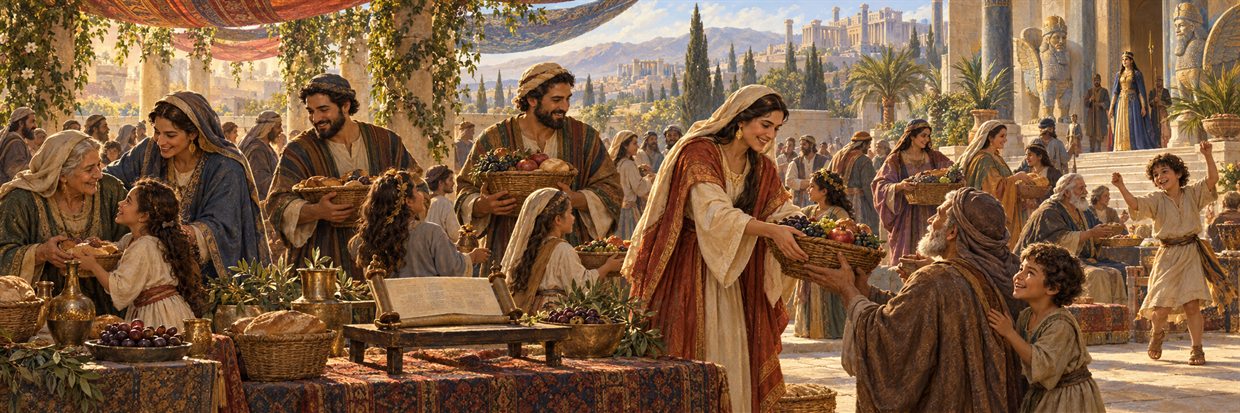
Purim celebrates the deliverance of the Jewish people in the Book of Esther. Observances include reading the story aloud, sharing food, giving to people in need and enjoying a festive meal.
The whole story is the Book of Esther, called the Megillah, the scroll. Haman cast the pur, the lot, to pick the day (Esther 3:7), which is why the festival is called Purim, the lots (Esther 9:26). Mordecai's warning to Esther that she may have come to the throne "for such a time as this" (Esther 4:14) and her answer, "if I perish, I perish" (Esther 4:16), are the hinge of the book. On the thirteenth of Adar, the day Haman had chosen, the Jews fought their enemies; on the fourteenth they rested and feasted, and in the walled capital of Shushan, where the fighting ran a second day, on the fifteenth (Esther 9:16-19).
Purim is a day of joy without a Yom Tov's rest: work is permitted, and the day is filled instead with the reading of the scroll, gifts, a meal, costumes and noise 3,6. It is the one Jewish holiday whose founding is written into the book it comes from.
Purim comes from the Book of Esther, which not only tells the story but commands the festival in Mordecai's letters, and the sages drew the day's four duties from those letters.
In Esther 9:20-28 Mordecai writes to all the Jews of the provinces to keep the fourteenth and fifteenth of Adar every year, "the days wherein the Jews had rest from their enemies," as "days of feasting and gladness, and of sending portions one to another, and gifts to the poor," and the Jews take the days upon themselves and their descendants "throughout every generation, every family, every province, and every city." A second letter from Esther and Mordecai confirms the days (Esther 9:29-32). No other Jewish holiday is founded this way, inside its own book, by a decree of the people rather than a command from Sinai.
The sages of the Mishnah and Talmud set the observance in order. Mishnah Megillah, the tractate named for the scroll, opens by ruling when it is read: cities walled since the days of Joshua read on the fifteenth of Adar, villages and towns on the fourteenth, and in a leap year the reading and the gifts to the poor belong to the second Adar 1. The Talmud records Esther asking the sages to "establish me for future generations" and to "write me for future generations," and the sages finding in Exodus 17:14, "write this for a memorial in the book," the warrant for the scroll to be read and for the day to stand 2. From Esther 9:22 the sages drew the four mitzvot of the day: hearing the Megillah, sending portions of food to friends, giving gifts to the poor, and the festive meal 3,6.
The Book of Esther is a book of the Hebrew Bible, one of the five scrolls read on festivals, and the only book of the Tanakh apart from the Song of Songs that never names God; Jewish tradition reads that silence as the point, God working through what looks like coincidence 7. The Talmud records the sages debating whether the scroll carried the full sanctity of scripture before ruling that it was written under the Holy Spirit 2, and it is one of the few books of the Hebrew Bible not found among the Dead Sea Scrolls 7. Whether the events happened as told is debated by scholars; the book knows the Persian court well and its Ahasuerus is usually identified with Xerxes I, who reigned in the fifth century BCE 7.
| Passage | What it is | Edition |
|---|---|---|
| Esther 9:20-32 | Institutes the day | JPS TaNaKH 1917 |
| the Book of Esther (the Megillah) | Read on the day | JPS TaNaKH 1917 |
| Exodus 17:8-16 | Read on the day | JPS TaNaKH 1917 |
| Deuteronomy 25:17-19 (Shabbat Zachor, the Sabbath before Purim) | Read on the day | JPS TaNaKH 1917 |
Who keeps it Many Rabbinic Jewish communities, with the reading of the Book of Esther, gifts of food, gifts to the poor, a festive meal and costumes; walled cities such as Jerusalem keep Shushan Purim a day later.
On the evening of Purim and again the next morning the Megillah is read aloud in the synagogue; the day is spent sending gifts of food to friends, giving to the poor, and sitting down to a festive meal, in costume, with noise at every mention of Haman.
The Megillah is read from a handwritten scroll on the night of Purim and again in the morning, and every word must be heard 3,6. When the reader reaches Haman's name, which the scroll says fifty-four times, the congregation drowns it out with graggers, rattles, and stamping, blotting out the name of the man who wanted to blot out the Jews 3,6. On the Purim morning the Torah reading is Exodus 17:8-16, the battle with Amalek, because the Talmud holds that Haman the Agagite was descended from Amalek, and on the Sabbath before Purim, Shabbat Zachor, the synagogue reads Deuteronomy 25:17-19, "remember what Amalek did" 6.
The four mitzvot fill the day. Mishloach manot, sending portions, is, as the halakha sets the minimum, two kinds of food sent to one person; matanot la'evyonim, gifts to the poor, is two gifts of food or money to two poor people, and the tradition holds it better to spend more on the poor than on the portions; and the seudah, the Purim feast, is eaten in the daytime, because the Talmud rules that a Purim feast eaten at night does not fulfil the duty, since Esther 9:22 says "days of feasting" 2,3. Costumes and masks, the Purim spiel, a comic play of the story, and hamantaschen, the three-cornered filled pastries called Haman's pockets or Haman's ears, are customs that have grown around the day; masquerading probably began among the Jews of Italy at the end of the fifteenth century 3,6. Purim is the one holiday on which Jewish tradition recommends drinking: Rava's ruling in the Talmud is to drink on Purim until one cannot tell "cursed is Haman" from "blessed is Mordecai," and the Talmud follows it at once with a cautionary tale of two sages who drank too much 2,3.
The day before Purim, the thirteenth of Adar, is the Fast of Esther, a dawn-to-dusk fast remembering the day the Jews fought and Esther's own fast before she went to the king (Esther 4:16); it is not in the Talmud and is first recorded as a custom in the eighth century CE, and it moves to the Thursday before when the thirteenth falls on Shabbat 4,8. In Jerusalem, and in any city walled since the days of Joshua, Purim is kept on the fifteenth of Adar, Shushan Purim, as the Jews of Shushan kept it (Esther 9:18-19); the sages chose Joshua's day rather than Ahasuerus's to honour the Land of Israel, which lay in ruins when the story took place, and cities whose ancient walls are uncertain, such as Hebron and Tiberias, keep both days 1,5,6. In a Hebrew leap year, which has two months of Adar, Purim is kept in Adar II, so that it stays a month before Passover 1,5.
These passages offer a starting point for study. Service readings and verse numbering can differ by tradition, Bible edition and year; use the relevant community's calendar for a particular service.
The synagogue reads the whole Book of Esther twice, at night and in the morning, and the Torah portion about Amalek on the morning of the day.
The Megillah, the whole of the Book of Esther, is chanted from a handwritten scroll at night and again in the morning; the Talmud, in the name of Rabbi Joshua ben Levi, extends the duty to the night reading and to women, because they too were part of the miracle 6. The Torah reading on Purim morning is Exodus 17:8-16, Amalek's attack in the wilderness and God's oath to blot out his memory, which the Mishnah sets down as the reading for the day 6. On Shabbat Zachor, the Sabbath before, the additional Torah reading is Deuteronomy 25:17-19, because the Talmud holds that Haman, the Agagite, was descended from Amalek 6,10; the Talmud counts 1 Samuel 15, Saul and Agag, as the Prophets' mention of Amalek 2.
The Talmud ties these three passages together: when the sages hesitated to add the scroll to scripture because Amalek was already remembered three times, in Exodus, in Deuteronomy and in Samuel, they found in Exodus 17:14, "write this for a memorial in the book," a place for the Megillah as well 2.
In brief The Book of Esther, evening and morning; Exodus 17:8-16 (Amalek). On the Sabbath before, Deuteronomy 25:17-19.
Esther is read as Scripture in Jewish and Christian traditions, but their Bibles do not all contain the same form of the book.
The Greek form of Esther includes passages absent from the Hebrew text, including prayers and additional narrative material. Catholic Bibles include these additions as Scripture, and they also appear in Orthodox biblical traditions. Protestant editions usually follow the Hebrew form, sometimes printing the additions separately in the Apocrypha 7,9.
Purim's reading of the Megillah, food gifts, charity and festive meal belong to Jewish observance. Reading Esther as Christian Scripture does not imply observing Purim in the same way 3.
Esther and Mordecai are not named in the Qur'an, and Purim is not an Islamic festival.
The Book of Esther's Persian setting can be studied as part of its literary and historical context, without assuming a corresponding Islamic holiday 7.
Purim is the fourteenth of Adar, in late winter or early spring, a month before Passover; in Jerusalem it is the fifteenth, and in a leap year it falls in the second Adar.
The Hebrew calendar is lunar with a month added seven times in nineteen years, so Purim moves within the Gregorian calendar but stays between late February and late March. The Book of Esther gives the dates, the thirteenth of Adar for the battle and the fourteenth and fifteenth for the feast (Esther 9:17-19); Mishnah Megillah adds that in a leap year the reading is in the second Adar 1. The day begins at nightfall, with the first reading of the Megillah, and ends at nightfall the next day.
The Fast of Esther is the thirteenth, moved to the Thursday before when the thirteenth is a Sabbath 8. Shushan Purim, the fifteenth, is kept in Jerusalem; when the fifteenth falls on a Sabbath, Purim Meshulash, the Jerusalem observance is spread over three days, since the scroll is not read on Shabbat 1,6. The fourteenth of the first Adar in a leap year is Purim Katan, a little Purim with no set observances 1,6. The dates below are the fourteenth of Adar; Shushan Purim is the day after each and the Fast of Esther the day before.
| Rule | 2026 | 2027 |
|---|---|---|
| 14 Adar (Adar II in a leap year); 15 Adar in Jerusalem | Evening of 2 March to nightfall 3 March; Shushan Purim, kept in Jerusalem, is the following day; the Fast of Esther is the day before | Evening of 22 March to nightfall 23 March; Shushan Purim, kept in Jerusalem, is the following day; the Fast of Esther is the day before |
Yes. The Book of Esther tells the story and founds the festival: Mordecai's letters in Esther 9:20-28 tell the Jews to keep the fourteenth and fifteenth of Adar every year as days of feasting, gladness, sending portions to one another and gifts to the poor. The Megillah reading, the noise at Haman's name and the Fast of Esther came later, from the sages and from custom 1,2,3,6.
Hearing the Megillah, the Book of Esther, read at night and in the morning; mishloach manot, sending portions of food to friends; matanot la'evyonim, gifts to the poor; and the seudah, a festive meal eaten in the daytime. The sages drew all four from Esther 9:22 2,3,6.
Because the Jews of the walled capital Shushan fought a second day and rested on the fifteenth (Esther 9:18-19). The Mishnah rules that cities walled since the days of Joshua keep the fifteenth, Shushan Purim; today that is Jerusalem, with a few cities of uncertain status keeping both days 1,5,6.
To blot out the name of the man who wanted to blot out the Jews. The scroll names Haman fifty-four times, and at each one the congregation drowns him out with graggers, rattles and stamping; the custom is traced to the Tosafists of the thirteenth century and to a midrash that reads the command to blot out Amalek's memory as blotting it out even from wood and stone 3,6.
The Hebrew book never names God, and Jewish tradition reads that as the point: God works through what looks like coincidence. The Greek version of Esther adds prayers and God's name, and Catholic and Orthodox Bibles include those additions as deuterocanonical; Protestant and Jewish Bibles read the Hebrew book 7.
Quoted from the JPS TaNaKH 1917; each links to its chapter and carries a Memorize button that starts the five-step path. Switch the edition to read them in another Bible here.
the days wherein the Jews had rest from their enemies, and the month which was turned unto them from sorrow to gladness, and from mourning into a good day; that they should make them days of feasting and gladness, and of sending portions one to another, and gifts to the poor.
Mordecai's letter names the days and what to do on them: feasting, gladness, portions to one another, gifts to the poor. The sages drew the four mitzvot of the day from this verse.
and that these days should be remembered and kept throughout every generation, every family, every province, and every city; and that these days of Purim should not fail from among the Jews, nor the memorial of them perish from their seed.
The Jews take the days upon themselves throughout every generation. This is the verse that founds the festival, inside the book that tells it.
For if thou altogether holdest thy peace at this time, then will relief and deliverance arise to the Jews from another place, but thou and thy father's house will perish; and who knoweth whether thou art not come to royal estate for such a time as this?'
Mordecai to Esther: relief will come from another place if she is silent, and who knows whether she has come to the throne for such a time as this. The book's nearest approach to naming God.
'Go, gather together all the Jews that are present in Shushan, and fast ye for me, and neither eat nor drink three days, night or day; I also and my maidens will fast in like manner; and so will I go in unto the king, which is not according to the law; and if I perish, I perish.'
Esther's answer: fast for me three days, and I will go in to the king, and if I perish, I perish. The fast the day before Purim carries her name.
Make it part of your day
Optional further reading: you can explore the text without sharing its beliefs or taking part in the observance.
Mordecai's question to Esther, asked every year when the scroll is read.
For if thou altogether holdest thy peace at this time, then will relief and deliverance arise to the Jews from another place, but thou and thy father's house will perish; and who knoweth whether thou art not come to royal estate for such a time as this?'
The numbers match the references in the article. Links include religious texts, community explanations and historical studies. Read more about how this guide was researched.
BibleVerse Editorial, "Purim: What It Marks, Where It Comes From, and How It Is Kept", BibleVerse, published 2026-09-11, updated 2026-09-12, https://bibleverse.site/holidays/purim/
Version 1.0. Awaiting review by a member of the community it describes. Dates in the table are for 2026 and 2027 and are refreshed yearly. Corrections are welcome through the contact page.
See which Jewish, Christian and Islamic holidays the Bible commands, tells or names, and where the rest come from.
Hanukkah is the eight-day Jewish Festival of Lights. It commemorates the rededication of the Temple in Jerusalem, and families mark it by lighting candles each evening.
Explore the books and their place in four scriptural traditions.