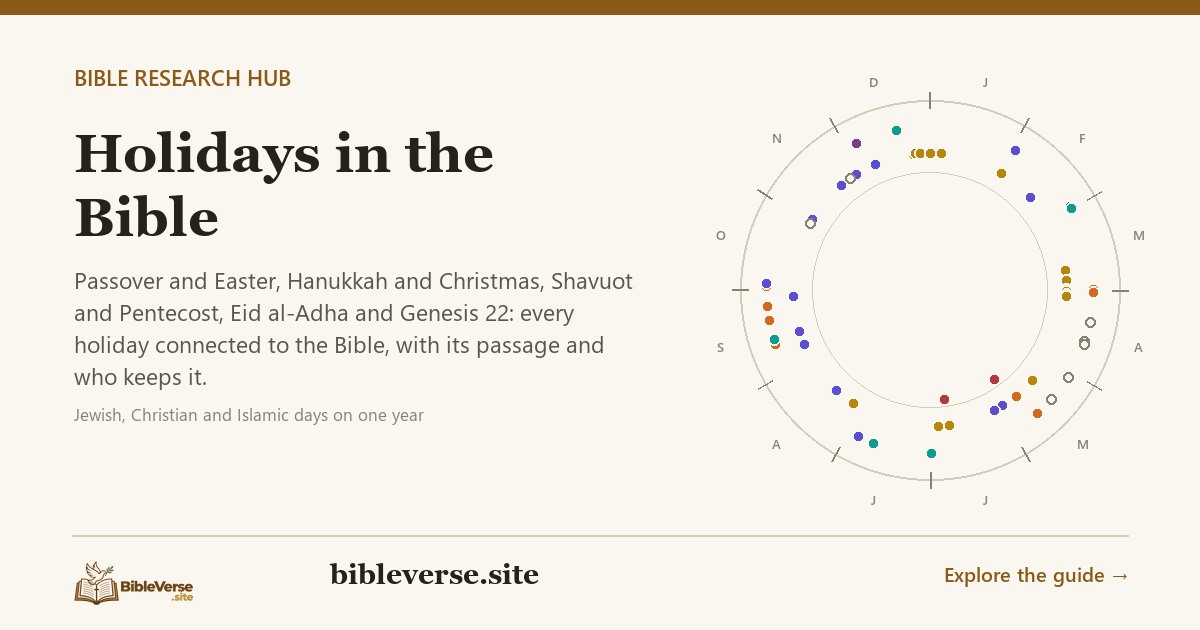
Holidays in the Bible
See which Jewish, Christian and Islamic holidays the Bible commands, tells or names, and where the rest come from.
Holidays in the Bible · Christian
All Hallows · Hallowmas
All Saints' Day honors the saints, including those whose names are unknown. Many Western churches celebrate it on 1 November; Eastern Orthodox churches observe it on the Sunday after Pentecost.
When 1 November; the Sunday after Pentecost in the East. 2026 1 November; nominal date, local liturgical transfers may apply; the Orthodox keep All Saints on the Sunday after Pentecost.
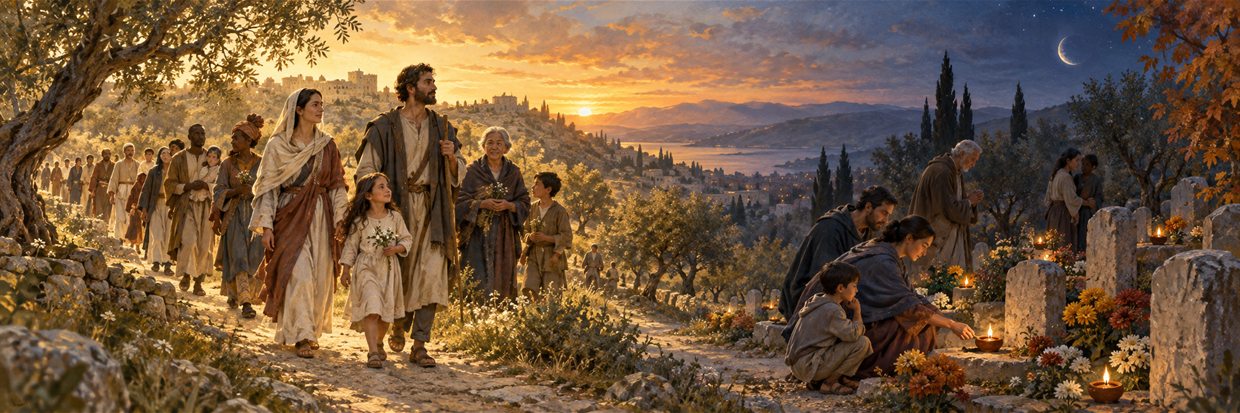
All Saints' Day honors the saints, including those whose names are unknown. Many Western churches celebrate it on 1 November; Eastern Orthodox churches observe it on the Sunday after Pentecost.
No verse commands either day. What the Bible gives is the picture the feast reads: John's vision of "a multitude too large to count, from every nation and tribe and people and tongue, standing before the throne" in white robes (Revelation 7:9-17), the "great cloud of witnesses" of Hebrews 12:1 after the roll of the faithful in Hebrews 11, and the Beatitudes, "blessed are the pure in heart, for they will see God" (Matthew 5:1-12). Paul calls every Christian a saint (Romans 1:7), and that older sense is the one Protestant churches keep on the day 3.
All Saints' Day is kept by the Catholic Church as a solemnity and holy day of obligation, by Lutherans as a festival, by Anglicans as a principal feast, and by Methodists and other Protestants, and it is a public holiday in France, Belgium, Poland, Spain, Croatia, Hungary and several German states; the Orthodox churches keep All Saints on the Sunday after Pentecost instead 3. All Souls' Day is the Catholic Commemoration of All the Faithful Departed, kept also by many Anglicans and Lutherans as an extension of All Saints', and in Mexico it is the Day of the Dead 4,6.
All Saints developed from Christian commemorations of martyrs. All Souls is a related but distinct observance, associated in Western history with prayer for the dead and the monasteries of Cluny.
The Catholic Encyclopedia describes fourth-century commemorations honoring groups of martyrs and the later dedication of Rome's Pantheon as a Christian church. These accounts show stages in the feast's development, rather than a single beginning shared by all churches 1,3.
The November date became established in Western calendars during the early Middle Ages. Its development, and its relationship to seasonal customs later associated with Halloween, should not be reduced to a single act of replacing another festival. Eastern Orthodox churches observe All Saints on the Sunday after Pentecost 1,3.
The Catholic Encyclopedia associates the spread of All Souls with Abbot Odilo of Cluny around the end of the tenth century. Catholic teaching connects prayer for the departed with purification after death. Protestant traditions differ on that teaching and on prayers for the dead; All Saints and All Souls therefore do not have identical roles across churches 2,4.
| Passage | What it is | Edition |
|---|---|---|
| Revelation 7:2-4 | Read on the day | Berean Standard Bible |
| Revelation 7:9-17 | Read on the day | Berean Standard Bible |
| Matthew 5:1-12 | Read on the day | Berean Standard Bible |
| 1 John 3:1-3 | Read on the day | Berean Standard Bible |
| Hebrews 11:32-40 | Read on the day | Berean Standard Bible |
| Hebrews 12:1 | A text the day draws on | Berean Standard Bible |
Who keeps it Catholic, Anglican, Lutheran and Methodist churches on 1 November (Halloween is its eve, All Hallows' Eve); the Orthodox keep All Saints on the Sunday after Pentecost. Many Protestant churches remember their dead on the nearest Sunday.
Catholics go to Mass on All Saints' and visit the graves of their dead through the three days of Allhallowtide, lighting candles and laying chrysanthemums; Protestants remember all Christians living and dead; Orthodox Christians keep All Saints in early summer and pray for the dead on Soul Saturdays through the year.
In the Catholic Church All Saints' is a holy day whose attendance obligation depends on local church rules, and the liturgy begins with first vespers on the evening of 31 October, All Hallows' Eve, which was traditionally a day of fasting 3. Families visit cemeteries through Allhallowtide, and on the Continent the graves are the centre of the day: in France, Belgium and Hungary chrysanthemums are laid on every tomb, in Poland and Croatia the cemeteries fill with candles and a liturgy is held among the graves, in Austria and Bavaria godparents give their godchildren a braided loaf, and in Spain the play Don Juan Tenorio is performed 3. On All Souls' the Office of the Dead is said and every Mass is a requiem; the Dominicans began the custom of three Masses on the day in the fifteenth century, and Benedict XV extended it to every priest during the First World War for the sake of the war dead, and a plenary indulgence for the souls in purgatory is offered to those who visit a cemetery and pray from 1 to 8 November 2,4.
Lutheran churches kept the feast after the Reformation, and in the Church of Sweden and other Lutheran lands it is a public holiday and the general day of remembrance of the dead, with the martyrs given special place; All Souls' is folded into it, and Lutherans visit and decorate graves through the season 3,4. In the Church of England All Saints' is a principal feast, kept on 1 November or the Sunday between 30 October and 5 November, and the Commemoration of All Faithful Departed on 2 November is optional and understood as an extension of it; the Anglican revival of prayer for the dead came from the need to mourn the millions of the First World War 3,4. Methodist and other Protestant congregations remember all Christians, living and dead, on the day or the nearest Sunday; for Protestants the saints are all believers, in Paul's sense, and the emphasis is on the whole community of believers 3,4.
The Orthodox churches keep All Saints on the Sunday after Pentecost, and the Sundays after that for the saints of each land, All Saints of America, All Saints of Mount Athos; the dead are remembered instead on several Saturdays of the Souls through the year 3. In Mexico and among Mexican communities everywhere, 1 and 2 November are the Day of the Dead, kept with home altars, marigolds, sugar skulls and visits to the graves with the favourite food of the departed; scholars are divided on how much of it is Aztec and how much Spanish Catholic, with differing interpretations of that history 6.
Halloween is All Hallows' Eve, the vigil of All Saints'; the name is Christian, the customs of guising, souling for soul cakes and lanterns grew up around Allhallowtide in Britain and Ireland, and Christians today keep it, ignore it or oppose it as their conscience leads, with different views across communities 5.
These passages offer a starting point for study. Service readings and verse numbering can differ by tradition, Bible edition and year; use the relevant community's calendar for a particular service.
The West reads the great multitude of Revelation 7, the children of God of 1 John 3, and the Beatitudes; All Souls' reads the Masses for the dead.
The Roman lectionary for All Saints' reads Revelation 7:2-4 and 9-14, the sealing of the servants of God and the multitude in white robes; 1 John 3:1-3, "we are now children of God, and what we will be has not yet been revealed"; and the Beatitudes, Matthew 5:1-12. Anglican and Lutheran churches read the same passages, with Hebrews 12:1-2, the cloud of witnesses after the roll of the faithful in Hebrews 11:32-40, "of whom the world was not worthy," as the theme of the day.
All Souls' draws its readings from the Masses for the dead: Wisdom 3:1-9, "the souls of the righteous are in the hand of God," from the deuterocanon; Job 19:23-27, "I know that my Redeemer lives"; Romans 5:5-11; 1 Thessalonians 4:13-18, "we do not want you to grieve like the rest, who have no hope"; John 6:37-40, "I will raise him up at the last day"; and John 11:21-27, "I am the resurrection and the life." Revelation 14:13, "blessed are the dead who die in the Lord," is the sentence of the day in every rite.
In brief Revelation 7:2-4, 9-14; 1 John 3:1-3; Matthew 5:1-12.
Jewish communities have their own ways of remembering the dead, including Yizkor and commemorations of a person's death. These are distinct from Christian saints' days.
The Hebrew Bible calls the death of God's faithful precious in his sight (Psalm 116:15) and promises that the wise will shine like the stars (Daniel 12:3); Judaism honours its tzaddikim, its righteous, and Jews visit their graves, with practices that should not be equated with Christian canonization or a universal saints' feast. The Jewish counterpart to the church's remembrance of the dead is Yizkor, the memorial prayer said in Ashkenazi synagogues after the Torah reading on Yom Kippur and the last days of Passover, Shavuot and Sukkot, whose earliest source is the custom of remembering the dead and pledging charity for them on Yom Kippur, and which spread amid the persecutions of the Crusades 8.
The history of some Christian devotions also includes antisemitism. The devotion of Simon of Trent developed around a false accusation of Jewish ritual murder following a child's death in 1475. The Catholic Church ended the authorized devotion in 1965. That history is important when discussing how religious communities remember revered figures 11.
Islamic traditions include prayer for the dead and, in some communities, devotion associated with revered religious figures. These practices are not an Islamic version of All Saints.
Views about visiting shrines, honoring holy people and seeking intercession differ within Islam. The term wali is often translated as 'friend of God'; Islamic uses of this term should not be assumed to match Christian sainthood or canonization 9,10.
These comparisons concern distinct religious traditions. Similar acts of remembrance do not imply agreement about intercession, sainthood or the Christian feast.
All Saints' Day is 1 November and All Souls' Day 2 November, fixed dates in the West; the Orthodox keep All Saints on the Sunday after Pentecost, which moves with Easter.
The Western dates do not move. Where the Catholic Church keeps All Saints' as a holy day whose attendance obligation depends on local church rules it falls on whatever weekday 1 November is; the Church of England may move it to the Sunday between 30 October and 5 November, and many Protestant congregations keep the nearest Sunday 3. In the older Roman rite All Souls' moves to 3 November when 2 November is a Sunday; in the present rite it stays 4. Allhallowtide runs from the evening of 31 October, All Hallows' Eve, through All Saints' to All Souls' 3.
The Orthodox All Saints' Sunday is the first Sunday after Pentecost, fifty-six days after Pascha; the dates table gives 1 November with the Orthodox Sunday of each year noted. Reformation Day, 31 October, shares the eve, and has its own card on the overview.
For example, the USCCB calendar states that the obligation to attend Mass on All Saints is abrogated in 2027 under the applicable US rule because November 1 is a Monday. The feast itself remains on the calendar 12.
| Rule | 2026 | 2027 |
|---|---|---|
| 1 November; the Sunday after Pentecost in the East | 1 November; nominal date, local liturgical transfers may apply; the Orthodox keep All Saints on the Sunday after Pentecost | 1 November; nominal date, local liturgical transfers may apply; the Orthodox keep All Saints on the Sunday after Pentecost |
All Saints draws on biblical themes such as the multitude in Revelation 7 and the witnesses in Hebrews 12. The annual feast developed through church tradition, with different dates in Eastern and Western calendars 1,3.
All Saints honors the saints, known and unknown. All Souls is a Catholic commemoration of the faithful departed, associated with prayer for those undergoing purification. Other churches differ in how they understand and observe these days 2,4.
The name comes from All Hallows' Eve, the evening before All Saints. Halloween customs have developed through several cultural settings, and Christians differ about participating 3,5.
On the Sunday after Pentecost, so the date changes with Pascha. It is not a fixed June observance. The November date belongs to Western calendars 3.
The Mexican keeping of 1 and 2 November, with home altars, marigolds, sugar skulls and visits to the graves with the favourite food of the departed. It falls on All Saints' and All Souls' and grew from Spanish Catholic observance and, scholars argue, from indigenous Mesoamerican ways of honouring the dead; how much is which is disputed 6.
Quoted from the Berean Standard Bible; each links to its chapter and carries a Memorize button that starts the five-step path. Switch the edition to read them in another Bible here.
After this I looked and saw a multitude too large to count, from every nation and tribe and people and tongue, standing before the throne and before the Lamb. They were wearing white robes and holding palm branches in their hands.
The multitude no one could count, from every nation, before the throne in white. The feast's picture of all the saints together.
Therefore, since we are surrounded by such a great cloud of witnesses, let us throw off every encumbrance and the sin that so easily entangles, and let us run with endurance the race set out for us.
Surrounded by so great a cloud of witnesses. The line after the roll of the faithful in Hebrews 11, and the reason the church keeps their day.
Blessed are the pure in heart, for they will see God.
Blessed are the pure in heart, for they will see God. The Beatitudes are the Gospel of All Saints' Day.
And I heard a voice from heaven telling me to write, “Blessed are the dead—those who die in the Lord from this moment on.” “Yes,” says the Spirit, “they will rest from their labors, for their deeds will follow them.”
Blessed are the dead who die in the Lord; they will rest from their labours, and their deeds will follow them. The sentence of All Souls' Day.
Make it part of your day
Optional further reading: you can explore the text without sharing its beliefs or taking part in the observance.
The sentence the churches say over their dead, and the promise the two days rest on.
And I heard a voice from heaven telling me to write, “Blessed are the dead—those who die in the Lord from this moment on.” “Yes,” says the Spirit, “they will rest from their labors, for their deeds will follow them.”
The numbers match the references in the article. Links include religious texts, community explanations and historical studies. Read more about how this guide was researched.
BibleVerse Editorial, "All Saints' Day and All Souls' Day: What They Mark, Where They Come From, and How They Are Kept", BibleVerse, published 2026-09-12, updated 2026-09-12, https://bibleverse.site/holidays/all-saints/
Version 1.1. Awaiting review by a member of the community it describes. Dates in the table are for 2026 and 2027 and are refreshed yearly. Corrections are welcome through the contact page.
See which Jewish, Christian and Islamic holidays the Bible commands, tells or names, and where the rest come from.
The anniversary of Luther's Ninety-five Theses of 31 October 1517, a historical day with no biblical text of its own; Lutherans read Romans 3 and John 8 on it.
Follow the branching histories of Christian and Jewish traditions.