
Verse collection
Bible verses for grief
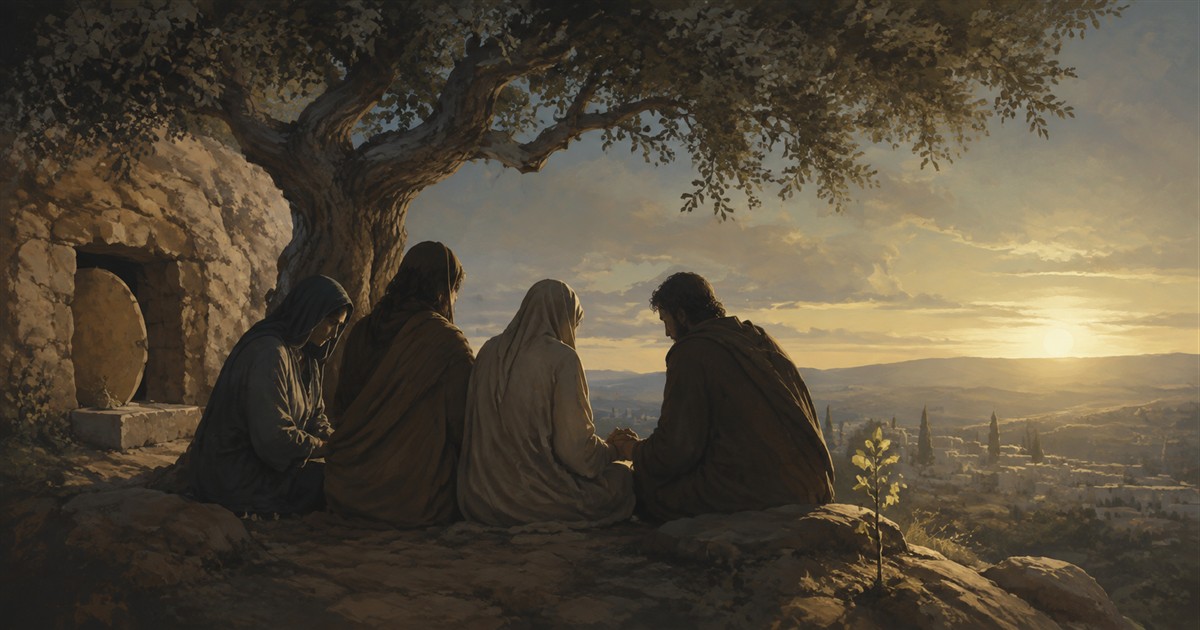
Thirteen verses for the weeks after a death, shortest first. The shortest is two words, and it is Jesus crying at a grave.
Print: verse cards · take-home slips · copywork sheets · all printables
The Bible does not hurry grief. It lets Jesus weep, keeps a bottle for the tears, and only then speaks of a morning when death is swallowed up. The verses below follow that order: permission to mourn first, then the promise. For verses of general comfort in hard times, see Bible verses for comfort; these are the ones for loss. Every verse below is quoted from the Berean Standard Bible with a line of context. Several are read at funerals; the short ones are the ones to learn by heart, because grief does not wait for you to look them up.
Jesus wept.
The shortest verse in the Bible, at the tomb of a friend Jesus was about to raise. He knew the ending and wept anyway, which settles whether grief is a failure of faith.
“Comfort, comfort My people,” says your God.
The turn in Isaiah from judgment to consolation, and the word is said twice. Comfort is the first thing God says after the silence.
Rejoice with those who rejoice; weep with those who weep.
Ten words for the people around the bereaved. Weeping with is asked for, not fixing; it is the most useful verse here for a friend.
Those who sow in tears will reap with shouts of joy.
Tears sown now, joy reaped later. The verse does not say when the harvest is, only that the tears are not wasted.
“Where, O Death, is your victory? Where, O Death, is your sting?”
Paul taunting death, at the end of the longest chapter on resurrection in the Bible. Read aloud at gravesides for two thousand years.
You turned my mourning into dancing; You peeled off my sackcloth and clothed me with joy
Mourning into dancing, sackcloth for joy. The psalm is looking back on a grief that has passed, and so is a promise to one that has not.
You have taken account of my wanderings. Put my tears in Your bottle— are they not in Your book?
God keeps the tears in a bottle and the wanderings in a book. Nothing about the grief is unnoticed, which is a different comfort from its being over.
Surely He took up our infirmities and carried our sorrows; yet we considered Him stricken, struck down by God, and afflicted.
The suffering servant carried our sorrows, and the word is plural. Christians read this of Jesus, and it means the grief has been carried before.
Truly, truly, I tell you, you will weep and wail while the world rejoices. You will grieve, but your grief will turn to joy.
Jesus to the disciples before His death: you will grieve. He does not soften it; He adds that the grief itself will turn to joy, not be replaced by it.
Why are you downcast, O my soul? Why the unease within me? Put your hope in God, for I will yet praise Him for the salvation of His presence.
A man talking to his own soul, asking it why it is downcast and telling it where to put its hope. Grief argued with, gently, from inside.
He will swallow up death forever. The Lord GOD will wipe away the tears from every face and remove the disgrace of His people from the whole earth. For the LORD has spoken.
Death swallowed up, tears wiped from every face, and the promise sealed: for the LORD has spoken. Revelation 21 quotes it at the end of the Bible.
Jesus said to her, “I am the resurrection and the life. Whoever believes in Me will live, even though he dies. And everyone who lives and believes in Me will never die. Do you believe this?”
Said to Martha, four days after her brother died. Jesus does not explain resurrection; He says He is it, and then asks her a question she has to answer.
Brothers, we do not want you to be uninformed about those who sleep in death, so that you will not grieve like the rest, who are without hope. For since we believe that Jesus died and rose again, we also believe that God will bring with Jesus those who have fallen asleep in Him.
Paul to a church whose members had died before Christ's return. Not that they will not grieve, but that they will not grieve like those without hope. The longest passage here and the one most often read at funerals.
Word counts use this site's counting rule in the Berean Standard Bible. Each reference links to the verse in its chapter, because a verse understood in context lands better than a verse alone. Where a verse is quoted on its own, a trailing comma or a quotation mark left unbalanced is dropped (Psalm 30:11).
A verse to hold on to
Grief comes back at odd hours, and a verse you know by heart is the one that comes with it. The five-step method takes a few minutes a day, and it can be done in the middle of everything else: hear the verse aloud, say it while more and more words hide themselves, and finish by reciting it from just the reference. Start with Psalm 126:5 or Romans 12:15; the long passages can wait.
Questions
What does the Bible say about grief?
That it is allowed. Jesus wept at the tomb of Lazarus (John 11:35) knowing He was about to raise him, and Paul tells grieving Christians not that they should not grieve but that they should not grieve like those without hope (1 Thessalonians 4:13). God is described as keeping the tears in a bottle (Psalm 56:8) and near to the brokenhearted (Psalm 34:18). The promise that answers grief is that death will be swallowed up and every tear wiped away (Isaiah 25:8, Revelation 21:4).
What Bible verses are read at a funeral?
The most common are John 11:25-26 (I am the resurrection and the life), Psalm 23, 1 Thessalonians 4:13-14, 1 Corinthians 15:55 (Where, O Death, is your victory?), John 14:1-3 (In My Father's house are many rooms), Isaiah 25:8 and Revelation 21:4. For a card or a short reading, Psalm 126:5 and Isaiah 40:1 are each under a dozen words.
What should I say to someone who is grieving?
Romans 12:15 is the Bible's own answer: weep with those who weep. Presence and shared sorrow are asked for, not explanations. If you want words, the short verses here are safe ones: the LORD is near to the brokenhearted (Psalm 34:18), or Jesus wept (John 11:35), which gives a grieving person permission to do the same.
Half remember a different verse?
The words don't need to match exactly, just type what you remember.