
Verse collection
Bible verses about money
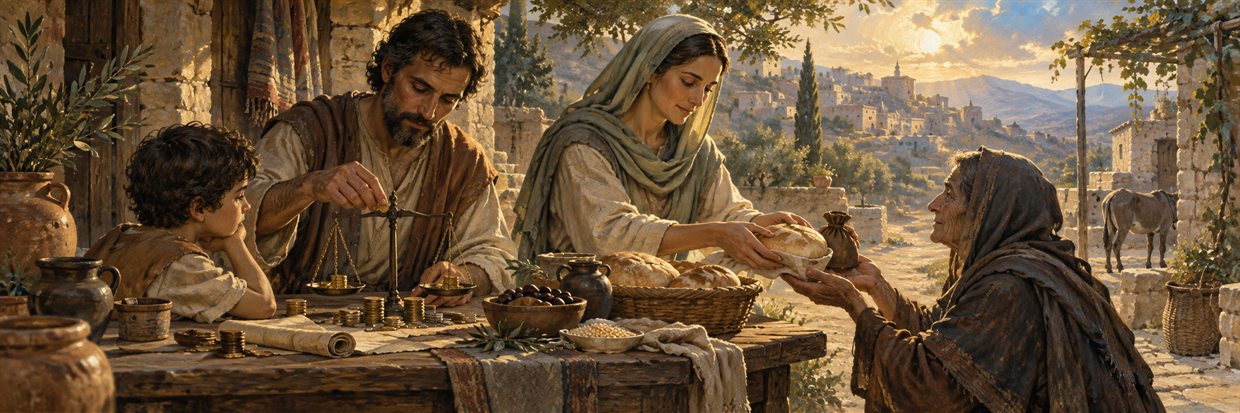
Fourteen verses on money, debt, giving and enough, shortest first. The Bible talks about money more often than most people expect, and it is neither impressed by it nor afraid of it.
Print: verse cards · take-home slips · copywork sheets · all printables
Money in the Bible is treated as a test of the heart rather than a measure of it. The same book warns that the love of money uproots faith and commends the cheerful giver, tells the borrower he is a servant and tells the rich to be generous, and asks for neither poverty nor riches. Jesus talked about it often, mostly to point out that where a person's treasure goes, the heart follows. Every verse below is quoted from the Berean Standard Bible with a line of context. Pick a short one, learn it in about five days, and it will speak up the next time a purchase, a bill or a request for help is in front of you.
For where your treasure is, there your heart will be also.
The last line of Jesus' teaching on treasure, and the one that explains the rest. He does not say the heart chooses the treasure; He says the treasure pulls the heart.
A generous soul will prosper, and he who refreshes others will himself be refreshed.
A proverb from Solomon's collection, and one of the Bible's plainest claims about giving. The giver is the one who ends up refreshed, which is the opposite of how generosity looks from the outside.
The rich rule over the poor, and the borrower is slave to the lender.
Not a command but an observation, and an honest one. The proverb does not forbid borrowing; it tells you plainly what borrowing costs, so that you count it before you sign.
Kindness to the poor is a loan to the LORD, and He will repay the lender.
Giving to the poor is described as lending to God, which puts the repayment in His hands rather than the recipient's. A verse for the moment you wonder whether the help will be wasted.
He who loves money is never satisfied by money, and he who loves wealth is never satisfied by income. This too is futile.
The Teacher, traditionally identified with Solomon, had more money than anyone in Israel and reports that it never once satisfied. He is not moralizing; he is giving evidence.
Each one should give what he has decided in his heart to give, not out of regret or compulsion. For God loves a cheerful giver.
Paul is raising money for famine relief in Jerusalem, and he refuses to pressure anyone. The amount is left to each heart; the only thing he asks is that the giving be glad.
Whoever is faithful with very little will also be faithful with much, and whoever is dishonest with very little will also be dishonest with much.
The close of the parable of the shrewd manager. Faithfulness with money is treated as a small thing, and as the very thing that shows whether a person can be trusted with more than money.
And He said to them, “Watch out! Guard yourselves against every form of greed, for one’s life does not consist in the abundance of his possessions.”
Said to a man who wanted Jesus to settle an inheritance. Greed is called something to guard against, like a thief, and the reason is a sentence worth learning on its own: a life is not its possessions.
For the love of money is the root of all kinds of evil. By craving it, some have wandered away from the faith and pierced themselves with many sorrows.
Often misquoted as money is the root of all evil. Paul says the love of it, and he says all kinds, and then he describes the damage he has watched it do to people he knew.
Keep your lives free from the love of money and be content with what you have, for God has said: “Never will I leave you, never will I forsake you.”
The command is to be content, and the reason is a promise about God's presence, not about provision. The writer quotes Deuteronomy and Joshua: you will not be left, so you do not have to grab.
No one can serve two masters: Either he will hate the one and love the other, or he will be devoted to the one and despise the other. You cannot serve both God and money.
Jesus names money, and nothing else, as the rival master to God. The verse is not against having it; it is against serving it, and it says the two masters cannot share.
In everything, I showed you that by this kind of hard work we must help the weak, remembering the words of the Lord Jesus Himself: ‘It is more blessed to give than to receive.’
Paul, saying goodbye to the Ephesian elders, quotes a saying of Jesus that the Gospels do not record. He had worked with his hands to prove it, and he wanted them to remember the working as much as the words.
Of course, godliness with contentment is great gain. For we brought nothing into the world, so we cannot carry anything out of it. But if we have food and clothing, we will be content with these.
Paul to his young colleague Timothy, on what counts as gain. The math is simple: you arrive with nothing, you leave with nothing, and food and clothing in between is enough to be content.
Keep falsehood and deceitful words far from me. Give me neither poverty nor riches; feed me with the bread that is my portion. Otherwise, I may have too much and deny You, saying, ‘Who is the LORD?’ Or I may become poor and steal, profaning the name of my God.
Agur, one of the few named authors in Proverbs, asks for the middle. Riches might make him forget God and poverty might make him steal, and he knows himself well enough to fear both.
Word counts use this site's counting rule in the Berean Standard Bible. Each reference links to the verse in its chapter, because a verse understood in context lands better than a verse alone. Where a verse is quoted on its own, a trailing comma or a quotation mark left unbalanced is dropped (Acts 20:35).
Money you can hold loosely
A verse about money does its work at the moment of decision, which is why it needs to be in your memory rather than on a shelf. The five-step method takes a few minutes a day: hear the verse aloud, say it while more and more words hide themselves, and finish by reciting it from just the reference. Start with Matthew 6:21 or Proverbs 22:7; either is yours within the week.
Questions
What does the Bible say about money?
The Bible does not call money evil; it calls the love of money a root of all kinds of evil (1 Timothy 6:10) and warns that no one can serve both God and money (Matthew 6:24). At the same time it commends generosity given gladly and without pressure (2 Corinthians 9:7), calls kindness to the poor a loan to the LORD (Proverbs 19:17), and asks for neither poverty nor riches but enough (Proverbs 30:8-9). The through line is that money is a test of where the heart is, not a verdict on the person who has it or lacks it.
What does the Bible say about debt?
The Bible does not forbid borrowing, but it is honest about the cost: the borrower is slave to the lender (Proverbs 22:7). Faithfulness with small amounts is treated as the test of trustworthiness in larger things (Luke 16:10), and contentment with what you have is set against the love of money (Hebrews 13:5). Read together, the verses counsel counting the cost before you borrow and living within your portion rather than beyond it.
Which Bible verse about money is best to memorize first?
Matthew 6:21 is eleven words: For where your treasure is, there your heart will be also. It is the sentence Jesus uses to sum up His teaching on money, and it applies to every purchase. Proverbs 22:7 is fourteen words and a plain warning about debt. Either can be learned in a few days with a few minutes of practice.
Half remember a different verse?
The words don't need to match exactly, just type what you remember.